

Square Root Calculator
The square root calculator returns both the exact radical form and the decimal. The square root of 72 is 6√2, or about 8.4853. It also handles cube roots, higher roots, fractions, and negative numbers, with a full step by step breakdown for every answer. Enter a value, pick your root type, and press calculate.
How do you calculate a square root?
A square root of a number is the value that, multiplied by itself, gives that number back. The square root of 25 is 5, because 5 times 5 is 25. This calculator returns both the decimal form and the simplified radical form, and it handles cube roots and higher roots too.
To find a square root by hand, you look for a number that squares to your target. For perfect squares this is quick: 36 gives 6, 81 gives 9, 144 gives 12. For everything else the answer is a decimal that runs on forever, which is why a calculator saves the effort. The square root of 50 is about 7.0711, and no amount of manual work makes that terminate.
Enter any number in the field above and press calculate. You get the exact answer, a rounded decimal, a step by step breakdown, and, where possible, the simplified radical. Negative numbers, fractions written as decimals, and roots higher than two all work.
Square root formula
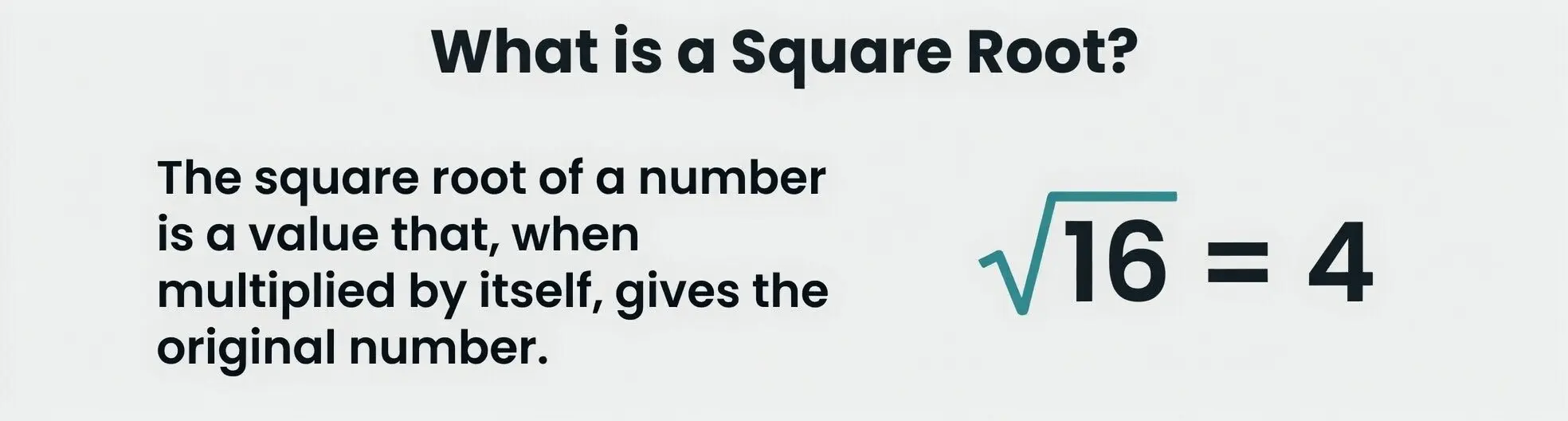
The square root formula is written as:
√x = y, where y × y = x
Read it plainly: the square root of x is the number y that gives you x when multiplied by itself. So √36 = 6 because 6 × 6 = 36, and √100 = 10 because 10 × 10 = 100.
Two related rules make harder problems easier. The product rule says the square root of a product equals the product of the square roots: √(a × b) = √a × √b. The quotient rule does the same for division: √(a ÷ b) = √a ÷ √b. These two are what let you simplify messy radicals and take the square root of a fraction, both covered further down. Most square roots do not land on a whole number, so rounding to significant figures decides how much of that decimal you should actually keep.
What is a perfect square?
A perfect square is a number whose square root is a whole number, with nothing left over. 49 is a perfect square because √49 = 7 exactly. 50 is not, because its root is 7.0711 and trails off.
Knowing the first fifteen perfect squares by heart makes estimation much faster, because any number sits between two of them and you can guess from there.
| Number | Square root |
|---|---|
| 1 | 1 |
| 4 | 2 |
| 9 | 3 |
| 16 | 4 |
| 25 | 5 |
| 36 | 6 |
| 49 | 7 |
| 64 | 8 |
| 81 | 9 |
| 100 | 10 |
| 121 | 11 |
| 144 | 12 |
| 169 | 13 |
| 196 | 14 |
| 225 | 15 |
Square root table for non-perfect numbers
Most numbers are not perfect squares, so their roots are irrational decimals that never end and never repeat. Here are the common ones, rounded to four places, alongside their simplified radical form where one exists.
| Number | Decimal (≈) | Simplified radical |
|---|---|---|
| 2 | 1.4142 | √2 |
| 3 | 1.7321 | √3 |
| 5 | 2.2361 | √5 |
| 6 | 2.4495 | √6 |
| 7 | 2.6458 | √7 |
| 8 | 2.8284 | 2√2 |
| 10 | 3.1623 | √10 |
| 12 | 3.4641 | 2√3 |
| 15 | 3.8730 | √15 |
| 18 | 4.2426 | 3√2 |
| 20 | 4.4721 | 2√5 |
| 24 | 4.8990 | 2√6 |
| 32 | 5.6569 | 4√2 |
| 40 | 6.3246 | 2√10 |
| 45 | 6.7082 | 3√5 |
| 48 | 6.9282 | 4√3 |
| 50 | 7.0711 | 5√2 |
| 72 | 8.4853 | 6√2 |
| 75 | 8.6603 | 5√3 |
| 98 | 9.8995 | 7√2 |
| 200 | 14.1421 | 10√2 |
How to simplify a square root into radical form
Simplifying a radical means pulling any perfect square factor out from under the root sign. The answer stays exact, unlike a rounded decimal, which is why maths teachers usually ask for it.
Take √72. Break 72 into a perfect square times something else: 72 = 36 × 2. Since 36 is a perfect square, its root, 6, comes out front, leaving the 2 inside. So √72 = 6√2. Check it: 6 × 1.4142 = 8.4853, which matches the decimal.
The same method handles √50 = √(25 × 2) = 5√2, and √48 = √(16 × 3) = 4√3. If a number has no perfect square factor other than 1, like 7 or 15, it is already in simplest form and stays under the radical. The calculator above shows this breakdown for any whole number you enter.
How to find the square root of a fraction
To take the square root of a fraction, take the root of the top and the root of the bottom separately. This is the quotient rule in action.
For 16/25: √16 is 4 and √25 is 5, so √(16/25) = 4/5, which is 0.8. For 25/4: √25 is 5 and √4 is 2, so the answer is 5/2, or 2.5. When both parts are perfect squares, the result is clean.
When they are not, convert to a decimal first. √(4/3) means √4 ÷ √3 = 2 ÷ 1.7321 = 1.1547. The rule is the same, you just finish in decimal form because the bottom does not come out whole.
| Fraction | Square root |
|---|---|
| 1/4 | 1/2 = 0.5 |
| 4/9 | 2/3 ≈ 0.6667 |
| 9/16 | 3/4 = 0.75 |
| 16/25 | 4/5 = 0.8 |
| 4/5 | ≈ 0.8944 |
| 4/3 | ≈ 1.1547 |
| 25/4 | 5/2 = 2.5 |
How to calculate a square root by hand
You do not always have a calculator, so it helps to know the manual methods. There are three worth knowing, from fastest to most precise.
Method 1: Prime factorization (best for perfect squares)
Break the number into prime factors, pair them up, and take one from each pair. For 36: the factors are 2 × 2 × 3 × 3. That gives one pair of 2s and one pair of 3s. Take a 2 and a 3, multiply them, and you get 6. So √36 = 6. This is exact but only clean when the number is a perfect square.
Method 2: Estimation (quick and close enough)
Find the two perfect squares your number sits between, then guess. For √50: it lands between √49 (which is 7) and √64 (which is 8), and much closer to 49. So √50 is a hair over 7, roughly 7.07. Good for a fast mental check when you do not need decimals.
Method 3: Long division (works for any number)
The long division method pairs the digits from right to left, finds the largest square under the first group, subtracts, brings down the next pair, and repeats. It produces decimals to any precision you like. It is accurate for both perfect and non-perfect squares, but it is slow, which is exactly why the calculator above exists.
What is the square root of a negative number?
The square root of a negative number is not a real number. There is no real value that squares to a negative, because a negative times a negative is always positive. Instead the answer uses an imaginary number.
The square root of −1 is written as i, the imaginary unit. So √(−16) = 4i, because you take the root of 16, which is 4, and attach i to mark the negative. Imaginary numbers are not just a maths curiosity, they run through electrical engineering, signal processing, and quantum physics. The calculator above returns the i form automatically when you enter a negative under an even root.
Odd roots behave differently. The cube root of −8 is a real number, −2, because −2 × −2 × −2 gives −8. Only even roots of negatives go imaginary.
Cube roots and higher roots
A cube root asks which number, multiplied by itself three times, gives your target. The cube root of 27 is 3, because 3 × 3 × 3 = 27. It is written with a small 3 on the radical: ∛27 = 3.
The idea extends to any root. A fourth root uses four factors, a fifth root uses five, and so on. The calculator above switches between square root, cube root, fourth, fifth, and any custom root up to the twentieth using the dropdown. Common cube roots worth knowing: ∛8 = 2, ∛64 = 4, ∛125 = 5, and ∛1000 = 10.
Properties of square roots
A handful of rules govern how square roots behave. They are what make simplification and algebra with radicals possible.
- Product rule: √(a × b) = √a × √b. So √(9 × 4) = 3 × 2 = 6.
- Quotient rule: √(a ÷ b) = √a ÷ √b. So √(16/25) = 4/5.
- Square of a root: taking the square root and then squaring cancels out, so √(a²) = |a|. Note the absolute value: √((−5)²) = 5, not −5.
- Non-negative rule: the principal square root of a real number is never negative. √9 = 3, not −3, even though (−3)² is also 9. This is why the calculator returns the positive value.
- Zero: √0 = 0. Irrational results: if a number is not a perfect square, its root is irrational, a decimal that never ends and never repeats, like √2 = 1.4142...
Where square roots are used in real life
Square roots are not just a classroom exercise. They turn up any time a squared quantity has to be reversed.
- Geometry and construction: the side of a square from its area (a square of area 64 has sides of √64 = 8), and the diagonal of any rectangle.
- Distance: the distance formula and the Pythagorean theorem both end in a square root. Finding how far apart two points are means squaring the differences, adding them, and taking the root.
- Statistics: standard deviation is the square root of the variance. Every time you measure how spread out data is, a square root is doing the final step. You can see this directly in the standard deviation calculator and the variance calculator.
- Physics and engineering: velocity, acceleration, and electrical formulas lean on square roots constantly, especially anything involving energy or oscillation.
- Finance: volatility and risk models use the square root of time to scale how much a value might swing.
Frequently asked questions
What is the square root of 2?
The square root of 2 is approximately 1.4142. It is irrational, so the decimal never ends and never repeats. It cannot be simplified into a radical with a whole number in front, so √2 is already its simplest exact form.
Is the square root always positive?
The principal square root, the one calculators and this tool return, is always non-negative. So √9 = 3. Technically −3 also squares to 9, so an equation like x² = 9 has two solutions, +3 and −3, but the square root symbol itself refers to the positive value.
What is the square root of 0?
Zero. √0 = 0, because 0 × 0 = 0. It is the only number whose square root is itself and also zero.
How do you find the square root of a decimal?
The same way as any number: enter it in the calculator above. For example √0.71 ≈ 0.8426 and √11.52 ≈ 3.3941. By hand, the estimation method works, find the perfect squares on either side and narrow in.
What is the difference between a square and a square root?
Squaring multiplies a number by itself: 5² = 25. A square root reverses that: √25 = 5. They undo each other, which is why √(a²) brings you back to a.
Can every number have a square root?
Every non-negative real number has a real square root. Negative numbers do not have a real square root, but they have an imaginary one written with i, so √(−16) = 4i.
What is the fastest way to calculate a square root?
For a perfect square, memorize the first fifteen and recognize them on sight. For anything else, the calculator above is instant and gives you the decimal, the simplified radical, and the steps. Manual methods work but cost time.
How do you simplify a square root?
Pull out the largest perfect square factor. √72 = √(36 × 2) = 6√2. If there is no perfect square factor other than 1, the radical is already simplified.
Try these next
- Significant Figures Calculator: round your root to the right number of digits.
- BODMAS Calculator: handle roots inside a full order-of-operations sum.
- Slope Intercept Form Calculator: another core algebra tool for graphing lines.
- Geometric Mean Calculator: uses roots to average numbers by multiplication.