

Daily Fat Intake Calculator
Step 1 — Basal Metabolic Rate (BMR)
Mifflin-St Jeor: kcal/dayStep 2 — Total Daily Energy Expenditure (TDEE)
BMR × activity factor = kcal/dayStep 3 — Fat grams
Fat has 9 kcal per gram, so fat g = (calories × fat%) ÷ 9. Your recommended: ( × 27.5%) ÷ 9 = g.What this means
- USDA Dietary Guidelines for Americans: 20 to 35% of calories from fat
- Academy of Nutrition and Dietetics: focus on unsaturated fats, keep saturated under 10%
- WHO: total fat under 30% of energy, saturated under 10%
Estimate only. Needs vary by age, health, and goals. Not medical advice. Talk to a dietitian or doctor for a personalized plan.
Your daily fat intake should be 20 to 35 percent of your total calories, which for most adults means somewhere between 45 and 90 grams of fat per day. This fat intake calculator turns your calorie needs into exact fat grams using the Mifflin-St Jeor formula, so you stop guessing. Fat is not the enemy: your body needs it for hormones, energy, and absorbing vitamins A, D, E, and K. What changes the number is your calorie total and goal, not your body weight.
It answers a common question:
How much fat per day should I eat?
Daily fat intake is not the same for everyone.
It depends on total calories, activity level, and whether your goal is weight loss, muscle gain, or maintenance.
This calculator converts calories into grams of fat per day, making it easier to plan meals without guessing.
You can use this tool if you want to:
- Manage weight without cutting fat too low
- Balance fat, protein, and carbs
- Support hormone and overall health
- Build a sustainable diet plan
In short, this tool shows how to calculate daily fat intake in a practical and personalized way.
How Much Fat Should You Eat Per Day?
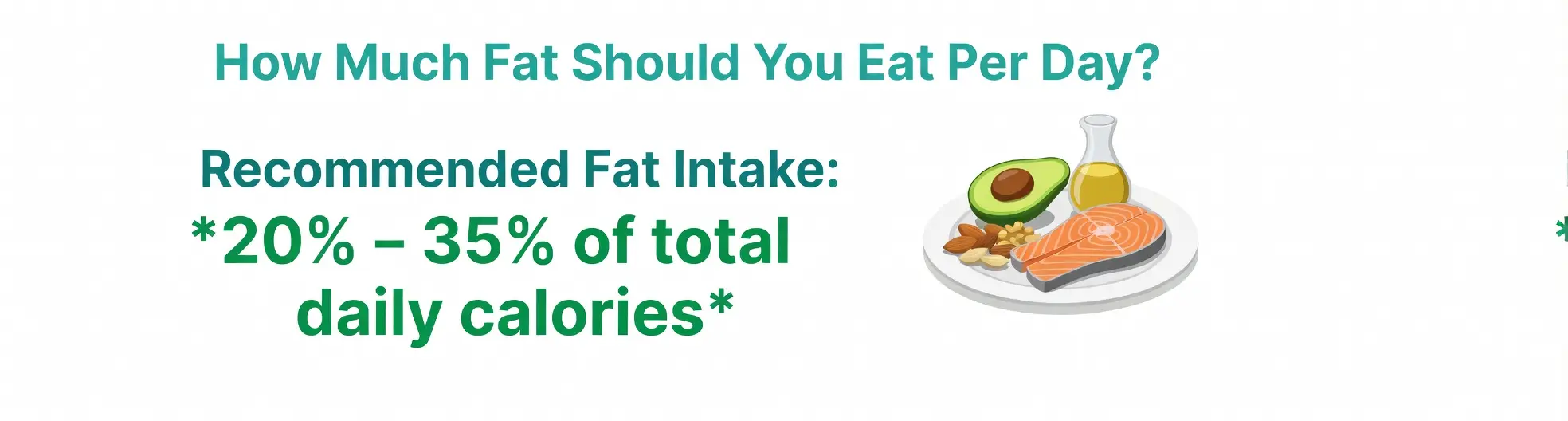
How much fat per day you need depends mainly on your total calorie intake.
Fat is not the enemy.
Your body needs it for hormones, nutrient absorption, and long term health.
For most adults, fat intake usually falls within this range:
- 20 to 35 percent of total daily calories
Going below this for long periods is not ideal.
Going far above it can crowd out protein and carbs.
Simple example
If you eat 2,000 calories per day:
- 20 percent from fat = about 44 g fat
- 30 percent from fat = about 67 g fat
- 35 percent from fat = about 78 g fat
This explains why there is no single answer to
how much fat should I eat per day.
Someone eating 1,600 calories will need less fat.
Someone eating 2,500 calories will need more.
That is where a Fat Intake Calculator helps.
It adjusts daily fat intake based on calories and goals, instead of fixed rules.
What Is Daily Fat Intake?
Daily fat intake is the total amount of dietary fat you eat in one day, measured in grams.
Fat is one of the three main macronutrients, along with protein and carbohydrates.
It provides energy, supports hormone production, and helps your body absorb vitamins A, D, E, and K.
Each gram of fat contains 9 calories.
That makes fat more calorie dense than protein or carbs.
This is why fat intake matters.
Eating too little fat can lead to:
- Low energy
- Hormonal issues
- Poor nutrient absorption
Eating too much fat can:
- Push calories too high
- Make it harder to balance other nutrients
So when people ask how much fat should I eat per day, they are really asking how to balance fat within their total calories.
How to Calculate Fat Intake
You calculate daily fat intake using your total calorie needs.
Fat intake is not based on body weight.
It is based on calories.
Here is the basic method.
Step 1: Know your daily calories
This can come from a calorie calculator or your diet plan.
Step 2: Choose a fat percentage
Most people fall between 20 to 35 percent of total calories from fat. That band is not arbitrary, it is the acceptable macronutrient distribution range published in the federal Dietary Guidelines, and it is set wide because the right split depends on your overall diet rather than on fat alone.
Step 3: Convert fat calories to grams
- Fat calories = Total calories × Fat percentage
- Fat grams = Fat calories ÷ 9
Example
If you eat 2,200 calories per day and choose 30 percent fat:
- 2,200 × 0.30 = 660 fat calories
- 660 ÷ 9 = 73 g fat per day
That is your estimated daily fat intake.
Doing this manually works, but it is easy to miscalculate.
A Fat Intake Calculator does this instantly and adjusts the result based on your goal, such as weight loss or muscle gain.
How Much Fat Per Pound of Body Weight?
Fat intake is usually set from calories, not body weight, which is how the calculator above works. But some people, especially in fitness circles, prefer a per-bodyweight rule of thumb. A common one is 0.3 to 0.5 grams of fat per pound of body weight.
- 150 lb person: about 45 to 75 g fat per day
- 180 lb person: about 54 to 90 g fat per day
- 200 lb person: about 60 to 100 g fat per day
This is a rougher method than the calorie-based one. If your two numbers disagree, trust the calorie-based figure, since fat has to fit inside your total calories alongside protein and carbs. Use the per-pound rule only as a quick sanity check.
Daily Fat Intake by Calories
Your daily fat intake scales directly with how many calories you eat.
That is why two people can need very different fat amounts, even if they weigh the same.
Below is a practical breakdown using 30 percent of calories from fat, which works well for most people.
1,600 calories per day
- Fat calories: 480
- Daily fat intake: 53 g
2,000 calories per day
- Fat calories: 600
- Daily fat intake: 67 g
2,500 calories per day
- Fat calories: 750
- Daily fat intake: 83 g
If you prefer lower fat, you can use 20 to 25 percent instead.
If you tolerate fat well, 30 to 35 percent may work better.
Daily Fat Intake Chart by Calories
This table shows your fat grams at low (20%), recommended (27.5%), and high (35%) of calories. Find your daily calorie level and read across.
| Daily Calories | Low (20%) | Recommended (27.5%) | High (35%) |
|---|---|---|---|
| 1,200 kcal | 27 g | 37 g | 47 g |
| 1,400 kcal | 31 g | 43 g | 54 g |
| 1,500 kcal | 33 g | 46 g | 58 g |
| 1,600 kcal | 36 g | 49 g | 62 g |
| 1,800 kcal | 40 g | 55 g | 70 g |
| 2,000 kcal | 44 g | 61 g | 78 g |
| 2,200 kcal | 49 g | 67 g | 86 g |
| 2,400 kcal | 53 g | 73 g | 93 g |
| 2,500 kcal | 56 g | 76 g | 97 g |
| 2,800 kcal | 62 g | 86 g | 109 g |
| 3,000 kcal | 67 g | 92 g | 117 g |
This is why asking only how much fat per day can be misleading without calorie context.
Fat Intake for Weight Loss
When your goal is fat loss, daily fat intake still matters. Tracking body fat changes can help measure progress. You can estimate it using our Body Fat Calculator.
Cutting fat too low can slow progress.
Your body needs fat for hormones and overall health.
For most people, a good fat intake range during weight loss is:
- 20 to 30 percent of total daily calories
This keeps calories controlled while avoiding very low fat levels.
Example
If you eat 1,800 calories per day while dieting:
- 20 percent fat = 40 g fat
- 25 percent fat = 50 g fat
- 30 percent fat = 60 g fat
Going below 15 percent fat for long periods can:
- Affect hormone balance
- Reduce energy levels
- Make diets harder to stick to
Fat loss comes from a calorie deficit, not from eliminating fat entirely. Protein intake also matters during weight loss to preserve muscle. Use our Protein Calculator to calculate daily protein needs.
How Many Grams of Fat Per Day to Lose Weight?
For weight loss, aim for 20 to 30 percent of your calories from fat. The exact grams depend on your deficit calories, not your body weight. Here is what that looks like at common weight-loss calorie levels:
| Weight-Loss Calories | 20% Fat | 25% Fat | 30% Fat |
|---|---|---|---|
| 1,200 kcal | 27 g | 33 g | 40 g |
| 1,500 kcal | 33 g | 42 g | 50 g |
| 1,800 kcal | 40 g | 50 g | 60 g |
| 2,000 kcal | 44 g | 56 g | 67 g |
Most people lose fat well on 40 to 60 grams of fat per day while dieting. Do not drop below about 15 percent of calories for long, since that can hurt hormones and energy. Fat loss comes from the calorie deficit, not from cutting fat to zero.
How Much Fat Per Day for a Woman to Lose Weight?
Women dieting on 1,200 to 1,600 calories usually land at 27 to 53 grams of fat per day in the 20 to 30 percent range. A woman eating 1,500 calories aiming for 25 percent fat would target about 42 grams. The percentage guidance is the same for men and women; only the calorie total changes the grams.
Healthy Fats vs Unhealthy Fats
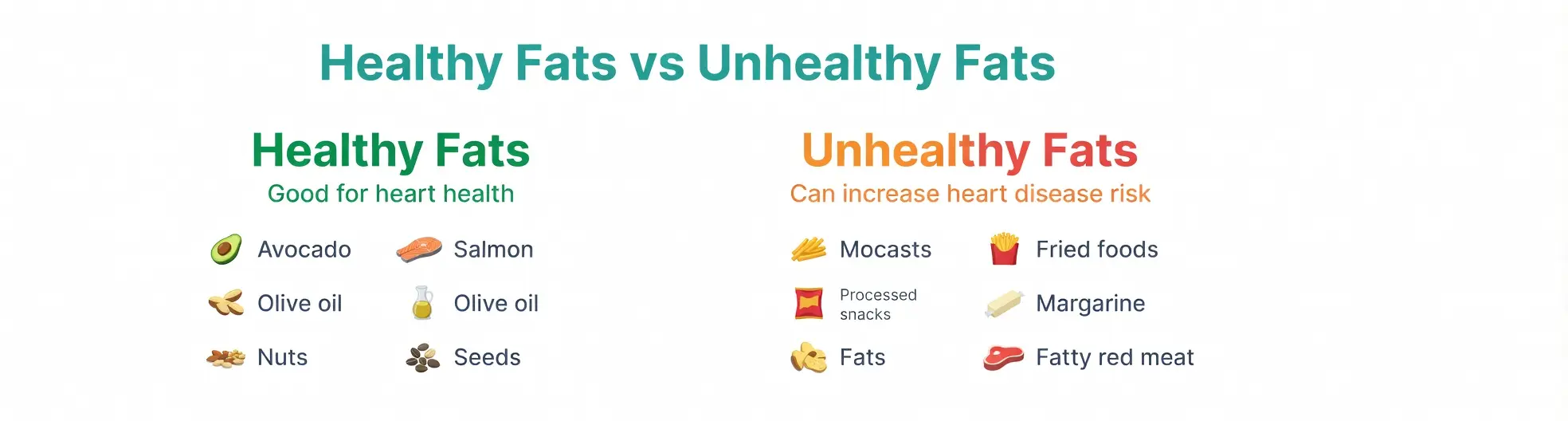
Not all fats affect your body the same way.
When calculating daily fat intake, quality matters just as much as quantity.
Healthy fats support heart health, hormones, and long term energy.
These fats are usually unsaturated.
Common sources include:
- Olive oil
- Avocados
- Nuts and seeds
- Fatty fish
These fats work well in most diets and fit easily into your daily fat target.
Unhealthy fats are the ones to limit.
These include:
- Trans fats
- Highly processed oils
- Fried and packaged foods
Trans fats are especially harmful and should be avoided completely when possible.
What about saturated fat?
It is not evil, but moderation matters.
Small amounts from whole foods can fit into a healthy diet. Large amounts from processed foods usually do not.
Hit your fat grams mostly from unsaturated sources. That improves diet quality without changing your calorie total.
How Much Saturated Fat Per Day?
The WHO and the USDA Dietary Guidelines both cap saturated fat at 10 percent of total calories. Since saturated fat also has 9 calories per gram, that works out to:
| Daily Calories | Saturated Fat Limit (10%) |
|---|---|
| 1,600 kcal | Under 18 g |
| 2,000 kcal | Under 22 g |
| 2,500 kcal | Under 28 g |
This limit sits inside your total fat target, not on top of it. So if your total fat goal is 70 grams, keeping saturated fat under about 20 grams means the rest should come from unsaturated sources like olive oil, nuts, and fish. The American Heart Association suggests an even tighter cap near 6 percent for people focused on heart health.
Try These Next
Frequently Asked Questions (FAQs)
How much fat should I eat per day?
Most adults do well with 20 to 35 percent of total daily calories coming from fat. The exact amount depends on your calorie intake and goals.
Is a low-fat diet healthy?
Very low-fat diets are not ideal long term. Fat is needed for hormones and vitamin absorption. Moderate fat intake is usually healthier and easier to maintain.
How much fat per day to lose belly fat?
There is no special fat target for belly fat. Fat loss happens through a calorie deficit. A fat intake of 20 to 30 percent of calories works well for most people trying to reduce body fat.
How much fat should I eat per day to lose weight?
For weight loss, aim for 20 to 30 percent of daily calories from fat. This supports health while keeping calories controlled.
How much fat per day for a man vs a woman?
The percentage is the same: 20 to 35 percent of calories for both. The difference is calorie total. Men usually eat more calories, so their fat grams run higher. A man on 2,500 calories targets about 56 to 97 grams, while a woman on 1,900 calories targets about 42 to 74 grams. Set it from your own calories, not a fixed gram number.