

BODMAS & PEMDAS Calculator
BODMAS and PEMDAS are the same order of operations under different names: Brackets or Parentheses first, then Orders or Exponents, then Division and Multiplication left to right, then Addition and Subtraction left to right. Enter an expression and the calculator shows every operation in order, not just the answer.
BODMAS and PEMDAS describe the same order of operations. BODMAS stands for Brackets, Orders, Division, Multiplication, Addition, Subtraction and is used in the UK, India, and Australia. PEMDAS stands for Parentheses, Exponents, Multiplication, Division, Addition, Subtraction and is used in the United States.
Both give the identical answer to every expression, because division and multiplication always share equal priority, as do addition and subtraction. Enter your expression above and the calculator shows each operation in order, one line at a time.
What is the BODMAS Rule?
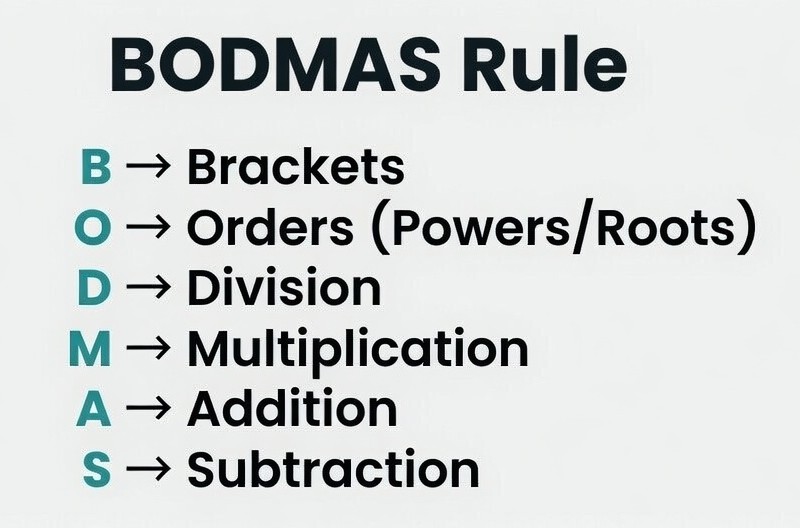
The BODMAS rule is a standard mathematical order of operations used to solve multi-step equations. Without this rule, different people could calculate the same math problem and arrive at different results. By following a specific sequence, you ensure that every calculation is consistent and accurate.
BODMAS Acronym Breakdown
To understand the bodmas rule, you must know what each letter represents in the hierarchy:
- B (Brackets): Always solve the parts of an equation inside parentheses or brackets first.
- O (Orders): This refers to numbers with powers (exponents) or roots, such as $x^2$ or $\sqrt{x}$.
- D/M (Division and Multiplication): These operations hold equal weight. You should solve them as they appear from left to right.
- A/S (Addition and Subtraction): These are the final operations to perform. Like division and multiplication, solve these from left to right.
Why the Order of Operations Matters
Getting the order wrong changes the answer, not just the working. For example, if you are calculating a construction budget or a simple finance sheet, adding before multiplying can lead to the wrong total in your final total. A bodmas solver applies the rules for you, so the order is never in question.
The BODMAS Formula and Order
The BODMAS rule functions as a mathematical map. It ensures you move through an equation in the correct sequence to reach the right answer. "Board mass formula" is a common misspelling of BODMAS and means the same hierarchy.
Understanding the Hierarchy
In mathematics, not all operations are created equal. Some must be completed before others to maintain the logic of the equation.
- Priority 1: Brackets.
- Priority 2: Orders (Exponents and Roots).
- Priority 3: Division and Multiplication.
- Priority 4: Addition and Subtraction.
The Left-to-Right Rule
A common point of confusion is whether division always comes before multiplication. In the bodmas rule, Division/Multiplication and Addition/Subtraction are "paired" groups. This means they have equal priority. You should solve them in the order they appear from left to right.
How to Solve BODMAS & PEMDAS Problems Manually
Solving math problems by hand is easy once you follow a consistent set of steps. Use this guide to solve any multi-step equation manually.
- Step 1: Look for brackets. Solve everything inside them first.
- Step 2: Solve the "Orders." Calculate any square roots or numbers with exponents.
- Step 3: Perform division and multiplication. Start from the left side of the equation and move to the right.
- Step 4: Perform addition and subtraction. Again, move from left to right until you reach the final total.
Using the BODMAS Solver
For a long equation with several brackets, the solver is quicker to check against than working it twice by hand.
- Step 1: Type your full mathematical expression into the input field.
- Step 2: Press the "Calculate" button to trigger the order of operations.
- Step 3: Review the result and the step-by-step breakdown provided.
The breakdown lists each step, so you can see where every number came from.
PEMDAS and BODMAS Examples Worked Out
Example 1: 5 + 2 × (3² − 1)
Brackets first, and inside the brackets there is a power, so that comes first: 3² = 9. Now 9 − 1 = 8, so the brackets close at 8. Next, multiplication: 2 × 8 = 16. Finally addition: 5 + 16 = 21.
Example 2: 12 × 3 + (4 − 2)² − 18 ÷ 3
Brackets: 4 − 2 = 2. Orders: 2² = 4. Then division and multiplication left to right: 12 × 3 = 36, and 18 ÷ 3 = 6. That leaves 36 + 4 − 6. Addition and subtraction left to right: 36 + 4 = 40, then 40 − 6 = 34.
Example 3: 10 + 5 × 3 − 8 ÷ 2
No brackets and no powers here, so start with division and multiplication, left to right: 5 × 3 = 15, and 8 ÷ 2 = 4. Now 10 + 15 − 4. Left to right: 10 + 15 = 25, then 25 − 4 = 21.
Example 4: 2 × (5 + 3)²
Brackets: 5 + 3 = 8. Orders: 8² = 64. Multiplication: 2 × 64 = 128. A common mistake here is squaring the 2 as well, which gives 256.
Every one of these can be checked in the calculator above, which shows the same steps line by line.
Why 6 ÷ 2 × (1 + 2) Equals 9
This expression goes viral every few years, and the arguments always split into 9 and 1.
The correct answer is 9. Here is why.
First the brackets: 1 + 2 = 3. The expression is now 6 ÷ 2 × 3.
Now the trap. People who learned PEMDAS often see the M before the D and multiply first: 2 × 3 = 6, then 6 ÷ 6 = 1. That is the wrong move, because multiplication does not outrank division.
Division and multiplication have equal priority, so you go left to right. 6 ÷ 2 = 3, then 3 × 3 = 9.
The same logic settles 8 ÷ 2 × (2 + 2), which equals 16, not 1. Try both in the calculator above and watch the step order.
One honest note: expressions like these are deliberately ambiguous and no mathematician would write them that way in real work. They exist to test whether you understand that DM and AS are paired, not ranked.
Common Mistakes to Avoid
Even with a bodmas calculator, it is helpful to recognize common errors people make when solving problems manually.
- Left-to-right errors: treating multiplication as if it outranks division. In 12 ÷ 3 × 2 the division comes first because it comes first, giving 8, not 2.
- Bracket Confusion: Attempting to solve numbers outside a bracket before finishing the operations inside.
- Misunderstanding Orders: Treating exponents as simple multiplication or ignoring them entirely.
- Addition Before Division: Starting at the beginning of an equation rather than following the bodmas rule hierarchy.
When to Use the BODMAS Rule
The rule turns up well beyond algebra homework: You will find it useful in several practical scenarios:
- Academic Work: Completing algebra homework or preparing for standardized math tests.
- Scientific Research: Ensuring complex data formulas are calculated with the intended result.
- Programming: Checking the logic of computer code to prevent calculation errors.
- Financial Planning: Managing budgets or interest rates where the order of operations changes the final amount.
PEMDAS vs BODMAS vs BEDMAS vs BIDMAS
Four acronyms, one rule. The country changes, the math does not.
- PEMDAS (United States): Parentheses, Exponents, Multiplication, Division, Addition, Subtraction
- BODMAS (UK, India, Australia): Brackets, Orders, Division, Multiplication, Addition, Subtraction
- BEDMAS (Canada): Brackets, Exponents, Division, Multiplication, Addition, Subtraction
- BIDMAS (parts of the UK): Brackets, Indices, Division, Multiplication, Addition, Subtraction
Look closely and you will notice something odd. PEMDAS puts multiplication before division. BODMAS puts division before multiplication. If the acronyms are correct, they cannot both be right.
They are both right, because neither letter order means what people think it means. Multiplication and division have equal priority and are solved from left to right. Addition and subtraction work the same way. The acronym is a memory aid, not a strict sequence.
This single misunderstanding causes most order of operations mistakes.
Frequently Asked Questions (FAQs)
What is the difference between BODMAS and PEMDAS?
The difference is primarily regional naming. BODMAS is commonly used in the UK, India, and Australia, while PEMDAS is used in the US. They follow the same logic, but PEMDAS uses "Parentheses" and "Exponents" instead of "Brackets" and "Orders."
What does the 'O' stand for in the BODMAS rule?
The 'O' stands for Orders. This refers to mathematical operations like square roots, indices, or exponents (powers). These must be calculated after brackets but before division and multiplication.
Does multiplication always come before division?
No. They rank equally, so whichever appears first is done first. In 20 ÷ 4 × 5 you divide first and get 25.
Can I use this for fractions?
Yes. You can use the bodmas solver for equations containing fractions. Treat the numerator and denominator as if they are in brackets if the division bar covers multiple terms.
Is the board mass formula the same as BODMAS?
Yes.
Is PEMDAS or BODMAS correct?
Both are correct. They are the same rule with different regional names. PEMDAS uses Parentheses and Exponents, BODMAS uses Brackets and Orders. The answer to any expression is identical under either one.
Why do PEMDAS and BODMAS list multiplication and division in a different order?
Because the order in the acronym does not set priority between them. Multiplication and division are equal and are solved left to right. The acronyms just needed some order to spell a pronounceable word.
Try these next
- Square Root Calculator
- Quadratic Formula Calculator
- Proportion Calculator
- Mean Median Mode Range Calculator