

Proportion Calculator (Solve for x)
To solve a proportion, cross-multiply and divide. In a/b = c/d, multiply a by d and b by c, set them equal, then divide to find the missing value. For example, in 3/4 = x/8, cross-multiply to get 3 × 8 = 4x, so x = 6. Above Proportion Calculator helps you quickly solve equations where two ratios are equal. Enter the three values you know and the tool returns the fourth.
If you need to solve the proportion this tool does the cross multiplication for you. It works with fractions, decimals, and whole numbers.
Proportions are the math behind scaling anything at a fixed rate: doubling a recipe, reading a blueprint, converting currency, or sizing similar triangles. If you know three parts of the relationship, the fourth is already determined. This tool finds it and shows the working, so you can check the method rather than just copy the answer. Students use it to check homework. Teachers use it for quick demonstrations. And anyone working with ratios can use this proportion solver to save time.
What Is a Proportion?
A proportion is an equation that shows two ratios are equal.
It compares two fractions like this:
If both sides represent the same value, the equation is a proportion.
For example, 1/2 = 2/4. Both sides equal 0.5, so the two ratios are in proportion.
Simple Example
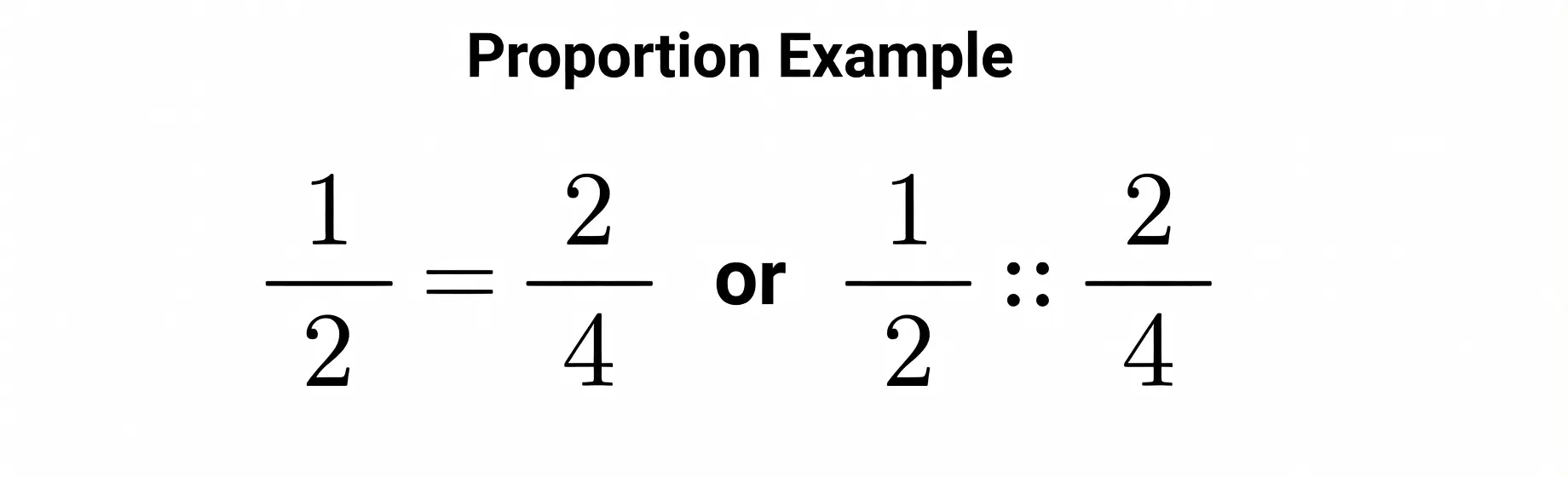
Both fractions equal 0.5.
So this is a true proportion.
Standard Form of a Proportion
Most proportions are written like this:
- a and d are called the extremes
- b and c are called the means
This structure makes it easy to solve the proportion using cross multiplication.
Real-Life Example
Imagine a recipe:
2 cups of flour make 12 cookies.
How much flour do you need for 24 cookies?
You can set up a proportion:
Then solve for x.
That is exactly what a proportion calculator helps you do.
How to Solve a Proportion (Step by Step)
Solving proportions is easier than it looks.
You just need one method: cross multiplication.
Let's go step by step.
How to Solve a Proportion for X
When x is the unknown in a proportion, isolate it in three steps.
Take 3/4 = x/8. Cross-multiply to get 3 × 8 = 4 × x, which is 24 = 4x. Divide both sides by 4, and x = 6.
The position of x does not change the method. Whether x sits on top or bottom, left or right, you cross-multiply first, then divide by the number attached to x. The calculator handles any position automatically.
Step 1: Write the Proportion Clearly
Start with the standard form:
a/b = c/d
Make sure each ratio is written correctly.
Example:
3/4 = x/8
Step 2: Cross Multiply
Multiply diagonally:
a × d = b × c
In our example:
3 × 8 = 4 × x
This gives:
24 = 4x
Step 3: Solve for the Unknown
Now divide both sides by 4:
24 ÷ 4 = x
x =
Step 4: Check Your Answer
Substitute x back into the original equation:
3/4 = 6/8
Both equal 0.75, so the proportion is correct.
Final Answer
3/4 = 6/8
This is how you solve the proportion manually.
The calculator above runs the same four steps and shows the working. The solver applies the same cross-multiplication method and shows each step, so you can check the working rather than only the answer.
Cross Multiplication Formula
Cross multiplication is the fastest way to solve a proportion.
It works when a proportion is written like this:
The Formula
Multiply diagonally:
a × d = b × c
This is called cross multiplication because you multiply across the equation.
Why It Works
If two ratios are equal, their cross products must also be equal.
So instead of dealing with two fractions, you turn the equation into a simple multiplication problem.
Quick Example
Solve:
5/6 = x/9
Step 1: Cross multiply
5 × 9 = 6 × x
45 = 6x
Step 2: Divide both sides by 6
x = 45 ÷ 6
x = 7.5
That is how you solve the proportion using the cross multiplication formula.
The calculator above applies this same rule and shows the missing value.
Proportional Relationships Explained
A proportional relationship happens when two quantities always change at the same rate.
In simple words, as one number increases, the other increases in a constant way.
What Makes a Relationship Proportional?
A relationship is proportional if:
- The ratio between the two quantities is constant
- It can be written as y/x = k
- The graph forms a straight line through the origin
The number k is called the constant of proportionality.
Example
If 1 notebook costs $3, then:
2 notebooks cost $6
3 notebooks cost $9
4 notebooks cost $12
The ratio stays the same:
Cost / Notebooks = 3
So this is a proportional relationship.
Formula for Proportional Relationships
The general formula is:
Where:
- y = dependent variable
- x = independent variable
- k = constant of proportionality
How to Tell If It Is Proportional
Ask yourself:
- Does the ratio stay constant?
- Does the graph pass through (0, 0)?
If yes, the relationship is proportional.
A proportional relationship calculator can help you quickly check whether two sets of values follow this pattern.
How to Find Proportion in Real Life
You use proportions outside the classroom more often than you notice.
Here are some real examples.
1. Cooking and Recipes
If a recipe needs:
2 cups of rice for 4 people
How much do you need for 10 people?
Set up a proportion:
2/4 = x/10
Solve for x.
2. Scale Drawings and Maps
Suppose 1 inch on a map represents 5 miles.
If two cities are 3 inches apart on the map:
1/5 = 3/x
Solve to find the real distance.
Architects and engineers use proportions all the time. Scaling a set of numbers up or down at a fixed rate is the same idea, which the ratio calculator is built for.
3. Speed and Distance
If a car travels:
60 miles in 1 hour
How far will it travel in 4 hours?
60/1 = x/4
Solve the proportion to find the distance.
4. Shopping and Pricing
If 3 items cost $15,
how much do 7 items cost?
3/15 = 7/x
Unit pricing on a shelf label is the same calculation run for you.
5. How to solve percent problems with proportions
Every percent question is a proportion in disguise. The setup is always part ÷ whole = percent ÷ 100. Fill in what you know, leave the unknown blank, and cross-multiply.
- What is 20% of 150? Set it up as x/150 = 20/100. Cross-multiply: 100x = 150 × 20 = 3000, so x = 30. Twenty percent of 150 is 30.
- 7.5% of what number is 3.15? Here the whole is unknown: 3.15/x = 7.5/100. Cross-multiply: 7.5x = 3.15 × 100 = 315, so x = 42. So 3.15 is 7.5% of 42.
- 3/4 is 75% of what number? Write 0.75/w = 75/100. Cross-multiply: 75w = 0.75 × 100 = 75, so w = 1. Three quarters is 75% of 1.
The pattern never changes. Put the part over the whole on one side, the percent over 100 on the other, and solve for whichever piece is missing. You can run any of these through the calculator above by entering them as a : b = c : d. For pure percentage questions, the percentage calculator handles them directly without setting up the ratio yourself.
Proportion vs Ratio
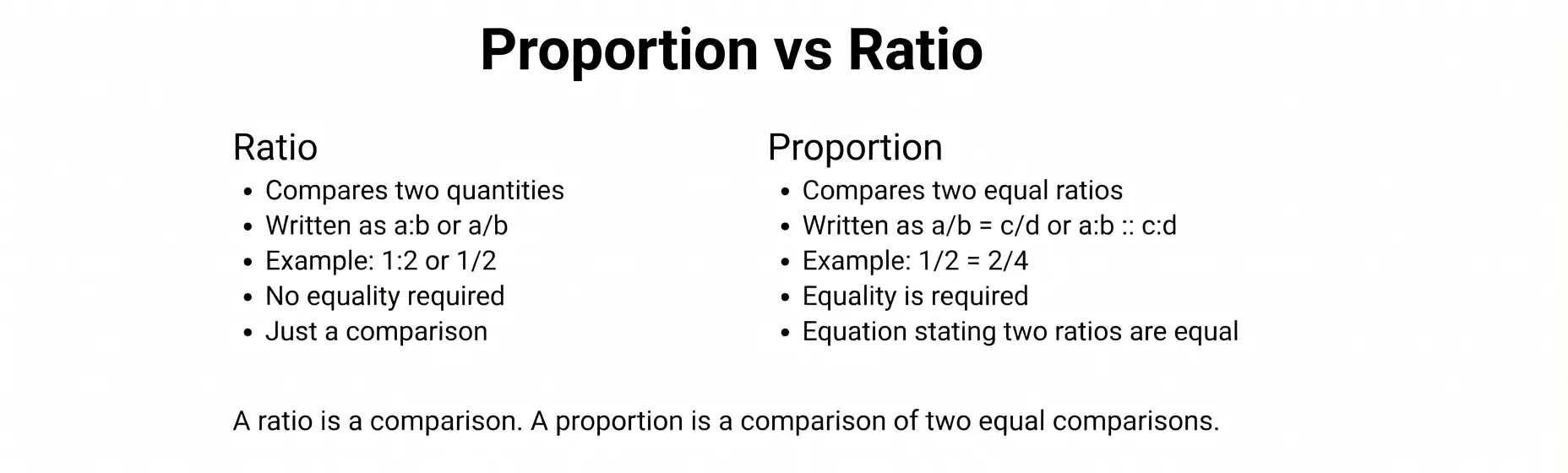
Ratio and proportion are easy to mix up.
They are related, but they are not the same.
What Is a Ratio?
A ratio compares two quantities.
It shows how much of one thing there is compared to another.
Example:
3:5
or
3/5
This means for every 3 of one item, there are 5 of another.
A ratio does not say anything about equality.
It is just a comparison.
What Is a Proportion?
A proportion is an equation that states two ratios are equal.
Example:
3/5 = 6/10
Here, both sides represent the same value.
So this is a true proportion.
Quick Comparison
| Ratio | Proportion |
|---|---|
| Compares two quantities | Compares two equal ratios |
| Written as a:b or a/b | Written as a/b = c/d |
| No equality required | Equality is required |
Simple Way to Remember
- A ratio is a comparison.
- A proportion is a comparison of two equal comparisons.
When you need to check if two ratios are equal or find a missing value, that is when you use a proportions calculator. If you want to simplify, scale, or solve a single ratio instead, the ratio calculator handles that side.
How to check if two ratios form a proportion
To check whether two ratios form a proportion, cross-multiply them. If the two cross products are equal, the ratios are in proportion. If they are not equal, they are not.
Take the ratios 10:5 and 4:2. Cross-multiply: 10 × 2 = 20, and 5 × 4 = 20. The products match, so yes, 10:5 and 4:2 do form a proportion. Both reduce to 2:1.
Now take 6:5 and 4:3. Cross-multiply: 6 × 3 = 18, and 5 × 4 = 20. The products are different, so these ratios do not form a proportion.
That is the whole test. Line the two ratios up as fractions, multiply the diagonals, and compare. Equal products mean a true proportion, unequal products mean it is false.
| Ratios | Cross products | Proportion? |
|---|---|---|
| 10:5 and 4:2 | 20 = 20 | Yes |
| 3:15 and 4:20 | 60 = 60 | Yes |
| 7:14 and 8:16 | 112 = 112 | Yes |
| 6:5 and 4:3 | 18 ≠ 20 | No |
| 7:9 and 18:24 | 168 ≠ 162 | No |
Common Mistakes When Solving Proportions
Even simple proportions can lead to errors if you're not careful. Here are the most common mistakes to watch out for:
1. Forgetting Cross Multiplication
Many people try to solve a proportion without using cross multiplication.
Remember: a/b = c/d → a × d = b × c
2. Mixing Up Numerator and Denominator
Placing the wrong numbers in the numerator or denominator will give the wrong answer.
Always double-check which number goes where.
3. Not Simplifying the Fraction
Sometimes you get the correct product but forget to simplify the fraction.
Always reduce your answer to its simplest form.
4. Ignoring Units
If you're solving a proportion involving measurements (like inches, liters, or dollars), make sure all units match before solving.
5. Skipping the Check Step
Always substitute your answer back into the original proportion to make sure both sides are equal.
This ensures your solution is correct.
Try these next
- Slope Intercept Form Calculator: proportional relationships graphed as lines.
- Square Root Calculator: another core algebra tool with full steps.
- BODMAS Calculator: get the order of operations right in any equation.
- Quadratic Formula Calculator: solve equations with a full worked solution.
Frequently Asked Questions (FAQs)
What is a proportion in math?
Two ratios set equal to each other, such as 2/3 = 4/6. If the cross products match, the proportion holds. It compares fractions or quantities in a way that maintains equality.
Example: 2/3 = 4/6.
How to solve a proportion?
Cross-multiply the two ratios, then divide to find the unknown. To solve a proportion:
1, Write it in standard form: a/b = c/d
2, Use cross multiplication: a × d = b × c
3, Solve for the unknown value
4, Check your answer by substituting it back
A proportion calculator runs the same cross-multiplication for you.
How to write a proportion?
A proportion is written by setting two ratios equal:
a/b = c/d
a and b form the first ratio
c and d form the second ratio
The unknown value can be in any position
Example: 3/4 = x/8
What are the types of proportion?
There are three main types of proportion in math:
Direct Proportion
When one quantity increases, the other also increases at a constant rate.
Example: 2 notebooks cost $6, 4 notebooks cost $12.
Formula: y = kx
Inverse Proportion
When one quantity increases, the other decreases so that their product is constant.
Example: 2 workers finish a job in 6 days, 3 workers finish it in 4 days.
Formula: x × y = k
Continued Proportion
When three or more numbers are in proportion, the middle term(s) squared equals the product of the extremes.
Example: a : b = b : c → b² = a × c
What does proportion mean in art?
In art, proportion refers to the relationship between the size of different elements in a composition.
It keeps objects visually balanced, like the size of a hand against a face or the height of buildings against each other.