

Waist to Height Ratio Calculator
Step 1 — Your measurements
Waist:Height:
Step 2 — The ratio
WHtR = waist ÷ height =What this means
Not medical advice. Measure at the narrowest part of your waist (usually just above the belly button), standing, without shoes. See a doctor for a full assessment.
Your waist to height ratio (WHtR) is your waist divided by your height, and the rule is simple: keep it under 0.5. That means your waist should be less than half your height. A 5’8″ person (68 inches) should keep their waist under 34 inches. This waist to height ratio calculator does the division for you and tells you which health-risk band you fall in, using the same 0.5 threshold doctors rely on.
WHtR targets belly fat, the type most linked to heart disease and type 2 diabetes, which BMI does not separate out. It works in inches or centimeters with no conversion needed.
How the Waist to Height Ratio Calculator Works
The tool requires only two inputs:
- Waist circumference (in cm or inches)
- Height (in cm or inches)
Once entered, the waist to height ratio calculator automatically calculates your ratio and categorizes your result into a health risk range.
What Is Waist to Height Ratio?
Waist to height ratio (WHtR) is a simple measurement that compares your waist size to your height to assess body fat distribution and health risk.
The formula is straightforward: Waist ÷ Height = Waist to Height Ratio
This measurement helps determine whether you carry excess fat around your abdomen, the type of fat most strongly linked to heart disease and type 2 diabetes.
Unlike BMI, which only considers weight and height, the waist to height ratio focuses on central (abdominal) fat. That’s why many health experts consider it a more accurate screening tool for health risk.
A commonly used rule is:
Keep your waist circumference less than half your height.
For example:
- If your height is 170 cm
- Your waist should be under 85 cm
If your waist is more than half your height, your waist to height ratio may indicate increased health risk.
A WHtR calculator gives you a clear result and helps you understand whether you are in a healthy range.
This is often written the other way round as height to waist ratio. The measure used clinically is waist divided by height.
The waist to height ratio holds up well because:
- It works for both men and women
- It applies to different ethnic groups
- It is simple and practical
- It better reflects abdominal fat than BMI
If you want a quick and reliable health indicator, the waist to height ratio calculator (also called a WHtR calculator) is one of the easiest tools available.
Waist to Height Ratio Chart (Men & Women)
After using the waist to height ratio calculator, the next step is understanding what your result means.
Your waist to height ratio (WHtR) falls into different health risk categories based on the final number.
Waist to Height Ratio Chart
| Waist to Height Ratio | Health Risk Level |
|---|---|
| Below 0.40 | Underweight (possible nutritional risk) |
| 0.40 – 0.49 | Healthy range |
| 0.50 – 0.59 | Increased health risk |
| 0.60 and above | High health risk |
What Does Your Exact Ratio Mean?
People often land here after getting a specific number. Here is what the common ones tell you:
- 0.37 to 0.39: Below the healthy band. You may be very lean or underweight. If unexpected, check with a doctor.
- 0.40 to 0.49: Healthy range. Lower risk of heart disease and type 2 diabetes.
- 0.50: The upper edge of healthy. Your waist is exactly half your height. Fine, but worth not going higher.
- 0.55: Increased risk. Central fat is building up. Trimming a few centimeters off your waist moves you back toward safe.
- 0.56 to 0.59: Still in the increased-risk band, closer to high. A good point to act on diet and activity.
- 0.60 and above: High risk. Strongly linked to central obesity. Worth discussing with a doctor.
Does It Differ for Men and Women?
The general WHtR cut-off of 0.50 applies to both men and women.
Unlike BMI, the waist to height ratio calculator does not require different formulas for gender.
Men do tend to store more abdominal fat than women, so recheck your ratio every few months if central fat is a concern.
Does Waist to Height Ratio Change With Age?
The 0.50 threshold holds for most adults, but there is nuance at the edges of age. For children and teens, slightly different boundaries are used by clinicians. For older adults, some researchers suggest the healthy ceiling can stretch a little, up to around 0.55 past age 50 or 60, because body shape naturally shifts with age. For the general adult population the simple rule stands: keep your waist under half your height. If you are well outside your age band, that is the signal to look closer, not to panic over a single reading. For a published set of bands, the UK’s NICE guideline classifies 0.4 to 0.49 as healthy central adiposity, 0.5 to 0.59 as increased health risk, and 0.6 or above as further increased risk.
Healthy Waist Size for Your Height
Since the healthy limit is a waist under half your height, you can read your target straight off your height. Stay under the number on your row and your waist to height ratio stays at or below 0.50. These figures come from the same waist ÷ height math the calculator uses.
Healthy Waist Size by Height (Feet and Inches)
| Height | Keep Waist Under | Healthy WHtR |
|---|---|---|
| 5’0″ (60 in) | 30.0 in | Under 0.50 |
| 5’1″ (61 in) | 30.5 in | Under 0.50 |
| 5’2″ (62 in) | 31.0 in | Under 0.50 |
| 5’3″ (63 in) | 31.5 in | Under 0.50 |
| 5’4″ (64 in) | 32.0 in | Under 0.50 |
| 5’5″ (65 in) | 32.5 in | Under 0.50 |
| 5’6″ (66 in) | 33.0 in | Under 0.50 |
| 5’7″ (67 in) | 33.5 in | Under 0.50 |
| 5’8″ (68 in) | 34.0 in | Under 0.50 |
| 5’9″ (69 in) | 34.5 in | Under 0.50 |
| 5’10” (70 in) | 35.0 in | Under 0.50 |
| 5’11” (71 in) | 35.5 in | Under 0.50 |
| 6’0″ (72 in) | 36.0 in | Under 0.50 |
| 6’1″ (73 in) | 36.5 in | Under 0.50 |
| 6’2″ (74 in) | 37.0 in | Under 0.50 |
Healthy Waist Size by Height (Centimeters)
| Height | Keep Waist Under | Healthy WHtR |
|---|---|---|
| 150 cm | 75.0 cm | Under 0.50 |
| 155 cm | 77.5 cm | Under 0.50 |
| 160 cm | 80.0 cm | Under 0.50 |
| 165 cm | 82.5 cm | Under 0.50 |
| 170 cm | 85.0 cm | Under 0.50 |
| 175 cm | 87.5 cm | Under 0.50 |
| 180 cm | 90.0 cm | Under 0.50 |
| 185 cm | 92.5 cm | Under 0.50 |
| 190 cm | 95.0 cm | Under 0.50 |
These are screening targets, not strict cutoffs. A waist a little over the line is not an emergency, but it is a signal to watch abdominal fat. For a fuller picture of body composition, pair this with your body fat percentage.
Waist to Height Ratio vs Height to Waist Ratio
Many people search for height to waist ratio, but the medically accepted measurement is the waist to height ratio.
Although the terms sound similar, they are not calculated the same way.
Correct Formula (Waist to Height Ratio)

This is the formula used in clinical research and by every standard waist to height ratio calculator.
Height to Waist Ratio (Reversed Formula)

This reversed version is not commonly used in medical risk assessment. While it produces a number, it does not follow the established health risk guidelines tied to WHtR.
Why Waist to Height Ratio Is the Standard
The waist to height ratio is preferred because:
- It directly measures abdominal fat risk
- It aligns with the “keep your waist less than half your height” rule
- It has strong scientific backing
- It works consistently across genders and ethnic groups
When you use a waist to height ratio calculator, it always applies the correct formula (waist divided by height).
Quick Example
If:
- Waist = 85 cm
- Height = 170 cm
Correct calculation:
85 ÷ 170 = 0.50
This means the waist is exactly half the height, the upper limit of the healthy range.
If calculated as height to waist ratio, the result would be:
170 ÷ 85 = 2.0
But this number does not correspond to standard health chart
So when searching online, even if you type height to waist ratio, what you actually want is a proper waist to height calculator that uses the WHtR formula.
For accurate health assessment, always rely on the waist to height ratio (WHtR) method.
Why Waist to Height Ratio Is Better Than BMI
For years, BMI has been the standard tool for assessing weight status. However, many experts now believe that waist to height ratio is a more accurate indicator of health risk.
1, Waist to Height Ratio Measures Abdominal Fat
BMI only looks at weight relative to height.
It does not measure where fat is stored.
The waist to height ratio specifically focuses on abdominal fat, the most dangerous type of body fat. Excess fat around the stomach is strongly linked to:
- Heart disease
- Type 2 diabetes
- High blood pressure
- Metabolic syndrome
A waist to height ratio calculator helps detect central obesity earlier than BMI.
2, BMI Can Misclassify People
BMI cannot distinguish between:
- Muscle and fat
- Athletic and sedentary individuals
- Fat distribution patterns
For example:
- A muscular athlete may have a “high” BMI but low body fat.
- A person with normal BMI may still carry excess belly fat.
The WHtR calculator avoids this issue because it measures waist size directly.
3, Simpler and More Practical Rule
Waist to height ratio uses one easy guideline:
Keep your waist less than half your height.
You can check the rule with a tape measure and no chart at all.
4, Works Across Genders and Ethnic Groups
Research suggests that the waist to height ratio works consistently across:
- Men and women
- Different age groups
- Various ethnic populations
Unlike BMI, it does not require different cutoffs for different populations in most cases.
Waist to height ratio vs BMI: quick comparison
| Factor | Waist to Height Ratio | BMI |
|---|---|---|
| Measures abdominal fat | ✅ Yes | ❌ No |
| Accounts for fat location | ✅ Yes | ❌ No |
| Simple universal rule | ✅ Yes | ❌ No |
| Requires weight input | ❌ No | ✅ Yes |
If you want a deeper analysis of body shape and fat distribution, you can also use Waist to Hip Ratio Calculator to compare your waist and hip measurements alongside your waist to height ratio.
BMI still works as a general screen, but reading it alongside your waist to height ratio gives a clearer picture of health risk.
Waist to Height Ratio Examples
Two quick worked examples so you can check your own number.
Example 1 (inches): A man with a 32-inch waist and 70-inch height. 32 ÷ 70 = 0.46. That sits in the healthy 0.40 to 0.50 band.
Example 2 (centimeters): A woman with a 90 cm waist and 175 cm height. 90 ÷ 175 = 0.51. That crosses into the increased-risk band, just over the line. Dropping the waist to 87 cm would bring it back to 0.50.
The math is identical in either unit because both numbers cancel out. That is why the waist to hip ratio and this WHtR method both work regardless of whether you measure in inches or centimeters.
How to Measure Waist Correctly
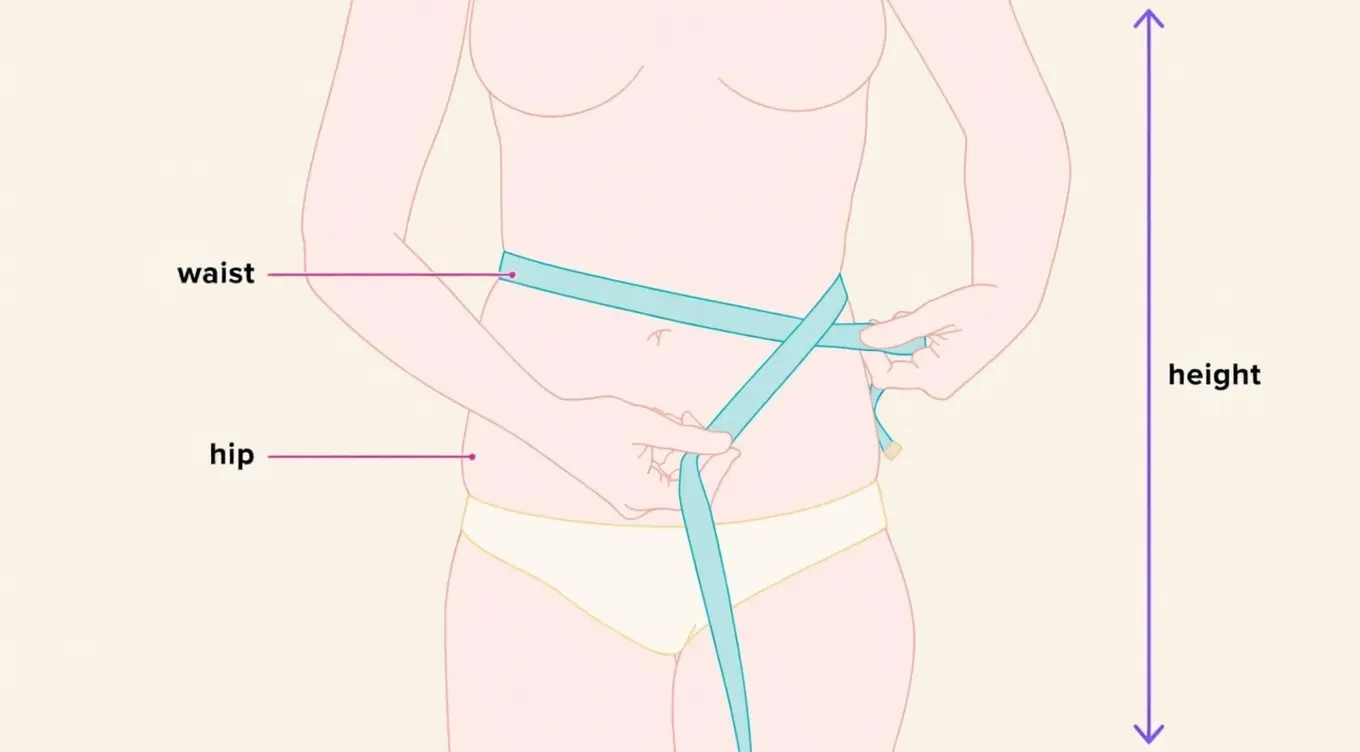
To get an accurate result from the waist to height ratio calculator, you must measure your waist correctly.
Even a small mistake can change your waist to height ratio result.
Here’s how to do it the right way.
Step 1: Find the Correct Spot
Stand upright and relax your stomach.
Place the measuring tape around your waist at:
- The midpoint between your lowest rib and the top of your hip bone
- Usually just above the belly button
Do not suck in your stomach.
Do not push it out.
Stay relaxed.
Step 2: Keep the Tape Level
Make sure the tape is:
- Horizontal all the way around
- Snug but not tight
- Not compressing your skin
A tilted tape can distort your waist to height ratio calculation.
Step 3: Measure After Breathing Out
Take a normal breath.
Then gently breathe out and measure.
Do not measure while inhaling.
This gives a more realistic waist measurement for your waist to height result.
Step 4: Measure Height Accurately
Your waist to height ratio depends equally on height.
Stand barefoot against a wall.
Keep your:
- Back straight
- Heels together
- Eyes looking forward
Measure from floor to the top of your head.
Common Mistakes to Avoid
- Measuring over thick clothing
- Pulling the tape too tight
- Measuring at the narrowest part of the waist instead of the midpoint
- Guessing height instead of measuring it