

Protein Intake Calculator
Step 1 — Body weight
Your weight is kg. Protein targets scale from this.Step 2 — Energy context (BMR & TDEE)
BMR: kcal/day · TDEE: kcal/day. This shows your calorie level so you can fit protein into your diet, though your protein target is set by body weight, not calories.Step 3 — Protein range
Multiply body weight by 0.8, 1.6, and 2.2 g/kg for the minimum, recommended, and optimal targets shown above.How much protein do experts recommend?
| Source | Guideline |
|---|---|
| WHO / RDA | 0.8 to 0.83 g/kg body weight (prevents deficiency) |
| Active adults | 1.2 to 1.6 g/kg for general fitness and maintenance |
| Strength / muscle gain | 1.6 to 2.2 g/kg to build and retain muscle |
| Dietary Guidelines | 10 to 35% of daily calories from protein |
What this means
Estimate only. Not medical advice. If you have kidney disease, are pregnant, or have another health condition, talk to a doctor or dietitian before raising protein intake.
Your daily protein need is set mostly by your body weight and goal, usually 0.8 to 2.2 grams per kg (about 0.36 to 1 gram per pound). This protein calculator turns your weight into three clear targets: a minimum for basic health, a recommended amount for active people, and an optimal amount for building muscle.
A 150 lb (68 kg) active adult, for example, lands near 109 grams per day. Protein is what rebuilds muscle after training and keeps you full while dieting, so it is the first number to get right.
It answers one simple question.
How much protein per day should I eat?
This protein intake calculator uses inputs like age, gender, weight, height, and activity level. Some versions also factor in your goal, such as muscle gain, fat loss, or maintenance.
The result is your daily protein intake in grams.
Instead of guessing or following generic advice, this tool gives a personalized number. That makes it more useful than fixed recommendations like “eat more protein.”
How Much Protein Do You Need Per Day?
Your daily protein intake depends on more than just body weight.
It changes based on activity level, age, and fitness goals.
For a sedentary adult, protein needs are lower.
For active people, athletes, or anyone lifting weights, needs increase.
A common guideline is:
- 0.8 g per kg of body weight for inactive adults
- 1.2 to 1.6 g per kg for active individuals
- 1.6 to 2.2 g per kg for muscle gain or intense training
So if you weigh 70 kg and train regularly, your protein per day could fall between 84 and 112 grams.
This is why generic advice often fails.
The calculator applies these ranges to your own weight and training days, so you get a gram target rather than a band.
How to Calculate Protein Intake
You can calculate your daily protein intake with a simple formula.
Start with your body weight.
Then match it with your activity level and goal.
Basic protein formula:
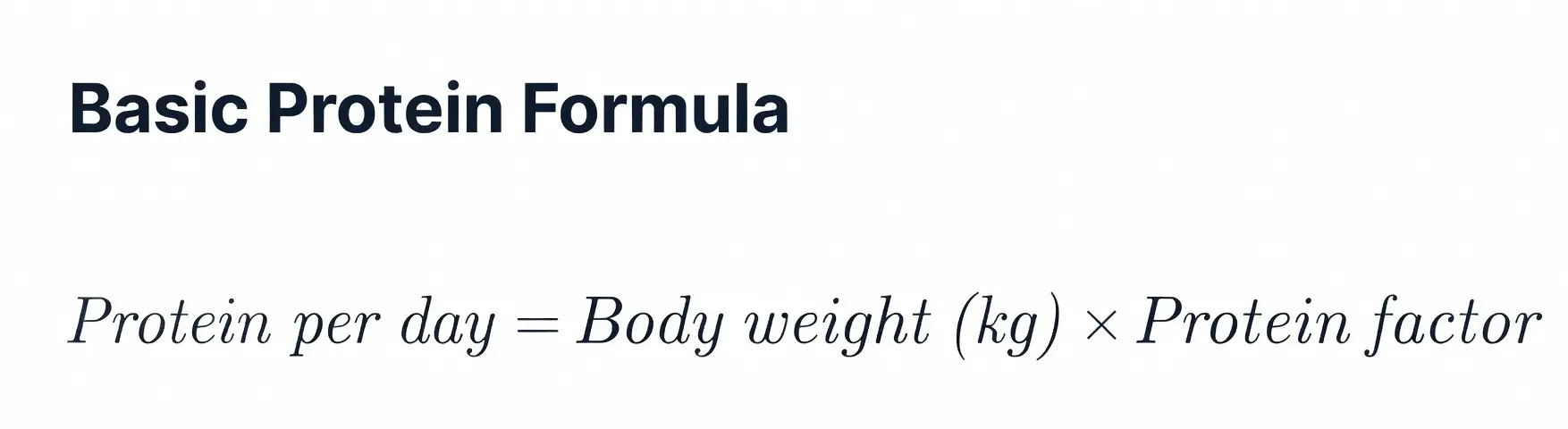
Common protein factors:
- 0.8 g for sedentary adults
- 1.2 to 1.6 g for active lifestyles
- 1.6 to 2.2 g for muscle gain or strength training
- 1.8 to 2.4 g during fat loss while preserving muscle
Example:
If you weigh 75 kg and work out 4 to 5 times a week:
75 × 1.6 = 120 g protein per day
That is your estimated daily protein intake. Along with protein, dietary fat plays a key role in meeting your daily calorie needs. Use our Fat Intake Calculator to find how much fat you should eat per day.
Manually calculating works, but it takes time.
The calculator does the multiplication for you and shows all three targets side by side.
How Many Calories Are in Protein?
One gram of protein contains 4 calories. So if your target is 120 grams of protein per day, that is 480 calories from protein alone (120 × 4).
This matters when you fit protein into your daily calories. The Dietary Guidelines suggest 10 to 35 percent of calories from protein. On a 2,000-calorie diet, 30 percent protein would be 600 calories, which is 150 grams. Protein is the most filling of the three macros, so hitting your target often makes it easier to control total calories too.
Daily Protein Intake by Body Weight
Body weight is the fastest way to estimate daily protein intake.
This method works well for most people.
Especially if your goal is maintenance, fat loss, or muscle gain.
Below is a simple breakdown using grams of protein per kg of body weight.
Protein needs by goal:
- General health: 0.8 g per kg
- Light activity: 1.0 to 1.2 g per kg
- Regular training: 1.4 to 1.6 g per kg
- Muscle gain: 1.6 to 2.2 g per kg
- Fat loss: 1.8 to 2.4 g per kg
Quick examples:
- 60 kg person aiming for maintenance
60 × 1.0 = 60 g protein per day - 70 kg person training regularly
70 × 1.6 = 112 g protein per day - 80 kg person cutting fat
80 × 2.0 = 160 g protein per day
This approach answers a common question fast:
how much protein a day do I need based on my weight?
Keep in mind, body weight alone is not perfect. For more precision, you can calculate protein needs based on lean mass using our Lean Body Mass Calculator.
Factors like age, training intensity, and body composition also matter.
The calculator above folds weight, age and activity into one number so you do not have to weigh those factors yourself.
Protein Per Pound of Body Weight (Full Chart)
Most people search in pounds. Here is your daily protein at three common levels: the RDA minimum (0.36 g/lb), an active target (0.7 g/lb), and a muscle-building target (1 g/lb, the popular “gram per pound” rule). Worth knowing what the RDA actually is: it is the minimum set by the federal Dietary Guidelines to prevent deficiency, not the amount that is optimal for building muscle. The higher two numbers are training targets, not official recommendations.
| Body Weight | Minimum (RDA) | Active | Muscle Gain |
|---|---|---|---|
| 110 lb | 40 g | 77 g | 110 g |
| 120 lb | 43 g | 84 g | 120 g |
| 130 lb | 47 g | 91 g | 130 g |
| 140 lb | 50 g | 98 g | 140 g |
| 150 lb | 54 g | 105 g | 150 g |
| 160 lb | 58 g | 112 g | 160 g |
| 175 lb | 63 g | 122 g | 175 g |
| 180 lb | 65 g | 126 g | 180 g |
| 190 lb | 68 g | 133 g | 190 g |
| 200 lb | 72 g | 140 g | 200 g |
| 220 lb | 79 g | 154 g | 220 g |
| 240 lb | 86 g | 168 g | 240 g |
| 250 lb | 90 g | 175 g | 250 g |
Protein Per Kg of Body Weight
If you measure in kilograms, use these. The factors are 0.8 g/kg (RDA), 1.6 g/kg (active), and 2.2 g/kg (muscle gain).
| Body Weight | Minimum (0.8) | Active (1.6) | Muscle Gain (2.2) |
|---|---|---|---|
| 50 kg | 40 g | 80 g | 110 g |
| 55 kg | 44 g | 88 g | 121 g |
| 60 kg | 48 g | 96 g | 132 g |
| 65 kg | 52 g | 104 g | 143 g |
| 70 kg | 56 g | 112 g | 154 g |
| 75 kg | 60 g | 120 g | 165 g |
| 80 kg | 64 g | 128 g | 176 g |
| 85 kg | 68 g | 136 g | 187 g |
| 90 kg | 72 g | 144 g | 198 g |
| 100 kg | 80 g | 160 g | 220 g |
How Much Protein Should I Eat for My Weight?
Here are the most searched body weights worked out. The range runs from the RDA minimum up to the muscle-building target, so pick based on your activity and goal.
- If you weigh 130 lb: 47 to 130 g protein per day (active target around 91 g)
- If you weigh 140 lb: 50 to 140 g per day (active around 98 g)
- If you weigh 150 lb: 54 to 150 g per day (active around 105 g)
- If you weigh 175 lb: 63 to 175 g per day (active around 122 g)
- If you weigh 200 lb: 72 to 200 g per day (active around 140 g)
The lower number keeps you healthy; the higher number suits heavy lifters building muscle. Most active people sit comfortably in the middle. Enter your exact weight in the calculator above for your own three targets.
Protein Intake for Muscle Gain
If your goal is muscle growth, protein is the nutrient to get right first.
You are breaking muscle fibers during training.
Protein is what rebuilds them stronger.
Recommended protein range for muscle gain:
- 1.6 to 2.2 grams per kg of body weight
This range is backed by most sports nutrition research.
More than this does not add extra muscle for most people.
Examples:
- 65 kg lifter
Needs 104 to 143 g protein per day - 75 kg lifter
Needs 120 to 165 g protein per day - 85 kg lifter
Needs 136 to 187 g protein per day
Does timing matter?
Yes, but total intake matters more.
Try to:
- Spread protein across 3 to 5 meals
- Include 20 to 40 g protein per meal
- Consume protein within a few hours of training
Protein Intake for Weight Loss
Protein does two jobs on a diet: it holds onto muscle and it keeps you full.
It helps you lose fat without losing muscle.
It also keeps you full, which makes dieting easier.
Recommended protein intake for weight loss:
- 1.8 to 2.4 grams per kg of body weight
Higher protein intake:
- Preserves lean muscle
- Reduces hunger
- Increases calorie burn slightly through digestion
Examples:
- 60 kg person cutting fat
Needs 108 to 144 g protein per day - 70 kg person on a calorie deficit
Needs 126 to 168 g protein per day - 85 kg person aiming for aggressive fat loss
Needs 153 to 204 g protein per day
Why protein matters more during fat loss
When calories drop, your body looks for energy.
Without enough protein, it may use muscle tissue.
Protein protects your muscle mass while you lose fat. Knowing your body fat percentage helps fine-tune protein intake. You can estimate it using our Body Fat Calculator.
Helpful tips:
- Prioritize protein in every meal
- Choose lean sources to control calories
- Combine protein with fiber for better fullness
Using a daily protein intake calculator makes this easier.
It balances protein needs with your calorie deficit and activity level.
Protein Intake for Different Activity Levels
Your activity level changes how much protein your body actually needs.
Someone who sits most of the day does not need the same intake as someone training hard.
Sedentary or low activity
This includes desk jobs with little or no exercise.
- 0.8 to 1.0 g per kg of body weight
Enough for basic health.
Not ideal for muscle growth.
Moderately active
Light workouts, walking, or training 2 to 3 times per week.
- 1.2 to 1.6 g per kg
Supports recovery and daily performance.
Highly active or athletic
Heavy training, gym workouts, or sports 4 to 6 days per week.
- 1.6 to 2.2 g per kg
Helps repair muscle and improve strength.
Very intense training
Athletes, bodybuilders, or people in a calorie deficit with high training volume.
- 2.0 to 2.4 g per kg
Protects muscle and improves recovery.
This is why many people ask:
how much protein per day do I need based on my activity level?
Above protein intake calculator answers this more accurately by combining:
- Body weight
- Activity level
- Fitness goal
Frequently Asked Questions (FAQs)
How much protein should I eat a day?
Most adults need between 0.8 and 2.2 grams of protein per kg of body weight.
The exact amount depends on your activity level and goal. Muscle gain and fat loss usually require higher intake.
How to calculate protein intake?
Multiply your body weight in kg by a protein factor based on activity.
For example, active individuals use 1.4 to 1.6 g per kg.
A protein intake calculator does this automatically with better accuracy.
How much protein is in an egg?
One large egg contains about 6 grams of protein.
Eggs are a complete protein source with all essential amino acids.
How to increase protein intake?
Add protein to every meal.
Use foods like eggs, chicken, fish, dairy, beans, and protein shakes.
Planning meals ahead also helps hit your daily protein target.
How much protein do I need?
Your needs depend on weight, activity, and fitness goal.
Use a daily protein intake calculator to get a personalized number instead of guessing.
How much protein per day for a man?
An active man usually needs 1.6 to 2.2 g of protein per kg of body weight. For an 80 kg (176 lb) man that is about 128 to 176 g per day. Sedentary men can sit lower, near 64 g, while those building muscle aim for the top of the range.
How much protein per day for a woman?
An active woman needs the same 1.6 to 2.2 g per kg. For a 68 kg (150 lb) woman that is roughly 109 to 150 g per day. The gram target is set by body weight and goal, not gender, so use your own weight in the calculator.
Is 80 grams of protein enough?
It depends on your weight and goal. For a smaller or sedentary adult around 100 lb, 80 g is plenty. For a 180 lb person who lifts, 80 g is on the low side; an active target there is closer to 126 g. Match the number to your body weight.