

MCG to MG Calculator
Micrograms are written as mcg or µg, and both mean the same thing. Always check the dose on your label or with a pharmacist before taking anything. This tool is for reference, not medical advice.
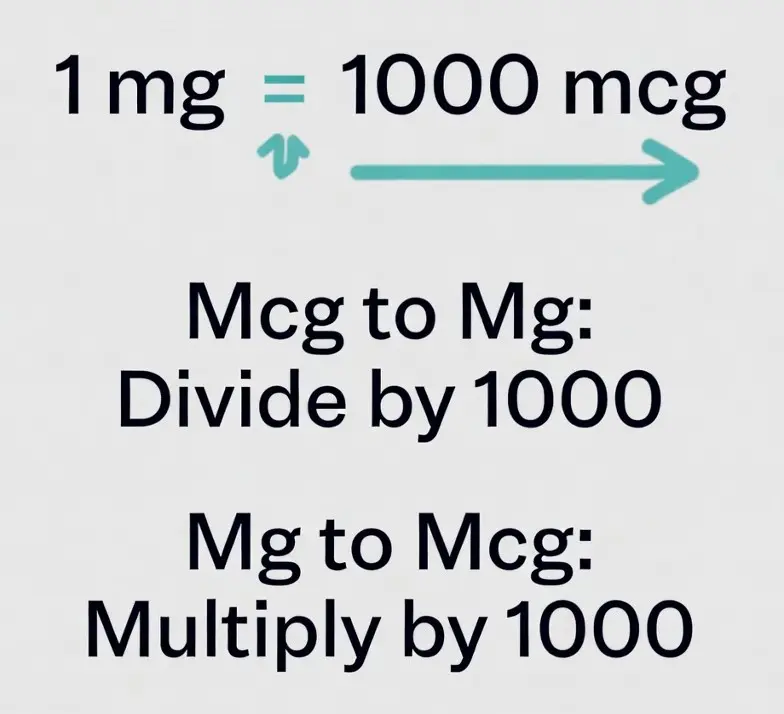
To convert mcg to mg, divide the micrograms by 1000, because 1 mg equals 1000 mcg. So 1000 mcg is 1 mg, 500 mcg is 0.5 mg, and 250 mcg is 0.25 mg. Supplement and prescription labels often print the same dose in both units, which is where the confusion starts.
How do you convert mcg to mg?
Divide the micrograms by 1000. That gives you milligrams, because 1 mg equals 1000 mcg.
The number always gets smaller going this way. A microgram is one thousandth of a milligram, so when you move up to the bigger unit, it takes fewer of them to say the same amount. If your answer came out larger than the number you started with, you divided the wrong way.
The quickest method is to move the decimal point three places to the left. 1000 mcg becomes 1.000 mg. 250 mcg becomes 0.250 mg. No calculator needed once the pattern clicks.
MCG to MG formula
mg = mcg ÷ 1000
There is no rounding and no odd decimal factor. Every 1000 micrograms is exactly 1 milligram by definition, so the answer is always clean.
Going the other way, from milligrams to micrograms, you multiply by 1000 instead. For that direction use the mg to mcg calculator.
MCG to MG chart
Common microgram doses converted to milligrams. These are the values that show up most on real supplement and prescription labels:
| Micrograms (mcg) | Milligrams (mg) | Common use |
|---|---|---|
| 25 mcg | 0.025 mg | Low thyroid dose |
| 50 mcg | 0.05 mg | Levothyroxine, vitamin D |
| 75 mcg | 0.075 mg | Thyroid dose |
| 88 mcg | 0.088 mg | Thyroid dose |
| 100 mcg | 0.1 mg | Thyroid, biotin |
| 112 mcg | 0.112 mg | Thyroid dose |
| 125 mcg | 0.125 mg | Thyroid, digoxin |
| 137 mcg | 0.137 mg | Thyroid dose |
| 150 mcg | 0.15 mg | Thyroid, iodine |
| 200 mcg | 0.2 mg | Folic acid, selenium |
| 250 mcg | 0.25 mg | Vitamin B12 |
| 300 mcg | 0.3 mg | Biotin, iodine |
| 400 mcg | 0.4 mg | Prenatal folic acid |
| 500 mcg | 0.5 mg | Folic acid, B12 |
| 600 mcg | 0.6 mg | Supplement dose |
| 750 mcg | 0.75 mg | Supplement dose |
| 800 mcg | 0.8 mg | High folic acid |
| 1000 mcg | 1 mg | B12, folate |
| 1250 mcg | 1.25 mg | Supplement dose |
| 1500 mcg | 1.5 mg | Supplement dose |
| 2000 mcg | 2 mg | High B12 |
| 2500 mcg | 2.5 mg | Supplement dose |
| 5000 mcg | 5 mg | High-dose B12 |
| 10000 mcg | 10 mg | Bulk supplement |
What is 1000 mcg in mg?
1000 mcg is 1 mg.
This one comes up most often because of Vitamin B12. Most B12 supplements are sold as 1000 mcg tablets, and the label sometimes prints the same dose as 1 mg. They are identical. A 1000 mcg tablet and a 1 mg tablet contain the same amount.
What is 500 mcg in mg?
500 mcg is 0.5 mg.
Folic acid and B12 both show up at this dose. If your bottle says 500 mcg and a chart lists 0.5 mg, they match. 500 mcg is half of a 1 mg dose, not double it, even though 500 looks like the bigger number.
What is 250 mcg in mg?
250 mcg is 0.25 mg.
This is a common B12 and biotin dose. Written as 0.25 mg it can look tiny and easy to misread, which is exactly why the microgram figure, 250 mcg, is usually printed right next to it on the label.
What is 800 mcg in mg?
800 mcg is 0.8 mg.
This is the higher folic acid dose, often recommended during pregnancy. The standard prenatal amount is 400 mcg (0.4 mg), and 800 mcg doubles it for people who need more.
What is 50 mcg in mg?
50 mcg is 0.05 mg.
This is a starting dose for levothyroxine and a common vitamin D strength. Thyroid tablets step up in small increments, so the microgram figure keeps the numbers readable instead of writing 0.05 mg on every box.
How many mcg in a mg?
There are 1000 mcg in 1 mg.
This is fixed in the metric system, not an approximation. One milligram always holds exactly one thousand micrograms, the same way one meter always holds one thousand millimeters. It never changes, whatever you are measuring.
Is mcg the same as µg?
Yes. mcg and µg are two ways of writing microgram, and they mean exactly the same thing.
Pharmacies and hospitals in many countries prefer mcg over µg on purpose. The symbol µ can smudge in print or get misread as an m in handwriting, and mistaking micrograms for milligrams is a thousandfold dosing error. Spelling it out as mcg removes that risk. If you see either one on a label, treat them as identical.
mcg vs mg: what is the difference?
A milligram is 1000 times larger than a microgram. So mg is the bigger unit and mcg is the smaller one.
A 500 mcg dose is smaller than a 1 mg dose, even though 500 is a bigger number than 1. The unit decides the size, not the digit in front of it. Always read the unit first, then the number.
| Unit | Full name | Size |
|---|---|---|
| mcg (µg) | Microgram | 1/1000 of a milligram |
| mg | Milligram | 1/1000 of a gram |
So it takes 1000 mcg to make 1 mg, and 1000 mg to make 1 gram. Each step up the scale is another factor of a thousand.
How to convert mcg to mg step by step
Take any microgram value and follow three steps.
Step one, write down the number of micrograms. Step two, divide it by 1000. Step three, the result is your answer in milligrams. For 750 mcg: 750 divided by 1000 is 0.75, so 750 mcg is 0.75 mg. The same three steps work for any value, large or small.
Where mcg to mg conversions get used
- Vitamin B12. Sold almost everywhere as 1000 mcg, which is 1 mg. Anyone comparing it to a chart in milligrams has to convert first.
- Folic acid. The prenatal dose is 400 mcg (0.4 mg), and the higher dose is 800 mcg (0.8 mg). Both get looked up constantly by people reading pregnancy guidance.
- Thyroid medication. Levothyroxine is dosed in micrograms: 50 mcg, 75 mcg, 100 mcg, 125 mcg. Bottles occasionally print the milligram version, so a 100 mcg tablet is 0.1 mg.
- Vitamin D. Often labeled in mcg on newer packaging and IU on older stock. A 25 mcg dose is 0.025 mg.
Common mistakes with mcg and mg
- Multiplying instead of dividing. Going from mcg to mg always makes the number smaller. If your answer got bigger, you ran the formula backwards.
- Thinking the bigger number means the stronger dose. 500 mcg is less than 1 mg, even though 500 looks larger than 1. Check the unit before the number.
- Reading µg as mg. These differ by a factor of 1000. In a medical setting that gap is dangerous, which is the whole reason mcg is the preferred spelling.
- Losing a decimal place. Because the conversion is all about moving the decimal three spots, slipping one place turns 0.5 mg into 0.05 mg or 5 mg. Count the places twice on doses that matter.