

Rectangle Area & Perimeter Calculator
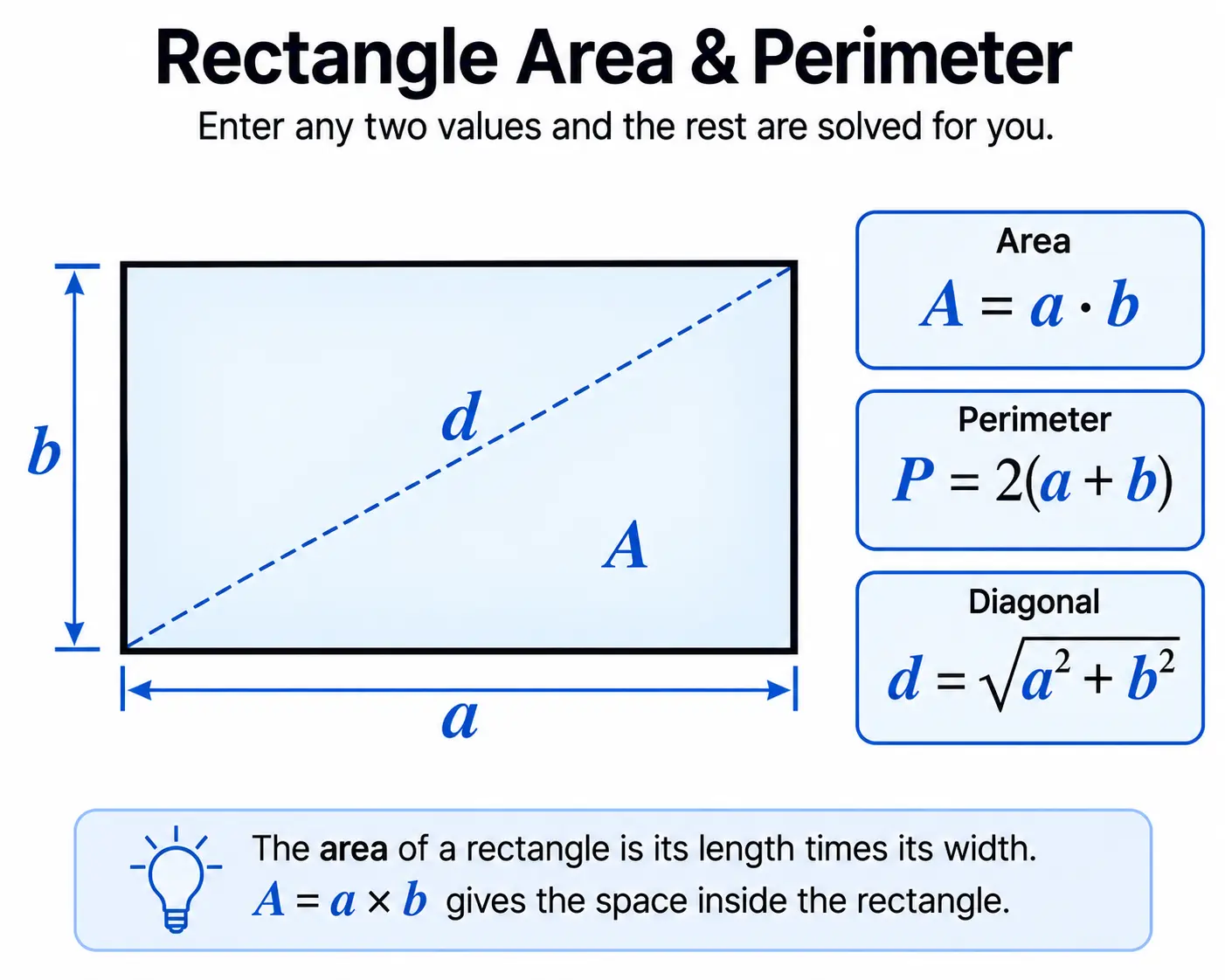
The area of a rectangle is its length times its width: A = a × b. Enter a 10 cm by 5 cm rectangle and the area is 50 cm². That is the whole rule.
Type in any two measurements you already know, a side, the perimeter, the diagonal, or the area itself, and it solves for everything else. Six units are built in, from millimeters to yards, and it converts between them as you go.
How do you find the area of a rectangle?
Multiply the two side lengths. A rectangle with sides a and b has an area of A = a × b. If one side is 8 m and the other is 3 m, the area is 24 m². The answer is always in square units, so meters become square meters and inches become square inches.
The order does not matter. A 3 by 8 rectangle and an 8 by 3 rectangle hold the same 24 square meters. Length times width and width times length give the identical result. b (length) a (width) A = a × b d
Worked example: area step by step
Say you have a rectangle 12 feet long and 8 feet wide. Write the formula: A = a × b. Drop in the numbers: A = 12 × 8. Multiply: A = 96. The area is 96 square feet. That is every step, no tricks. For a room this size you would buy flooring to cover 96 square feet, then add roughly ten percent for cuts and waste, so about 106 square feet on the order.
Now flip the problem. You know the area is 96 square feet and one side is 12 feet. Divide instead of multiply: 96 ÷ 12 = 8. The missing side is 8 feet. The calculator does this division for you the instant you enter a side and the area.
What is the rectangle area formula?
The core formula is short:
- Area: A = a × b
- Perimeter: P = 2 × (a + b)
- Diagonal: d = √(a² + b²)
These three are linked. Once you know two of the five values (side a, side b, area, perimeter, diagonal), the rest are fixed. That is why the calculator above only needs two inputs. Give it a side and the area, and it back-solves the missing side by dividing: b = A ÷ a.
Is area the same as surface area?
No, and mixing them up is a common mistake. Area is for a flat, two-dimensional rectangle, a single face. Surface area is for a three-dimensional box, adding up all six faces. If someone hands you a rectangular sheet of paper, you want area. If they hand you a shoebox and ask how much wrapping paper it needs, you want surface area. This calculator solves flat rectangle area. For the shoebox, you would add the areas of all six rectangular sides.
How do you measure a rectangle correctly?
Measure the two different sides, the long one and the short one, each from edge to edge. You only need two numbers because opposite sides of a rectangle are equal by definition. Common slip-ups: measuring on a slant instead of straight across, mixing units (one side in feet, the other in inches), and rounding too early. Keep both sides in the same unit and round only at the final answer. For a room, measure at floor level where the wall meets the floor, not partway up where furniture might block a straight line.
How do you calculate area when you know the perimeter?
Knowing the perimeter alone is not enough. A perimeter of 20 cm fits a 6 by 4 rectangle, a 7 by 3, a 9 by 1, and many more. You need one more clue, either a side, the area, or the diagonal.
Say the perimeter is 30 cm and the area is 50 cm². Half the perimeter is 15, so a + b = 15. The two sides that add to 15 and multiply to 50 are 10 and 5. The calculator solves this pair automatically using the values you enter.
How do you find the diagonal of a rectangle?
The diagonal cuts the rectangle into two right triangles, so the Pythagorean theorem applies. Square both sides, add them, take the square root: d = √(a² + b²). A 3 by 4 rectangle has a diagonal of √(9 + 16) = √25 = 5.
Working backward, if you know one side and the diagonal, subtract and take the root to get the other side: b = √(d² − a²). The calculator handles this the moment you type a side and a diagonal. b a d d = √(a² + b²)
Using the diagonal to check for square corners
Builders and DIYers use the diagonal as a right-angle test. Measure both diagonals of a rectangular frame, a deck, or a picture. If the two diagonals are equal, the corners are true right angles and the shape is a real rectangle. If they differ, the frame is skewed into a parallelogram. This is the fast on-site check behind the classic 3-4-5 triangle trick carpenters use to square up corners.
Rectangle area vs parallelogram area
They look related but the formula differs. A rectangle uses side times side. A parallelogram, which is a slanted rectangle, uses base times height, where height is the straight vertical distance between the parallel sides, not the slanted side length. Slant a rectangle over into a parallelogram and its area shrinks even though the side lengths stay the same, because the height drops. For a true rectangle the side and the height are identical, so A = a × b holds.
Rectangle area for common sizes
Quick reference for whole-number rectangles. Find your two sides to read the area, or use the calculator above for any exact size.
| Side a | Side b | Area (a × b) | Perimeter | Diagonal |
|---|---|---|---|---|
| 2 | 2 | 4 | 8 | 2.83 |
| 4 | 3 | 12 | 14 | 5.00 |
| 5 | 5 | 25 | 20 | 7.07 |
| 6 | 4 | 24 | 20 | 7.21 |
| 8 | 3 | 24 | 22 | 8.54 |
| 10 | 5 | 50 | 30 | 11.18 |
| 12 | 6 | 72 | 36 | 13.42 |
| 12 | 8 | 96 | 40 | 14.42 |
| 15 | 10 | 150 | 50 | 18.03 |
| 20 | 10 | 200 | 60 | 22.36 |
Units are consistent across the row. If your sides are in feet, the area is in square feet and the diagonal is in feet.
How do you find area from square feet to other units?
Area units square the length conversion. One foot is 12 inches, so one square foot is 12 × 12 = 144 square inches, not 12. This trips people up on flooring and paint jobs. The calculator converts area units directly, so you can enter sides in feet and read the area in square meters without touching the math.
| From | To | Multiply by |
|---|---|---|
| 1 ft² | in² | 144 |
| 1 m² | ft² | 10.764 |
| 1 yd² | ft² | 9 |
| 1 m² | cm² | 10,000 |
| 1 cm² | mm² | 100 |
Where do you use rectangle area in real life?
More often than you would think. Flooring and tiling need area to count boxes. Paint coverage is sold by square footage. A garden bed, a rug, a phone screen, a parking space, a sheet of plywood, all rectangles you size by area. Land plots and room dimensions run on the same A = a × b rule. Working with angled shapes instead? The area of a triangle uses half the base times height, and a trapezoid handles four sides with only one parallel pair.
For paint or flooring, measure the room in feet, multiply for square feet, then add ten percent for waste and cuts. That final number is what you buy.
Frequently asked questions
What is the area of a rectangle?
Multiply the two sides: A = a × b. A 10 by 5 rectangle covers 50 square units.
Is area length times width or width times length?
Both. A 4 by 6 and a 6 by 4 rectangle both come to 24.
What units does rectangle area use?
Square units. Whatever unit the sides use, the area gains a square: centimeters give square centimeters, feet give square feet. Always square whatever length unit the sides use.
Can I find the area with only the perimeter?
No. A perimeter of 20 cm fits a 6 by 4, a 7 by 3, and a 9 by 1, so you need a second value.
How do I find area if I know one side and the diagonal?
Find the missing side with b = √(d² − a²), then multiply the two sides together.
Is a square just a special rectangle?
Yes. A square is a rectangle with all four sides equal, so its area is side × side, or side squared. The same A = a × b rule still applies.
What is the area of a 12 by 10 rectangle?
120 square units. Multiply 12 by 10. In feet that is 120 square feet, in meters 120 square meters, following whatever unit the sides use.
Try these next
- Hexagon Calculator
- Perimeter of a Circle Calculator
- Equilateral Triangle Calculator
- Volume of a Cylinder Calculator