

Volume Of A Cylinder Calculator
Find the volume of a cylinder using V = π · r² · h. Enter the radius and height in any unit, and get the result in cubic units, liters, or gallons.
The volume of a cylinder is the area of its circular base times its height: V = π × r² × h. A cylinder with a 5 cm radius and 10 cm height holds about 785.4 cm³, which is a little under 0.8 liters. Type your radius and height above to get the volume.
This calculator does solid cylinders and hollow ones like pipes and tubes. Enter radius or diameter, work in any unit from millimeters to miles, and read the volume out in cubic units, liters, or gallons.
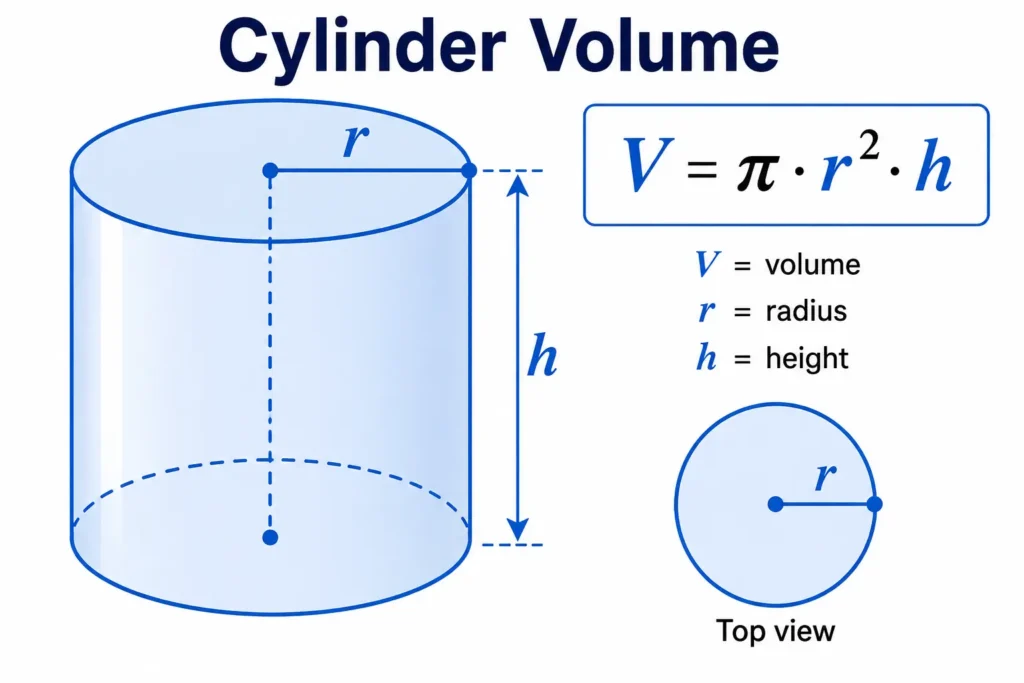
How do you find the volume of a cylinder?
Square the radius, multiply by pi, then multiply by the height. In symbols, V = π × r² × h. The r² × π part is the area of the round base. Multiply that by how tall the cylinder is and you have the space inside.
Take a cylinder with radius 3 cm and height 8 cm. Square the radius to get 9. Times pi is about 28.27. Times the height 8 is roughly 226.2 cm³. The calculator runs all three steps for you. r h V = π r² h
What is the cylinder volume formula?
The formula is V = π × r² × h. Each part earns its place. Pi times radius squared is the base area, the same circle area you would find on its own. The height stretches that circle straight up into a solid. Because the base is a circle, doubling the radius quadruples the volume, while doubling the height only doubles it. Width matters more than height.
How do you find cylinder volume from the diameter?
If you measured straight across the circle, you have the diameter, not the radius. Halve it. A diameter of 10 cm means a radius of 5 cm. Then run the formula as normal. This calculator links the radius and diameter fields, so type either one and the other fills itself in. You never have to halve by hand. The distance around that same circle is its perimeter or circumference.
What is the volume of a hollow cylinder or pipe?
A hollow cylinder is a tube with a wall thickness, like a pipe, a ring, or a toilet roll. It has an outer radius R and an inner radius r. Subtract the inner circle from the outer circle, then multiply by height: V = π × (R² − r²) × h.
For a pipe with outer radius 5, inner radius 3, and height 10, that is π × (25 − 9) × 10 = π × 16 × 10, about 502.7 cubic units. Switch the calculator to hollow mode and it asks for the inner radius too.
Worked example: hollow pipe volume step by step
Pipes need the hollow formula and it pays to go slow. Say a steel pipe has an outer radius of 5 cm, an inner radius of 3 cm, and a length of 100 cm. First square both radii: outer is 5 × 5 = 25, inner is 3 × 3 = 9. Subtract: 25 − 9 = 16. Multiply by pi: 16 × π is about 50.27. Multiply by the length 100: about 5,027 cm³, or roughly 5 liters of steel. Note you subtract the squared radii, not the radii themselves. Subtracting 5 − 3 first and then squaring gives the wrong answer. The calculator handles the order for you in hollow mode.
Does an oblique cylinder have a different volume?
No, though the answer looks wrong at first. An oblique cylinder leans to one side instead of standing straight, like a stack of coins pushed over. As long as the height, measured straight up between the two parallel circular faces, stays the same, the volume is identical to a right cylinder. This is Cavalieri's principle. The lean does not add or remove any space, so V = π × r² × h still holds. Just make sure the height is the perpendicular distance, not the slanted length along the side.
Cylinder volume for common sizes
Quick reference for solid cylinders using V = π × r² × h. Find your radius and height, or use the calculator for exact values.
| Radius (r) | Height (h) | Volume (πr²h) |
|---|---|---|
| 2 | 5 | 62.83 |
| 3 | 8 | 226.19 |
| 4 | 10 | 502.65 |
| 5 | 10 | 785.40 |
| 6 | 12 | 1,357.17 |
| 10 | 20 | 6,283.19 |
| 15 | 30 | 21,205.75 |
What units does cylinder volume use?
Cubic units. Radius and height in centimeters give cubic centimeters, which equal milliliters. Meters give cubic meters, inches give cubic inches. For liquids and containers, the calculator also reads out in liters, US and UK gallons, and fluid ounces, so you can size a tank or bottle by how much it holds. Keep radius and height in the same unit, or let the unit menus convert for you.
How much water does a cylinder hold?
Tanks, cans, and glasses are cylinders, so capacity is the usual reason people run this calculation. Find the volume in cubic centimeters and remember that one cubic centimeter equals one milliliter. So a cylinder of 785 cm³ holds 785 mL, or about 0.785 liters. Switch the output to liters or gallons and the calculator gives the capacity directly. A drum with a 30 cm radius and 90 cm height, for example, holds around 254 liters.
How do you work out a cylinder's capacity in liters?
Capacity is just volume expressed in liquid units. Calculate the volume in cubic centimeters, then divide by 1,000 to get liters, since one liter is 1,000 cm³. A cylindrical water tank with a 40 cm radius and 100 cm height holds π × 40² × 100, about 502,655 cm³, which is roughly 503 liters. The calculator skips the division: pick liters or gallons from the output menu and it converts automatically.
Cylinder compared to cone and sphere
For the same radius and height, the three shapes form a tidy ratio. The cylinder is the full π × r² × h and holds the most. A cone with that radius and height is exactly one third of the cylinder. A sphere with the same radius sits at two thirds of the cylinder whose height equals the diameter. So cylinder, sphere, cone line up as three, two, one in thirds. This is one of the most elegant results in geometry.
How do you find the height of a cylinder from its volume?
Rearrange the formula. If you know the volume and radius, the height equals the volume divided by pi times the radius squared: h = V ÷ (π × r²). A cylinder holding 1,000 cm³ with a radius of 5 cm has a height of 1,000 ÷ (π × 25), about 12.7 cm. The same rearranging works for the radius if you know the volume and height instead. Solve for whichever measurement is missing by dividing the volume by the part you already have.
Where is cylinder volume used in real life?
Everywhere round and straight-sided. Water tanks, oil drums, cans, bottles, and buckets are all cylinders. Engineers size pipes and tubes with the hollow version. Builders pour concrete into cylindrical footings and columns. Even a roll of paper or a battery is a cylinder. Any container shaped like a can uses this formula to find capacity.
Frequently asked questions
What is the volume of a cylinder?
It is the space inside the cylinder. Multiply the area of the base circle by the height: V = π × r² × h.
Why is there a pi in the cylinder formula?
Because the base is a circle, and every circle area uses pi. The base area is π × r², and the height simply multiplies that circle upward into a solid.
Is a cylinder three times a cone?
Yes. A cylinder holds exactly three times the volume of a cone with the same radius and height. Pour three full cones into a matching cylinder and it fills to the top.
How do I find the volume of a tube?
Use the hollow cylinder formula, V = π × (R² − r²) × h. Switch to hollow mode and enter both radii.
What is the volume of a cylinder with radius 4 and height 10?
About 502.65 cubic units. Square 4 to get 16, times pi is about 50.27, times 10 is 502.65.
Does a wider or taller cylinder hold more?
Width wins, because the radius is squared. Width wins, because the radius is squared and the height is not. Twice the width gives four times the volume, but twice the height gives only twice.
How many liters are in a cylinder?
Divide the cubic-centimeter volume by 1,000. A cylinder of 2,000 cm³ holds 2 liters.
Can I use diameter instead of radius?
Yes. Enter the diameter and the radius field fills itself in.
What is the difference between a cylinder and a prism?
A cylinder has a circular base, a prism has a flat polygon base. Both find volume as base area times height, but the cylinder uses π × r² for its base while a prism uses the polygon's area.
Try these next
- Volume of a Pyramid Calculator
- Volume of a Hemisphere Calculator
- Arc Length Calculator
- Area of a Rectangle Calculator