

Volume Of A Sphere Calculator
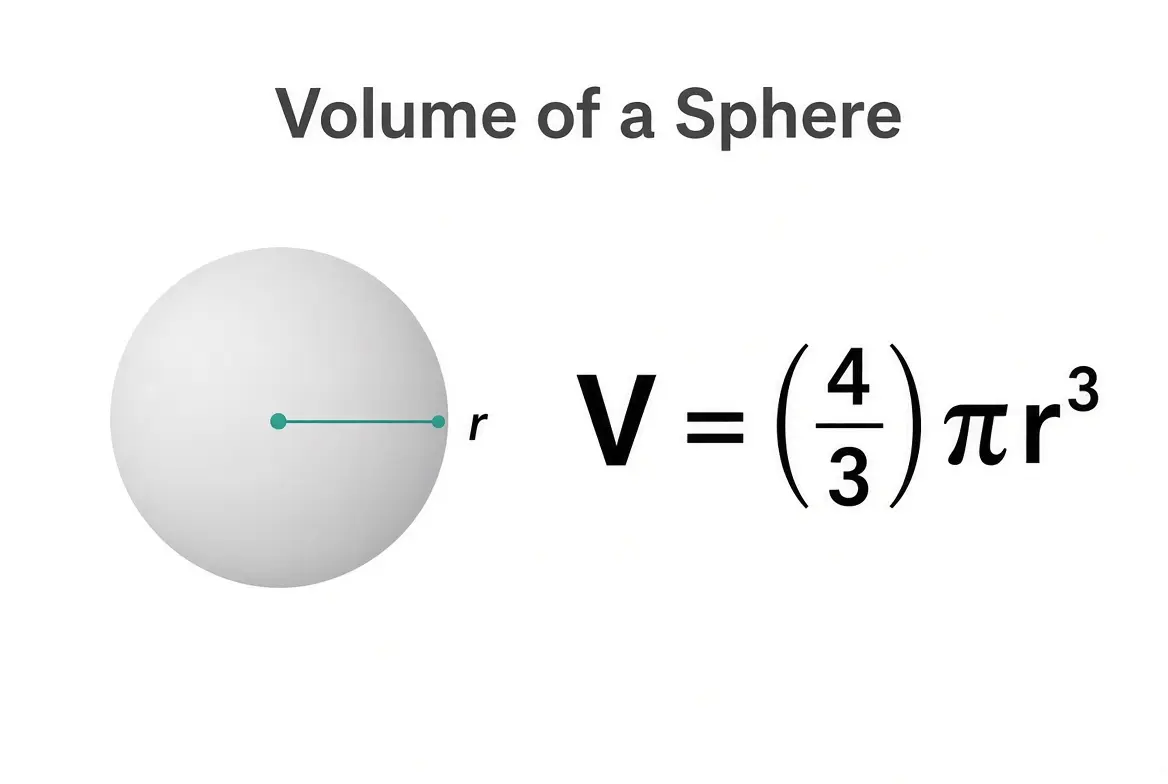
Find the volume of a sphere using V = (4/3) · π · r³. Enter the radius or circumference, and the rest are solved for you.
The volume of a sphere is four thirds of pi times the radius cubed: V = (4/3) × π × r³. A sphere with a 5 cm radius holds about 523.6 cm³. Enter the radius above to get the volume and the circumference.
This calculator works three ways. Enter the radius, the circumference around the middle, or even the volume itself, and it solves for the other two. Pick any unit from millimeters to miles and read the result in cubic units, liters, or gallons.
How do you find the volume of a sphere?
Cube the radius, multiply by pi, then multiply by four thirds. In symbols, V = (4/3) × π × r³. Cubing means multiplying the radius by itself three times. The radius is the distance from the center of the sphere out to its surface, the same in every direction.
Take a sphere with radius 3 cm. Cube it: 3 × 3 × 3 = 27. Times pi is about 84.8. Times four thirds is roughly 113.1 cm³. The calculator runs all three steps the moment you type the radius. r V = 4⁄3 π r³
What is the sphere volume formula?
The formula is V = (4/3) × π × r³. The r³ is what makes a sphere grow so fast. Because the radius is cubed, small changes in radius cause big changes in volume. Double the radius and the volume grows eight times, not twice. This is why a beach ball holds so much more air than a tennis ball even though it is only a few times wider.
The four thirds and pi are constants that never change. Only the radius varies from one sphere to the next.
How do you find sphere volume from the circumference?
If you measured around the sphere instead of across it, you have the circumference, not the radius. Find the radius first by dividing the circumference by 2π, then run the volume formula. A sphere with a circumference of 31.4 cm has a radius of about 5 cm, giving a volume near 523.6 cm³. The calculator does this conversion automatically when you enter the circumference. The same 2π relationship drives a circle's perimeter.
How do you find the radius from the volume?
Work the formula backward. Multiply the volume by three, divide by four pi, then take the cube root. A sphere holding 523.6 cm³ has a radius of the cube root of (3 × 523.6) ÷ (4π), which comes to 5 cm. The cube root is the tricky part to do by hand, so the calculator handles it. Just type the volume and read off the radius.
Worked example: finding radius from volume
This reverse problem shows up when you know how much a sphere holds and need its size. Say a spherical tank holds 4,188.79 cubic units and you want the radius. Multiply the volume by three: 4,188.79 × 3 = 12,566.4. Divide by four pi: 12,566.4 ÷ 12.566 = 1,000. Take the cube root: the cube root of 1,000 is 10. So the radius is 10 units. The cube root is what makes this hard on paper, since most volumes do not give clean roots. Enter the volume in the calculator and it returns the exact radius, circumference, and diameter.
Sphere volume for common radii
Quick reference using V = (4/3) × π × r³. Find your radius, or use the calculator for exact values and reverse lookups.
| Radius (r) | Volume (⁴⁄₃πr³) | Circumference (2πr) |
|---|---|---|
| 1 | 4.19 | 6.28 |
| 2 | 33.51 | 12.57 |
| 3 | 113.10 | 18.85 |
| 5 | 523.60 | 31.42 |
| 6 | 904.78 | 37.70 |
| 10 | 4,188.79 | 62.83 |
| 12 | 7,238.23 | 75.40 |
| 15 | 14,137.17 | 94.25 |
What units does sphere volume use?
Cubic units. A radius in centimeters gives cubic centimeters, which equal milliliters. Meters give cubic meters, inches give cubic inches. For liquids and containers, the calculator also converts to liters and gallons, so you can size a spherical tank or ball by how much it holds. Keep the radius in one unit, or let the built-in menus convert for you.
Why is sphere volume two thirds of a cylinder?
This is one of the oldest results in geometry, proved by Archimedes. Take a cylinder that a sphere fits inside perfectly, same radius, and a height equal to the sphere's diameter. The sphere fills exactly two thirds of that cylinder. Archimedes was so proud of this that he asked for a sphere and cylinder to be carved on his tomb. The ratio holds for every sphere, no matter the size.
Sphere volume compared to surface area
Volume and surface area are different measurements people often confuse. Volume, V = (4/3) × π × r³, is the space inside, in cubic units. Surface area, 4 × π × r², is the skin wrapping around it, in square units. As a sphere grows, volume climbs faster than surface area because it depends on the radius cubed rather than squared. This is why large animals lose heat more slowly than small ones: their volume outpaces their surface. A ball with radius 5 has a volume of about 523.6 cubic units but a surface area of about 314.2 square units.
How is a hemisphere related to a sphere?
A hemisphere is exactly half a sphere, a dome shape. Its volume is half the sphere formula, V = (2/3) × π × r³. So a hemisphere with the same radius holds half as much as the full ball. Bowls, domes, and half-round tanks use this. If you need the dome shape rather than the full sphere, use the hemisphere volume calculator or simply divide the sphere volume by two.
What about a hollow sphere or spherical shell?
A hollow sphere, like a ball with a thick wall or a spherical shell, has an outer radius R and an inner radius r. Find the volume of the full outer sphere, then subtract the empty inner sphere: V = (4/3) × π × (R³ − r³). This gives just the material in the wall. It is the same subtraction idea used for a hollow cylinder or pipe, applied to a round shell instead of a straight tube.
Where is sphere volume used in real life?
Balls of every kind, from marbles to planets. It sizes ball bearings, gas tanks shaped as spheres, water towers, bubbles, and scoops of ice cream. Chemists use it for atomic and molecular models. Astronomers use it to find the volume of planets and stars from their radius. Anything round and solid, or round and hollow like a balloon, uses this formula.
Does a bigger sphere always weigh more?
Only if it is the same material. Weight depends on both volume and density. Since volume grows with the radius cubed, a sphere twice as wide has eight times the volume, and if made of the same stuff, eight times the weight. This is why a small lead ball can outweigh a much larger foam one. To find weight, calculate the volume here, then multiply by the material's density. A solid steel ball of radius 5 cm, for instance, has a volume near 523.6 cm³ and a mass around 4.1 kilograms at steel's density.
Frequently asked questions
What is the volume of a sphere?
It is the space inside the ball, found with V = (4/3) × π × r³. Enter your radius above to get the number.
Why is there a four thirds in the sphere formula?
It comes from calculus, specifically from adding up an infinite stack of circular slices through the sphere. The four thirds is the exact constant that result produces, and it never changes.
How do I find sphere volume from the diameter?
Halve the diameter to get the radius, then cube it and multiply by four thirds pi. A diameter of 10 means a radius of 5, giving about 523.6 cubic units.
What is the volume of a sphere with radius 10?
About 4,188.79 cubic units. Cube 10 to get 1,000, times pi is about 3,141.6, times four thirds is 4,188.79.
Does doubling the radius double the volume?
No. It multiplies the volume by eight, because the radius is cubed. Two cubed is eight, so twice the radius means eight times the volume.
Is a sphere the most efficient shape for volume?
Yes. Yes. Nothing holds more volume for the same surface area, which is why bubbles and water droplets pull into spheres. This is why bubbles and water droplets form spheres, and why storage tanks are sometimes spherical.
How many liters does a sphere hold?
Find the volume in cubic centimeters and divide by 1,000. A sphere of radius 10 cm holds about 4,189 cm³, which is roughly 4.19 liters.
What is the volume of a basketball?
A basketball has a radius of about 12 cm, giving a volume near 7,238 cm³, or about 7.2 liters. Measure your ball's radius and use the calculator for an exact figure.
How do you find the diameter of a sphere from its volume?
Find the radius first by working the formula backward with a cube root, then double it. The diameter is always twice the radius.
Can a sphere and a cube have the same volume?
Yes, but not the same dimensions. For equal volumes, the sphere and cube simply have different radius and side lengths. A sphere is more space-efficient, so it needs less surface to hold the same volume.
Try these next
- Volume of a Cone Calculator
- Volume of a Pyramid Calculator
- Arc Length Calculator
- Area of a Rectangle Calculator