

Volume Of A Cone Calculator
The volume of a cone is one third of a cylinder with the same base and height: V = (1/3) × π × r² × h. A cone with a 5 cm base radius and 10 cm height holds about 261.8 cm³. Enter your radius and height above to get the volume.
This calculator does solid cones and truncated cones (frustums), takes radius or diameter, and reads out in everything from cubic centimeters to US gallons.
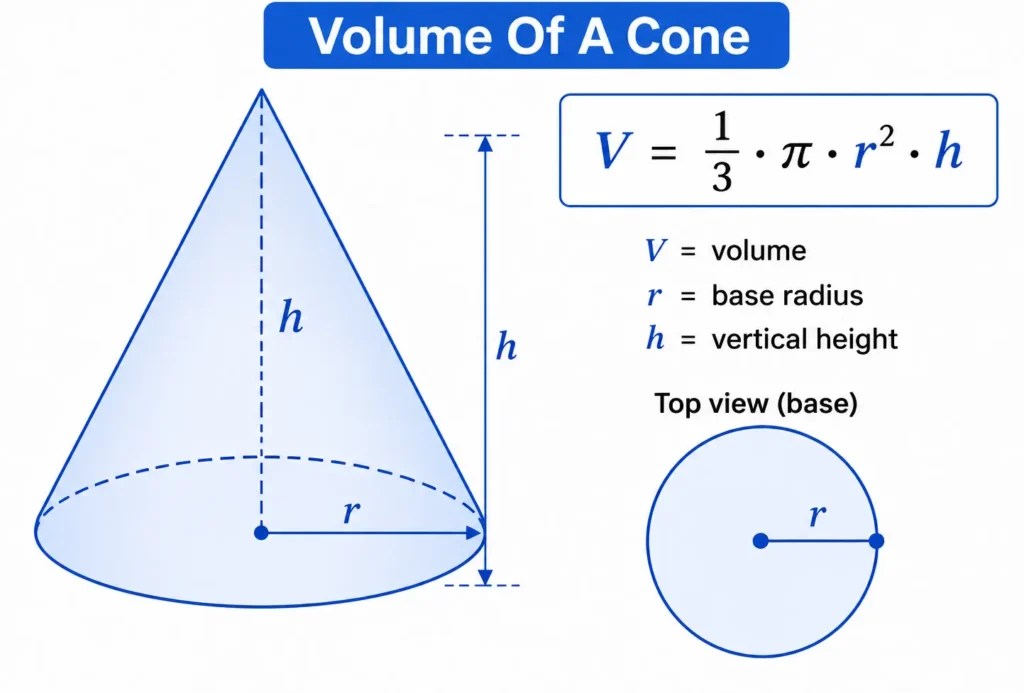
How do you find the volume of a cone?
Square the base radius, multiply by the height, multiply by pi, then divide by three. In symbols that is V = (1/3) × π × r² × h. The radius is the distance from the center of the round base to its edge. The height is the straight vertical distance from the base up to the tip, measured at a right angle, not along the slanted side.
Take a cone with radius 3 cm and height 8 cm. Square the radius to get 9. Times 8 is 72. Times pi is about 226.2. Divided by 3 gives roughly 75.4 cm³. The calculator runs all four steps the moment you type the numbers. r h V = ⅓ π r² h
What is the cone volume formula?
The formula is V = (1/3) × π × r² × h. Each piece has a job. The r² × π part is the area of the circular base. Multiply by height and you would have a cylinder. The one third is what makes it a cone, because a cone fills exactly a third of the cylinder that boxes it in. Pour three cones of water into a matching cylinder and it fills to the top. That is the whole idea behind the one third.
Why is a cone one third of a cylinder?
Same base, same height, but the cone holds a third as much. This is not a rounded estimate, it is exact. A cylinder with radius r and height h has volume π × r² × h. Slice that cylinder and the cone tapering to a point inside it takes up precisely one third of the space. The remaining two thirds is the gap between the straight cylinder wall and the sloping cone surface. This ratio holds for every cone, tall or squat, wide or narrow.
How do you find cone volume from the diameter?
If you measured across the base instead of from the center, you have the diameter, not the radius. Halve it first. A base diameter of 10 cm means a radius of 5 cm. Then run the normal formula. The calculator has a diameter toggle, so you can enter whichever one you measured and it handles the halving for you.
What is the volume of a truncated cone (frustum)?
A frustum is a cone with the tip sliced off, flat on top. Think of a bucket, a lampshade, or a paper coffee cup. It has two radii, a wider bottom R and a narrower top r. The formula is V = (1/3) × π × h × (R² + R × r + r²).
For a frustum with bottom radius 8, top radius 4, and height 12, that is (1/3) × π × 12 × (64 + 32 + 16) = (1/3) × π × 12 × 112, which comes to about 1,407 cubic units. Switch the calculator to frustum mode to solve these without the messy arithmetic.
Worked example: frustum volume step by step
The three-term bracket is the only awkward part, and it is plain arithmetic once you take it in order. Say you have a bucket shaped like a truncated cone: bottom radius 8 cm, top radius 4 cm, height 12 cm. Start inside the bracket. Square the bottom radius: 8 × 8 = 64. Multiply the two radii: 8 × 4 = 32. Square the top radius: 4 × 4 = 16. Add them: 64 + 32 + 16 = 112. Now the outside: multiply by height, 112 × 12 = 1,344. Multiply by pi, about 4,222. Divide by 3, about 1,407 cm³. That bucket holds roughly 1.41 liters. The frustum mode does every step for you.
How do you find cone volume from slant height?
The slant height runs along the sloped surface from the base edge to the tip. It is longer than the vertical height and the volume formula does not use it directly. You have to convert. The radius, vertical height, and slant height form a right triangle, so the vertical height equals the square root of the slant squared minus the radius squared: h = √(l² − r²). A cone with radius 6 and slant height 10 has a vertical height of √(100 − 36) = √64 = 8. Then plug 8 into the volume formula. This right-triangle step is the same idea behind the Pythagorean theorem. Skipping it and using slant height by mistake is the most common cone volume error.
Cone volume compared to cylinder and sphere
For the same radius and height, the three shapes line up in a clean ratio. A cylinder is the full π × r² × h. A cone is one third of that. A sphere, using the radius as both, sits in between at two thirds of the matching cylinder. So a cone always holds the least of the three for a given base and height, exactly a third of the cylinder that would enclose it.
Cone volume for common sizes
Quick reference for solid cones using V = (1/3) × π × r² × h. Find your radius and height, or use the calculator for exact values.
| Radius (r) | Height (h) | Volume (⅓πr²h) |
|---|---|---|
| 2 | 5 | 20.94 |
| 3 | 8 | 75.40 |
| 4 | 6 | 100.53 |
| 5 | 10 | 261.80 |
| 5 | 12 | 314.16 |
| 6 | 9 | 339.29 |
| 8 | 12 | 804.25 |
| 10 | 15 | 1,570.80 |
What units does cone volume use?
Cubic units. A radius and height in centimeters give a volume in cubic centimeters, which equals milliliters. Meters give cubic meters, inches give cubic inches. For liquids, the calculator also converts to liters, US and UK gallons, quarts, cups, and fluid ounces, so you can size a cone-shaped container by how much it actually holds.
Can you find half the volume of a cone?
Yes, but it is not as simple as halving the height. Because volume grows with height in a curved way for the tapered shape, filling a cone to half its height does not give half its volume. A cone filled to half its height holds only about one eighth of the total, since the top half is much wider than the narrow tip. To get exactly half the volume by liquid, you fill to roughly 79 percent of the height. It is worth knowing if you are measuring liquid in a cone-shaped glass.
Where is cone volume used in real life?
Ice cream cones, traffic cones, and funnels are the obvious ones. Beyond that, it sizes piles of sand, gravel, or grain dumped into a heap, which naturally form a cone. Silos with cone-shaped bottoms, cooling towers, party hats, and pointed roofs all use it. Engineers use the frustum version for buckets, hoppers, and tapered tanks. Anyone estimating how much material sits in a conical pile is running this formula.
Frequently asked questions
What is the volume of a cone?
It is the space inside the cone, found with V = (1/3) × π × r² × h. Enter your radius and height above to get the number.
Why divide by three in the cone formula?
Because a cone fills exactly one third of a cylinder with the same base and height. The division by three is what separates the pointed cone from the straight cylinder.
Is cone volume the same as a pyramid?
The idea is the same, one third of the base area times height. The difference is the base. A cone has a circular base, so it uses π × r². A pyramid has a flat polygon base, so it uses that polygon's area instead.
How do I find volume if I only have the slant height?
Convert first. The slant height, radius, and vertical height form a right triangle. Use height = √(slant² − r²) to get the true height, then apply the cone formula. The volume formula needs vertical height, not slant.
What is the volume of a cone with radius 5 and height 12?
About 314.16 cubic units. Square 5 to get 25, times 12 is 300, times pi is about 942.5, divided by 3 is 314.16.
Does a wider cone or a taller cone hold more?
It depends on the numbers, but width matters more because the radius is squared. Doubling the radius quadruples the volume, while doubling the height only doubles it.
What is the volume of an ice cream cone?
A standard waffle cone is roughly 2.5 cm in radius and 12 cm deep, giving about 78.5 cm³, or a bit over a quarter cup. Real cones vary, so measure yours and use the calculator for an exact figure.
Does the frustum formula work for a full cone?
Yes. Set the top radius to zero and the frustum formula collapses to the standard cone formula, since the R × r and r² terms drop out. A full cone is just a frustum with no flat top.
Try these next
- Volume of a Pyramid Calculator
- Volume of a Hemisphere Calculator
- Perimeter of a Circle Calculator
- Area of a Rectangle Calculator