

Circle Perimeter Calculator
Enter any one value. The perimeter (circumference) of a circle is p = 2 · π · r, with d = 2r and A = π · r². The rest are solved for you.
The perimeter of a circle is two times pi times the radius: p = 2 × π × r. It is the distance all the way around the edge, and it has a special name: the circumference. A circle with a 5 cm radius has a perimeter of about 31.4 cm. Enter any one measurement above and the rest are solved for you.
This calculator works four ways. Give it the radius, the diameter, the perimeter, or even the area, and it fills in the other three at once. Work in any unit from millimeters to yards, and copy the result when you are done. Every part of a circle is locked to its radius, so one number gives you all the others.
What is the perimeter of a circle?
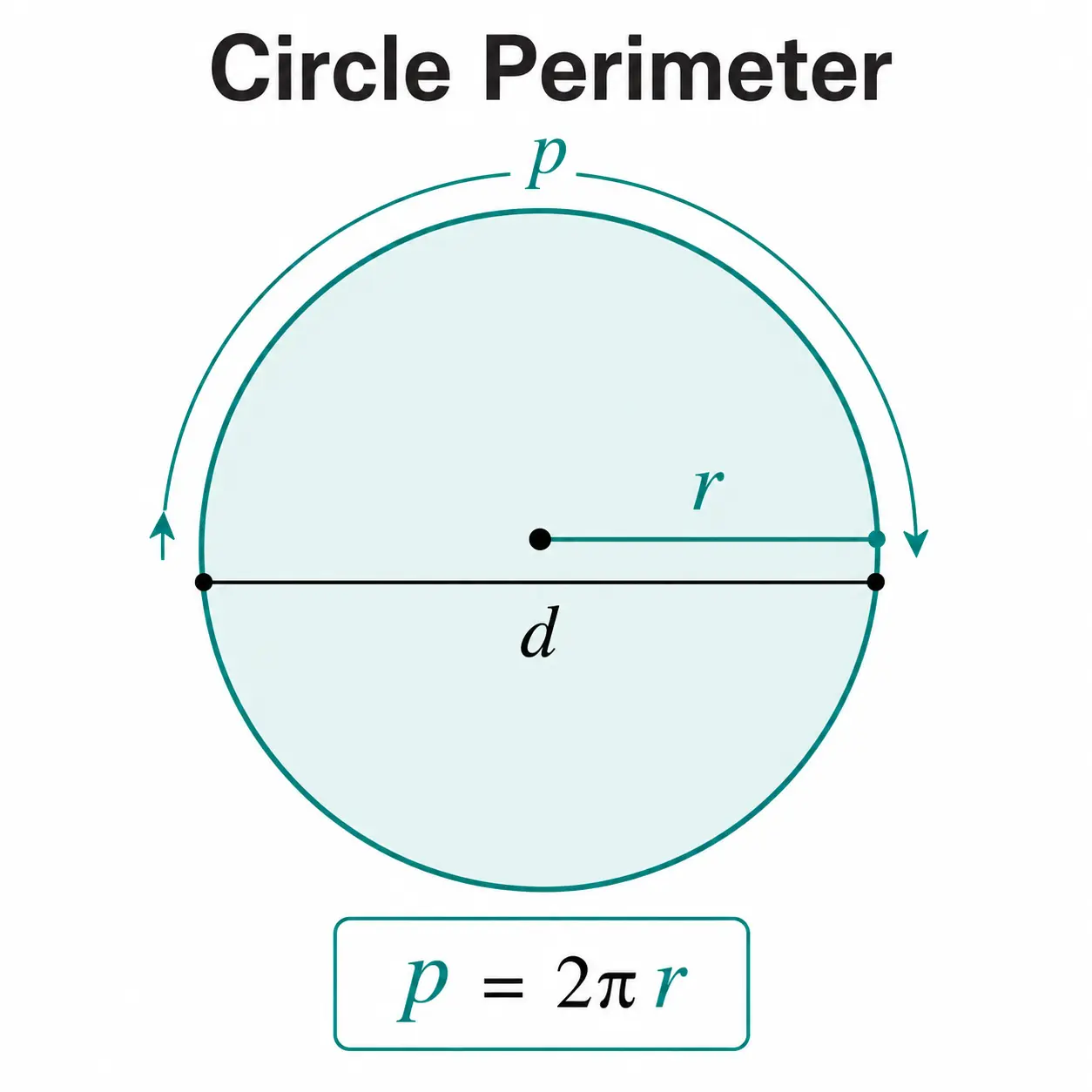
The perimeter of a circle is the length of its outer edge, the distance you would travel walking once around it. For any shape this is called the perimeter, but for a circle it has its own name, the circumference. The two words mean exactly the same thing here. The formula is p = 2 × π × r, where r is the radius and pi is about 3.14159.
A circle with a radius of 5 has a perimeter of 2 × π × 5, which is about 31.42. The calculator gives the exact figure once you type the radius. r d p = 2πr
What is the formula for the perimeter of a circle?
There are two forms of the same formula, depending on whether you have the radius or the diameter:
- Using the radius: p = 2 × π × r
- Using the diameter: p = π × d
They are identical, because the diameter is twice the radius. If you measured straight across the circle, use the diameter version. If you measured from the center to the edge, use the radius version. The calculator accepts either and handles the rest.
How do you find the circumference from the diameter?
Multiply the diameter by pi. That is the whole calculation: p = π × d. A circle with a diameter of 10 has a circumference of about 31.42. This is the oldest known way to find circumference, and it is where pi itself comes from. Pi is defined as the circumference divided by the diameter, the same ratio for every circle no matter its size.
How do you find the radius from the perimeter?
Work the formula backward. Divide the perimeter by 2π to get the radius. A circle with a perimeter of 31.42 has a radius of 31.42 divided by 6.283, which is 5. This is useful when you can wrap a tape measure around something round but cannot reach its center. Measure the distance around, divide by 2π, and you have the radius. The calculator does this when you enter the perimeter.
Worked example: perimeter from the area
Sometimes you know how much space a circle covers but not its size. Say a circular garden has an area of 78.54 square meters and you want to fence its edge. First find the radius: divide the area by pi, then take the square root. 78.54 divided by 3.14159 is 25, and the square root of 25 is 5. So the radius is 5 meters. Now the perimeter: 2 × π × 5 = 31.42 meters of fencing. The calculator does both steps at once, so you enter the area and read the perimeter straight off.
Circle perimeter for common radii
Quick reference using p = 2 × π × r. Find your radius, or use the calculator for exact values and reverse lookups.
| Radius (r) | Diameter (d) | Perimeter (2πr) | Area (πr²) |
|---|---|---|---|
| 1 | 2 | 6.28 | 3.14 |
| 2 | 4 | 12.57 | 12.57 |
| 3 | 6 | 18.85 | 28.27 |
| 5 | 10 | 31.42 | 78.54 |
| 7 | 14 | 43.98 | 153.94 |
| 10 | 20 | 62.83 | 314.16 |
| 15 | 30 | 94.25 | 706.86 |
What is the difference between perimeter and circumference?
Nothing, for a circle. Circumference is simply the specific name for the perimeter of a circle. Perimeter is the general word for the distance around any shape, a square, a triangle, or a circle. When that shape is a circle, mathematicians call the perimeter the circumference. So if a question asks for either one on a circle, the answer is the same number, found with p = 2 × π × r.
How is pi used to find circumference?
Pi is the heart of every circle measurement. It is the fixed ratio between a circle's circumference and its diameter, roughly 3.14159, and it never changes no matter how big or small the circle. Ancient mathematicians estimated it as 22 divided by 7, which is close enough for rough work at about 3.143. For anything precise, use the full value, which the calculator does automatically. That single constant is why any one measurement of a circle gives you all the others.
How does perimeter relate to arc length?
An arc is just a slice of the circle's edge, a portion of the full perimeter. If you know what fraction of the circle the arc covers, you multiply the perimeter by that fraction. A quarter circle has an arc length of one quarter of the full circumference. A half circle, a semicircle, has half. For any angle, the arc length is the perimeter times the angle divided by 360 degrees. So the circumference is the starting point for finding any arc length along the edge.
What units does circle perimeter use?
Plain length units, the same as the radius. A radius in centimeters gives a perimeter in centimeters. Feet give feet, meters give meters. Perimeter is a length, not an area, so it never uses square units. The area of the circle does use square units, and the calculator shows both so you can compare them side by side.
Real example: how far a wheel travels
This is circumference at work every day. A bicycle wheel with a diameter of 70 cm has a circumference of π × 70, about 220 cm, or 2.2 meters. That means every single rotation of the wheel moves the bike forward 2.2 meters. Spin it 100 times and you have traveled 220 meters. This is exactly how a car's odometer and a bike computer measure distance: they count wheel rotations and multiply by the circumference. Bigger wheels cover more ground per turn.
Perimeter compared to a square around the same circle
A neat comparison helps the numbers sink in. Take a circle with a radius of 5, giving a diameter of 10. A square drawn tightly around that circle, touching it on all four sides, has sides of 10 and a perimeter of 40. The circle's perimeter is only about 31.4, noticeably less than the square that boxes it in. This makes sense, since the circle cuts the corners off the square. For the same width across, a circle always has a shorter perimeter than the square around it, roughly 78.5 percent of it, the same pi-over-four ratio that governs their areas.
Where is circle perimeter used in real life?
Anything round and measured around the edge. Wheels and tires, where the circumference tells you how far one rotation travels. Running tracks, circular fences, and garden borders. Pipe wrapping and belt lengths in machinery. Sewing a hem around a round tablecloth. Even a wheel's circumference sets how a car's odometer counts distance. If you need the length around a circle, this is the number.
Frequently asked questions
What is the perimeter of a circle?
It is the distance around the edge, the measurement also known as the circumference: p = 2 × π × r.
Is circumference the same as perimeter?
Yes, for a circle. Circumference is the name for a circle's perimeter. Both mean the distance around the outside.
How do you find the perimeter of a circle without the radius?
Use the diameter instead, with p = π × d. Or if you know the area, the calculator finds the radius first and then the perimeter. Any single measurement is enough.
What is the perimeter of a circle with a diameter of 10?
About 31.42. Multiply the diameter by pi: 10 × 3.14159 = 31.42.
Why is pi in the circle formula?
Because pi is defined as circumference divided by diameter, so it is built into the formula.
Does a bigger circle have a proportionally bigger perimeter?
Yes. Perimeter grows in direct proportion to the radius. Double the radius and the perimeter doubles too, unlike the area, which quadruples.
What is the circumference of a circle with radius 10?
About 62.83. Multiply: 2 × π × 10 = 62.83. Double the radius of the earlier example and the circumference doubles too.
How do you measure the circumference of a round object?
Wrap a flexible tape measure around it, or roll it one full turn along a ruler and mark the distance. Both give the circumference directly, without any math. To find the radius from that, divide by 2π.
Can you find the area from the circumference?
Yes. Find the radius first by dividing the circumference by 2π, then use area equals pi times radius squared. The calculator shows the area alongside the perimeter automatically.
Is the perimeter of a circle a straight line?
No, it is a curve, the closed loop of the edge itself. But its length is measured as a straight distance, the total length if you unrolled that curve into a straight line.
Try these next
- Area of a Rectangle Calculator
- Hexagon Calculator
- Area of a Triangle Calculator
- Volume of a Sphere Calculator