

Triangle Area Calculator
Find the area of a triangle from base and height (A = ½ · b · h), three sides, two sides and the angle between them, or two angles and a side. Pick what you know below.
The area of a triangle is half its base times its height: A = ½ × b × h. A triangle with a 10 cm base and 6 cm height has an area of 30 cm². Half the base, times the height, done.
That formula needs the height, which you do not always have. This calculator solves four different setups. Base and height, three sides, two sides with the angle between them, or two angles with a side between them. Pick what you know, type the numbers, read the area in any unit from square millimeters to square yards.
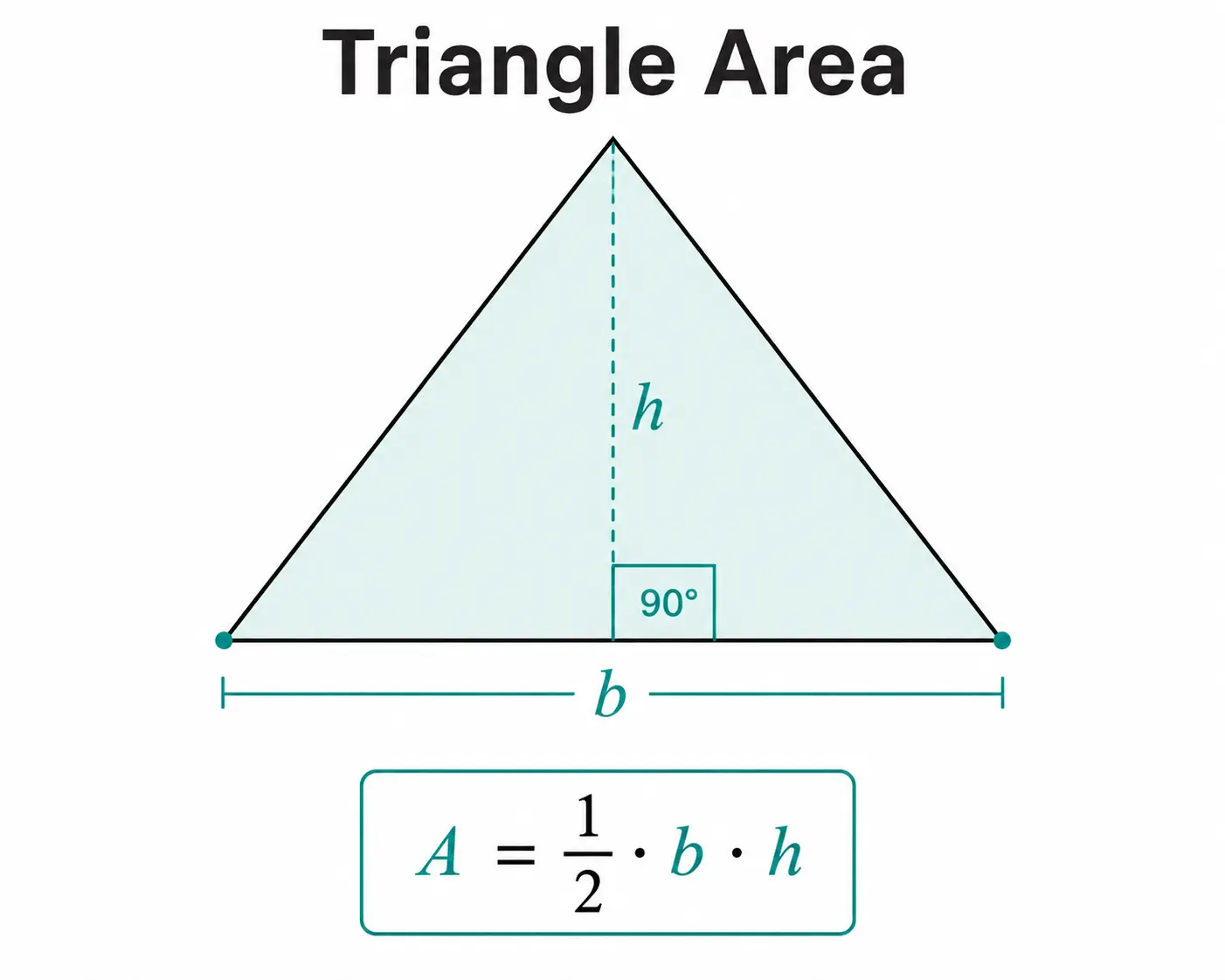
How do you find the area of a triangle?
The classic formula is A = ½ × b × h, half the base multiplied by the perpendicular height. The base is any one side. The height is the straight-line distance from that side up to the opposite corner, measured at a right angle, not along a slanted edge. For a triangle with base 8 m and height 5 m, the area is ½ × 8 × 5 = 20 m².
The height is easy to mix up with a side length. It is not the length of another side unless the triangle has a right angle there. It is the vertical drop from the top point down to the base line. b (base) h A = ½ b h
What is the triangle area formula?
There is more than one, because you do not always know the base and height. The four working formulas:
- Base and height: A = ½ × b × h
- Three sides (Heron's formula): A = √(s(s−a)(s−b)(s−c)), where s is half the perimeter
- Two sides and the angle between them: A = ½ × a × b × sin(C)
- Two angles and the side between them: A = a² × sin(B) × sin(C) ÷ (2 × sin(B + C))
The calculator picks the right one based on what you enter.
How do you find the area with three sides but no height?
Use Heron's formula. First add the three sides and halve the total to get s, called the semi-perimeter. Then multiply s by (s minus each side) and take the square root.
Take a triangle with sides 3, 4, and 5. The perimeter is 12, so s is 6. The area is √(6 × 3 × 2 × 1) = √36 = 6. No height needed. This is how surveyors and builders find area when all they can measure is the three edges. The same three sides also form a right angle, which you can confirm with the Pythagorean theorem.
How do you find area from two sides and an angle?
When you know two sides and the angle wedged between them, the formula is A = ½ × a × b × sin(C). The angle must be the one between the two sides you entered, not one of the other corners.
Two sides of 6 and 8 with a 90 degree angle between them give ½ × 6 × 8 × sin(90) = ½ × 48 × 1 = 24. Because the sine of 90 degrees is 1, a right angle here reduces the formula straight back to half base times height.
Worked example: area from two angles and a side
This is the setup students hit in trigonometry and it looks harder than it is. You know two angles and the side sitting between them. Say the side is 5 cm and the two angles touching it are 45 degrees each. The formula is A = a² × sin(B) × sin(C) ÷ (2 × sin(B + C)). Plug in: 5² × sin(45) × sin(45) ÷ (2 × sin(90)). That is 25 × 0.7071 × 0.7071 ÷ 2, which works out to 6.25 cm². The calculator runs this once you pick the two-angles mode and enter the values.
Does the triangle type change the formula?
No. The same formulas work for every triangle, right, acute, obtuse, isosceles, scalene, or equilateral. A triangle is a triangle. What changes is which measurements are easiest to get. A right triangle hands you the base and height for free, since the two legs meet at 90 degrees. An equilateral triangle lets you shortcut with A = (√3 ÷ 4) × side², but Heron's formula gives the same answer if you plug in three equal sides.
Is area the same as perimeter?
No, and the two are easy to confuse. Area is the space inside the triangle, measured in square units. Perimeter is the distance around the outside, the three sides added together, measured in plain units. A triangle with sides 3, 4, and 5 has a perimeter of 12 units but an area of 6 square units. Different questions, different answers. If you need the fencing around a triangular plot, that is perimeter. If you need the grass inside it, that is area.
How do you find the height of a triangle?
Rearrange the area formula. If you know the area and the base, height equals twice the area divided by the base: h = 2A ÷ b. A triangle with area 20 and base 8 has a height of 40 ÷ 8 = 5. For an obtuse triangle, the height can fall outside the triangle itself, dropping from the top vertex to an extended base line. The math still holds, the perpendicular distance is what counts, even when it lands past the corner.
Triangle area for common bases and heights
Quick reference using A = ½ × b × h. Read straight from your base and height, or use the calculator for exact and non-whole values.
| Base (b) | Height (h) | Area (½ × b × h) |
|---|---|---|
| 4 | 3 | 6 |
| 5 | 4 | 10 |
| 6 | 4 | 12 |
| 8 | 5 | 20 |
| 10 | 6 | 30 |
| 10 | 8 | 40 |
| 12 | 9 | 54 |
| 14 | 10 | 70 |
| 20 | 15 | 150 |
What units does triangle area use?
Square units, always. Multiply a base in centimeters by a height in centimeters and the area comes out in square centimeters. Feet give square feet, meters give square meters. Keep the base and height in the same unit before you multiply, or the answer will be wrong. The calculator converts units for you, so you can mix and match and still get a clean result.
Where is triangle area used in real life?
Roofs, gables, and triangular walls in construction. Plots of land that are not neat rectangles get split into triangles and added up. Sail makers size fabric by triangle area. Truss designs, ramps, garden beds, and flag shapes all lean on it. Any time a shape has three straight sides, this is the tool that measures the space inside. For four-sided plots, switch to the rectangle area calculator instead.
Land surveyors especially rely on Heron's formula, since they can measure three boundary lengths on the ground without ever finding a perpendicular height.
Frequently asked questions
What is the area of a triangle?
It is the space inside the three sides. Multiply the base by the perpendicular height and halve it: A = ½ × b × h. A triangle with base 10 and height 6 has an area of 30 square units.
Why is there a half in the triangle area formula?
Because a triangle is exactly half of a rectangle or parallelogram with the same base and height. Draw a rectangle, cut it corner to corner, and you get two equal triangles. Each one is half the rectangle's area.
How do I find area without the height?
Use Heron's formula if you know all three sides, or the two-sides-and-angle formula if you know two sides and the angle between them.
What is the area of a right triangle?
Half the product of its two legs, the sides that meet at the right angle. Those legs act as base and height. A right triangle with legs 3 and 4 has an area of ½ × 3 × 4 = 6.
Does area change if the triangle is tilted or flipped?
No. Rotating or flipping a triangle does not change its size, so the area stays the same. Only the base and height values matter, not the orientation.
Can any three side lengths form a triangle?
No. Each side must be shorter than the sum of the other two. Sides of 1, 2, and 10 cannot close into a triangle, so they have no area. The calculator flags this automatically.
How do you find the area of an equilateral triangle?
Use A = (√3 ÷ 4) × side². A side of 6 gives an area of about 15.59 square units. A side of 6 gives an area of about 15.59 square units.
What is the area of a triangle with all three angles but no sides?
It cannot be found. Three angles fix the shape but not the size. A tiny triangle and a huge one can share the exact same angles. You always need at least one length, a side or a height, to lock in the actual area.
Try these next
- Area of a Square Calculator
- Area of a Trapezoid Calculator
- Hexagon Calculator
- Perimeter of a Circle Calculator