

Area Of A Trapezoid Calculator
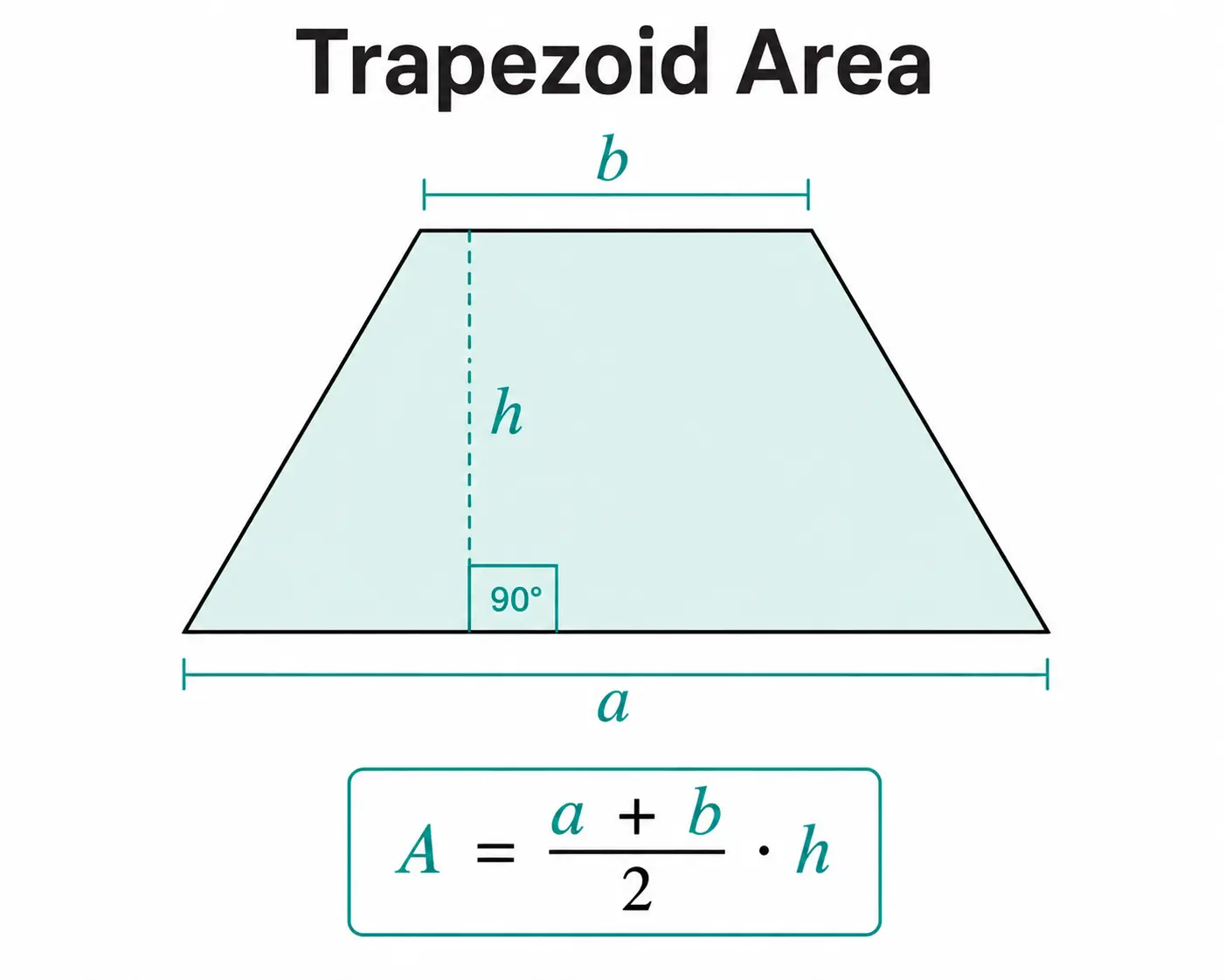
Find the area of a trapezoid using A = ((a + b) / 2) · h, where a and b are the parallel sides and h is the height. Add the two legs to also get the perimeter and angles.
The area of a trapezoid is the average of its two parallel sides times the height: A = ((a + b) / 2) × h. A trapezoid with parallel sides of 8 and 4 and a height of 5 has an area of 30 square units. Enter your two bases and the height above to get the area.
Add the two slanted legs and it also gives the perimeter and all four corner angles. Work in any unit from millimeters to yards, read the area in the square unit you want, and copy the result.
How do you find the area of a trapezoid?
Add the two parallel sides, divide by two, then multiply by the height. In symbols, A = ((a + b) / 2) × h. The two parallel sides are called the bases, labeled a and b. The height is the straight perpendicular distance between them, not the length of the slanted legs.
Take a trapezoid with bases of 10 and 6 and a height of 4. Add the bases: 10 + 6 = 16. Halve it: 8. Times the height: 8 × 4 = 32 square units. The calculator runs all three steps as you type. b a h c d
What is the trapezoid area formula?
The formula is A = ((a + b) / 2) × h. The clever part is the average. Because a trapezoid has one wide base and one narrow base, you take the average of the two, which gives the width of an equivalent rectangle. Multiply that average width by the height and you get the same area. This is why the formula works for any trapezoid, no matter how lopsided.
Another way to see it: the average line halfway up, called the midsegment, has a length exactly equal to (a + b) / 2. The area is that midsegment times the height.
Why do you average the two bases?
A trapezoid is like a rectangle with a slanted top. If both bases were equal, it would be a rectangle and the area would be base times height. Since the bases differ, you split the difference by averaging them. The average, (a + b) / 2, is the width the shape would have if you evened out the slant into a straight rectangle of the same height and area. It is a neat trick that turns an awkward shape into a simple one.
How do you find the height of a trapezoid?
Rearrange the area formula. If you know the area and both bases, the height equals twice the area divided by the sum of the bases: h = 2A / (a + b). A trapezoid with an area of 30 and bases of 8 and 4 has a height of 60 / 12 = 5. If instead you know the slanted legs, the height comes from a right triangle formed by the leg and the horizontal offset, the same idea as the Pythagorean theorem. The calculator finds the height from the legs automatically when you enter them.
Worked example: area, perimeter, and angles together
Take an isosceles trapezoid with a long base of 10, a short base of 4, and both slanted legs measuring 5. Start with area. Average the bases: (10 + 4) / 2 = 7. You need the height, which comes from the legs. The horizontal offset on each side is (10 - 4) / 2 = 3, so the height is the square root of (5² - 3²) = √(25 - 9) = √16 = 4. Now the area: 7 × 4 = 28 square units. The perimeter is all four sides: 10 + 4 + 5 + 5 = 24. The base angles work out to about 53.13 degrees at the bottom and 126.87 degrees at the top. The calculator gives every one of these when you enter the bases, height, and legs.
What is the midsegment of a trapezoid?
The midsegment is the line that runs across the middle, parallel to both bases, connecting the midpoints of the two legs. Its length is exactly the average of the two bases, (a + b) / 2. This is the same average that sits inside the area formula, which is no coincidence. The area equals the midsegment times the height. So if you ever know the midsegment directly, you can skip the averaging step and multiply straight by the height.
Trapezoid area for common sizes
Quick reference using A = ((a + b) / 2) × h. Find your two bases and height, or use the calculator for exact values.
| Base a | Base b | Height h | Area |
|---|---|---|---|
| 6 | 4 | 3 | 15 |
| 8 | 4 | 5 | 30 |
| 10 | 6 | 4 | 32 |
| 12 | 5 | 6 | 51 |
| 12 | 8 | 7 | 70 |
| 15 | 9 | 8 | 96 |
| 20 | 10 | 10 | 150 |
What units does trapezoid area use?
Square units, matching your measurements. Bases and height in centimeters give square centimeters, feet give square feet. Keep all three measurements in the same unit before you calculate, or use the unit menus to convert. Remember that area units square the length, so one square foot is 144 square inches, not 12.
How do you find the perimeter of a trapezoid?
Add all four sides: the two bases and the two legs. P = a + b + c + d. Unlike the area, the perimeter needs the slanted legs, since they are part of the outer edge. A trapezoid with bases 10 and 4 and both legs 5 has a perimeter of 10 + 4 + 5 + 5 = 24. Open the legs section in the calculator and it gives the perimeter along with the corner angles.
What are the types of trapezoids?
Three main kinds show up. An isosceles trapezoid has two equal legs and a line of symmetry, so its base angles match in pairs, like the classic lampshade shape. A right trapezoid has one leg perpendicular to the bases, giving it two right angles, common in cross-sections of ramps and canals. A scalene trapezoid has all four sides different, with no symmetry at all. The area formula is identical for all three, only the legs and angles differ.
Trapezoid or trapezium: what is the difference?
This trips people up because the words swap meaning across the ocean. In American English, a trapezoid is the four-sided shape with one pair of parallel sides, which is what this calculator solves. In British English, that same shape is called a trapezium, and the word trapezoid means a quadrilateral with no parallel sides. So if you searched trapezium and landed here, you are in the right place as long as you mean the shape with one parallel pair. The math is the same whatever you call it.
Where is trapezoid area used in real life?
Land plots are the big one, since real parcels are rarely neat rectangles and often have one slanted boundary. It sizes trapezoidal fields, roofs, retaining walls, and bridge supports. Sheet metal and woodworking parts are often trapezoids. Handbags, lampshades, and cross-sections of canals and ditches all use it. Any four-sided shape with exactly one pair of parallel sides is a trapezoid, and this is how you measure the space inside. For shapes with three sides instead, use the triangle area calculator.
Frequently asked questions
What is the area of a trapezoid?
It is the average of the two parallel sides times the height: A = ((a + b) / 2) × h.
What are the parallel sides of a trapezoid called?
The bases. A trapezoid has two bases, a longer one and a shorter one, which are the two sides that run parallel. The other two sides are the legs.
Do I use the slanted side or the height for area?
The height. Measure straight across between the two bases at a right angle, not along a leg.
What is the difference between a trapezoid and a parallelogram?
A trapezoid has exactly one pair of parallel sides. A parallelogram has two pairs. If both pairs of opposite sides are parallel, it is a parallelogram, not a trapezoid.
Can a trapezoid have a right angle?
Yes. In a right trapezoid the perpendicular leg doubles as the height, so you can use it straight in the formula.
How do you find the missing base of a trapezoid?
Rearrange the formula. If you know the area, height, and one base, the other base is (2A / h) minus the known base. The calculator handles this if you work backward from the area.
How do you find the area of a trapezoid with only the sides?
You cannot from the four sides alone, because a trapezoid can flex and change height while keeping the same sides. You need the height, or the legs plus the two bases so the height can be worked out. The calculator derives the height when you supply both legs.
What is the area of a trapezoid with bases 12 and 5 and height 6?
51 square units. Average the bases: (12 + 5) / 2 = 8.5. Times the height: 8.5 × 6 = 51.
Are all four angles of a trapezoid equal?
No. Only a rectangle has all four angles equal at 90 degrees, and a rectangle is a special parallelogram, not a general trapezoid. In a trapezoid, the two angles along each leg add up to 180 degrees.
Try these next
- Area of a Square Calculator
- Hexagon Calculator
- Equilateral Triangle Calculator
- Perimeter of a Circle Calculator