

Square Area Calculator
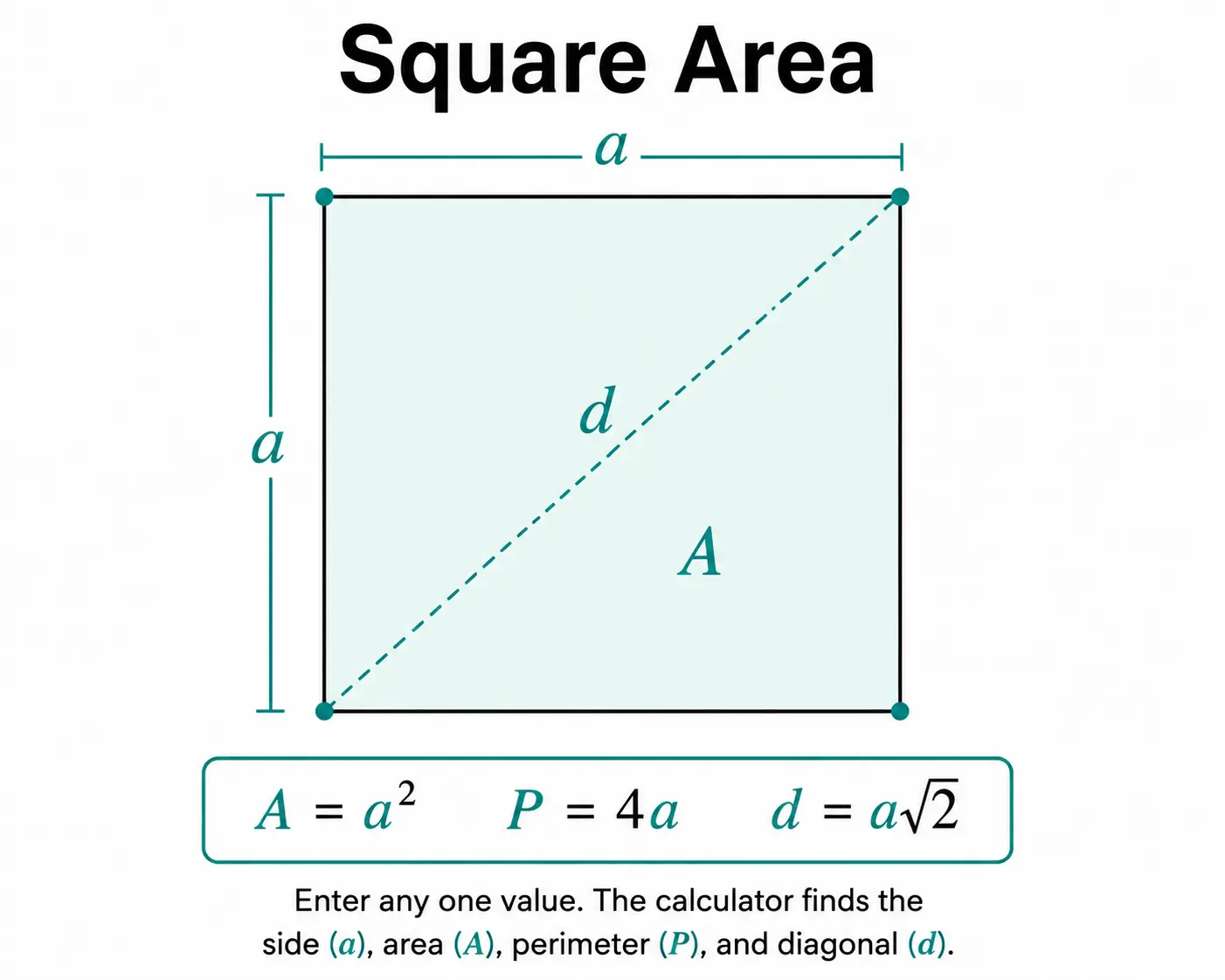
Enter any one value. A = a², P = 4a, d = a√2. The calculator finds the side, area, perimeter, and diagonal for you.
The area of a square is its side multiplied by itself: A = a². A square with 5 cm sides has an area of 25 cm². That is all it takes, one measurement.
Enter any single value, the side, the diagonal, the perimeter, or the area, and it fills in the other three at once. Work in any unit from millimeters to yards, and copy the result. No second measurement needed, because every part of a square is locked to its side length.
How do you find the area of a square?
Multiply the side by itself. A square with side a has an area of A = a², said as "a squared." Because all four sides of a square are equal, you only ever need one of them. A side of 8 m gives an area of 8 × 8 = 64 m². A side of 12 cm gives 144 cm². The answer always comes out in square units.
This is why a square is the simplest shape to measure. A rectangle needs length and width, but a square needs just the one side. a a d A = a²
What is the square area formula?
The core formula is A = a², where a is the side length. From that single side, three more values follow:
- Area: A = a²
- Perimeter: P = 4a
- Diagonal: d = a√2
Every one of these depends only on the side. Know the side and you know them all. Know any one of them and you can work backward to the side, which is exactly what the calculator does when you enter the diagonal, perimeter, or area instead.
How do you find the area from the perimeter?
Divide the perimeter by four to get the side, then square it. Since a square has four equal sides, the perimeter is always 4a, so the side is P ÷ 4. A square with a perimeter of 20 cm has a side of 5 cm and an area of 25 cm². The calculator makes this jump for you, but the two-step logic is worth knowing: perimeter to side, then side to area.
How do you find the area from the diagonal?
The diagonal of a square is the side times the square root of two, so d = a√2. To go the other way, divide the diagonal by √2 to get the side, then square it. There is also a shortcut straight to area: A = d² ÷ 2. A square with a diagonal of 10 cm has an area of 100 ÷ 2 = 50 cm². This is handy when you can only measure corner to corner.
Why is the diagonal area shortcut A = d² ÷ 2 true?
It comes straight from the diagonal formula. The diagonal is d = a√2, so squaring both sides gives d² = 2a². Since the area is a², that means a² = d² ÷ 2, which is the area. In plain terms, the diagonal of a square cuts it into two right triangles, and the relationship between the side and the diagonal always carries that factor of two. It is the same right-triangle math as the Pythagorean theorem, applied to a shape where both legs are equal.
Square area for common sizes
Quick reference using A = a². Find your side length to read area, perimeter, and diagonal, or use the calculator for any value.
| Side (a) | Area (a²) | Perimeter (4a) | Diagonal (a√2) |
|---|---|---|---|
| 2 | 4 | 8 | 2.83 |
| 4 | 16 | 16 | 5.66 |
| 5 | 25 | 20 | 7.07 |
| 6 | 36 | 24 | 8.49 |
| 8 | 64 | 32 | 11.31 |
| 10 | 100 | 40 | 14.14 |
| 12 | 144 | 48 | 16.97 |
| 15 | 225 | 60 | 21.21 |
| 20 | 400 | 80 | 28.28 |
Worked example: tiling a square floor
Real square-area math usually means tiles or flooring. Say you are tiling a square room that measures 12 feet on each side. The area is 12 × 12 = 144 square feet. Now the tiles: if each tile is 1 foot by 1 foot, you need 144 of them, plus about ten percent extra for cuts and breakage, so roughly 159 tiles to buy. If the tiles are smaller, say 6 inches square, each covers a quarter of a square foot, so you need four times as many, around 576 tiles before the waste margin. The area is the starting point for every flooring order.
What units does square area use?
Square units, matching the side. A side in centimeters gives area in square centimeters, a side in feet gives square feet. One thing to watch: converting area units is not the same as converting length. One foot is 12 inches, but one square foot is 144 square inches, because you square the conversion. The calculator handles this, so you can switch between square units without the mistake.
How do you find the side of a square from its area?
Take the square root of the area. Since area is side squared, reversing it means undoing the square. A square with an area of 64 has a side of √64 = 8. An area of 200 gives a side of √200, about 14.14. This is the one square calculation that does not give a clean whole number for most areas. Enter the area and it returns the side, diagonal, and perimeter.
Is a square just a special rectangle?
Yes. A square is a rectangle where all four sides happen to be equal. Every rule for a rectangle still applies, the area is length times width, but since length equals width, it simplifies to side squared. A square is also a special rhombus and a special parallelogram. It sits at the intersection of all of them, which is why its formulas are the shortest.
Square area compared to a circle
People often compare a square and a circle that share a measurement. A square with side a has area a². A circle that fits exactly inside that square, touching all four sides, has a diameter equal to a and an area of about 0.785 × a². So the inscribed circle fills just under 79 percent of the square, and the four corners are the leftover space. This shows up in packaging, cutting round shapes from square sheets, and pipe-in-duct fitting.
Where is square area used in real life?
Floor tiles, which are usually square, so you count them by area. Square rooms, garden plots, chessboards, window panes, and ceramic tiles all use it. Land is often sold in square units. Anytime you tile a surface or lay out a grid, square area tells you how much you need. A room that is 12 feet by 12 feet covers 144 square feet, which is the number you take to the flooring store.
Frequently asked questions
What is the area of a square?
Multiply one side by itself: A = a². A 6 cm square works out to 36 cm².
How do you find the area of a square with just the diagonal?
Use A = d² ÷ 2. A diagonal of 8 gives 64 ÷ 2 = 32 square units, with no need to find the side first.
What is the perimeter of a square?
P = 4a. A 5 cm side gives a 20 cm perimeter, measured around the outside edge.
Is area the same as perimeter?
No. Area is the space inside, in square units. Perimeter is the distance around the edge, in plain units. A square of side 5 has an area of 25 but a perimeter of 20.
What is the side of a square if the area is 100?
The square root of the area, so 10, because 10 × 10 = 100.
Does a square have the largest area for its perimeter?
Among all rectangles with the same perimeter, yes. The square encloses the most area, which is why it is the most efficient rectangle shape.
How many square feet is a 10x10 room?
100 square feet. A room described as 10 by 10 is a square with 10-foot sides, so the area is 10 × 10 = 100.
What is the area of a square with a 4 cm side?
16 square centimeters. Square the side: 4 × 4 = 16.
Can two squares have the same area but different perimeters?
No. For squares, area fixes the side, and the side fixes the perimeter. Two squares with equal areas are identical in every measurement. This differs from rectangles, where many shapes can share an area.
How is square area different from a cube?
Area is flat, a cube is three-dimensional. A square has area a². A cube built from that square has volume a³ and a surface area of six squares, 6a². The square is one face of the cube.
Try these next
- Area of a Triangle Calculator
- Hexagon Calculator
- Equilateral Triangle Calculator
- Area of a Trapezoid Calculator