

Hexagon Calculator
Enter any one value for a regular hexagon. A single measurement fixes the rest: A = (3√3 / 2) · a², P = 6a, long diagonal d = 2a, short diagonal s = a√3.
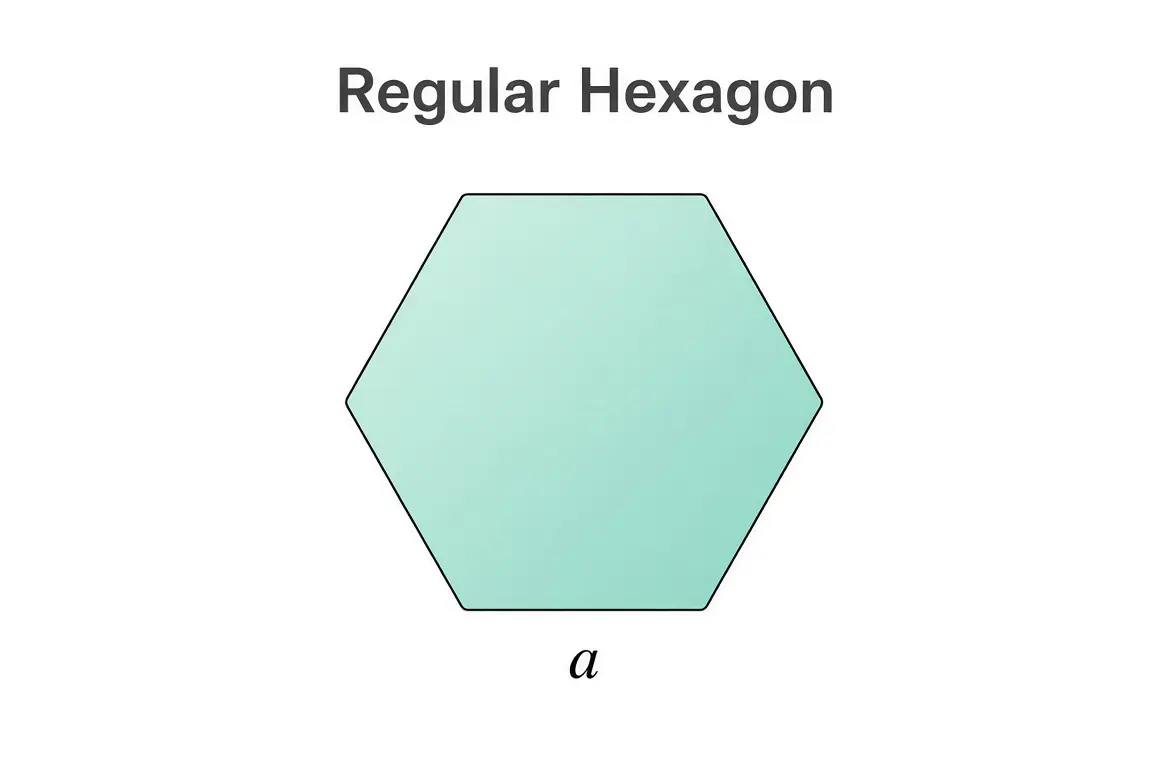
The area of a regular hexagon is A = (3√3 / 2) × a², where a is the side length. Because all six sides are equal, one measurement fixes everything. A hexagon with 6 cm sides has an area of about 93.53 cm². Enter any single value above, the side, area, perimeter, a diagonal, or a radius, and the rest are solved for you.
This calculator gives seven properties of a regular hexagon from one input. Area, perimeter, both diagonals, the circumcircle radius, and the apothem. Work in any unit from millimeters to yards, and copy the result out when you are done.
How do you find the area of a hexagon?
For a regular hexagon, square the side and multiply by three times the square root of three, divided by two. The formula is A = (3√3 / 2) × a². The constant 3√3 / 2 works out to about 2.598, so a fast estimate is 2.598 times the side squared.
Take a side of 6. Square it: 36. Multiply by 2.598: about 93.53 square units. The reason this works is simple. A regular hexagon splits neatly into six identical equilateral triangles, so its area is just six times the area of one of those triangles. R r d a
What is the hexagon area formula?
The formula is A = (3√3 / 2) × a². It comes directly from the six-triangle split. Each equilateral triangle has an area of (√3 / 4) × a², and six of them give 6 × (√3 / 4) × a², which simplifies to (3√3 / 2) × a². This only applies to a regular hexagon, one where all six sides and all six angles are equal. Irregular hexagons need to be broken into parts and added up separately.
Why does a hexagon split into six triangles?
Draw a line from the center to each of the six corners and the hexagon divides into six identical triangles. In a regular hexagon these are not just any triangles, they are equilateral, with every side equal to the hexagon's side length. This is a special property of the six-sided shape, and it is why the hexagon's circumradius equals its side. That single fact makes the hexagon the easiest regular polygon to work with after the square.
What is the apothem of a hexagon?
The apothem is the distance from the center to the middle of any side, meeting it at a right angle. It is the radius of the largest circle that fits inside. For a regular hexagon, the apothem is (√3 / 2) × a, about 0.866 times the side. It also equals half the short diagonal. The apothem matters because area can also be written as half the perimeter times the apothem, a formula that works for any regular polygon.
Worked example: finding the side from the area
Say a hexagonal tile covers 259.8 square centimeters and you need its side length. Work the formula backward. Multiply the area by two: 259.8 × 2 = 519.6. Divide by three times the square root of three: 519.6 ÷ 5.196 = 100. Take the square root: √100 = 10. So the side is 10 cm. Every other measurement follows: a perimeter of 60, a long diagonal of 20, and an apothem of about 8.66. The calculator runs the entire chain the moment you type the area, so you never touch the square root of three by hand.
Hexagon values for common sides
Quick reference from the side length. Find your side to read the area, perimeter, and apothem, or use the calculator for any value.
| Side (a) | Area | Perimeter | Apothem | Long diagonal |
|---|---|---|---|---|
| 2 | 10.39 | 12 | 1.73 | 4 |
| 4 | 41.57 | 24 | 3.46 | 8 |
| 6 | 93.53 | 36 | 5.20 | 12 |
| 8 | 166.28 | 48 | 6.93 | 16 |
| 10 | 259.81 | 60 | 8.66 | 20 |
| 12 | 374.12 | 72 | 10.39 | 24 |
What are the two diagonals of a hexagon?
A regular hexagon has two different diagonal lengths. The long diagonal runs corner to opposite corner, straight through the center, and equals 2a, twice the side. The short diagonal connects corners that skip one vertex, and equals a√3, about 1.732 times the side. There are three long diagonals and six short ones. The long diagonal is also the diameter of the circumcircle, which is why the circumradius equals the side.
Why do bees build hexagonal honeycomb?
Bees solve an optimization problem without knowing it. Of all the shapes that tile a flat surface with no gaps, only three work on their own: triangles, squares, and hexagons. Among those three, the hexagon encloses the most area for the least perimeter, which means bees use the least wax to store the most honey. A circle would be even more efficient per cell, but circles leave gaps between them. The hexagon is the closest gap-free shape to a circle, so it wins. This is called the honeycomb conjecture, and it was proven mathematically in 1999.
Which shapes can tile a plane like a hexagon?
Only three regular polygons tile a flat surface by themselves with no gaps or overlaps: the equilateral triangle, the square, and the regular hexagon. Pentagons leave gaps, and shapes with seven or more sides overlap. Of the three, the hexagon covers the most area per unit of edge, which is why you see it in floor tiles, paving, and nature. Three hexagons meet perfectly at every corner, each contributing its 120 degree angle to a full 360.
What units does hexagon area use?
Square units for the area, plain length units for the side, perimeter, diagonals, and radii. A side in centimeters gives an area in square centimeters. Keep your input in one unit, or switch with the built-in menus, which convert every result to match.
Real example: sizing a hex nut or bolt head
Hex nuts and bolt heads are measured across the flats, which is the short diagonal of the hexagon, the same as twice the apothem. A nut described as 19 millimeters across the flats has a short diagonal of 19, so its side is 19 divided by the square root of three, about 10.97 mm. From there its area and the wrench size it needs follow directly. Machinists and mechanics rely on this across-flats measurement constantly, since it is what a wrench actually grips.
Where are hexagons used in real life?
Nature and engineering both love the hexagon because it tiles a flat surface with no gaps and the least material. Honeycomb is the classic example, where bees build hexagonal cells to store the most honey using the least wax. Beyond that, hexagons appear in bolt heads and nuts, floor and bathroom tiles, chicken wire, carbon and graphene structures, board game grids, and pencil shapes. No other regular polygon that tiles a flat surface encloses this much area per unit of edge.
Frequently asked questions
What is the area of a hexagon?
For a regular hexagon it is (3√3 / 2) times the side squared. For a regular hexagon it is (3√3 / 2) times the side squared. Enter your side above to get the number.
How many sides does a hexagon have?
Six. The prefix hexa means six, so a hexagon is a six-sided polygon with six corners and six angles.
What is the area formula for a regular hexagon?
A = (3√3 / 2) × a², where a is the side length. It equals six times the area of the equilateral triangles the hexagon splits into.
What is the interior angle of a regular hexagon?
120 degrees. The six interior angles add up to 720 degrees, so each one in a regular hexagon is 720 divided by 6, which is 120.
Is the circumradius of a hexagon equal to its side?
Yes. This is a unique property of the regular hexagon. The distance from the center to any corner is exactly the side length.
How do you find the side of a hexagon from its area?
Rearrange the area formula: the side is the square root of two times the area divided by three times the square root of three. The calculator does this when you enter the area.
What is the perimeter of a hexagon?
Six times the side, since all six sides are equal. A hexagon with a side of 8 has a perimeter of 48.
What is the difference between the long and short diagonal?
The long diagonal goes corner to opposite corner through the center and equals twice the side. The short diagonal skips one corner and equals the side times the square root of three. The long one is always larger.
Are all hexagons regular?
No. A regular hexagon has six equal sides and angles, but an irregular hexagon can have sides and angles of any size, as long as it has six of each. These formulas apply only to regular hexagons.
How do you find the area from the apothem?
Use area equals half the perimeter times the apothem. Or find the side first, since the side is the apothem times two divided by the square root of three, then use the main formula. The calculator handles either path.
What is the area of a hexagon with a side of 10?
About 259.81 square units. Multiply 2.598 by the side squared: 2.598 × 100 = 259.81.
Try these next
- Area of a Rectangle Calculator
- Area of a Triangle Calculator
- Area of a Trapezoid Calculator
- Perimeter of a Circle Calculator