

Equilateral Triangle Calculator
Enter any one value. In an equilateral triangle all sides are equal, so a single measurement fixes the rest: A = (√3 / 4) · a², h = (√3 / 2) · a, P = 3a.
The area of an equilateral triangle is A = (√3 / 4) × a², where a is the side length. Every side is equal, so one measurement fixes everything. A triangle with 6 cm sides has an area of about 15.59 cm². Enter any single value above, the side, height, area, perimeter, or either radius, and the rest are solved for you.
This calculator gives six properties from one input. Beyond area, it finds the height, perimeter, and both the circumscribed and inscribed circle radii. Work in any unit from millimeters to yards, and copy the result out when you are done.
What is an equilateral triangle?
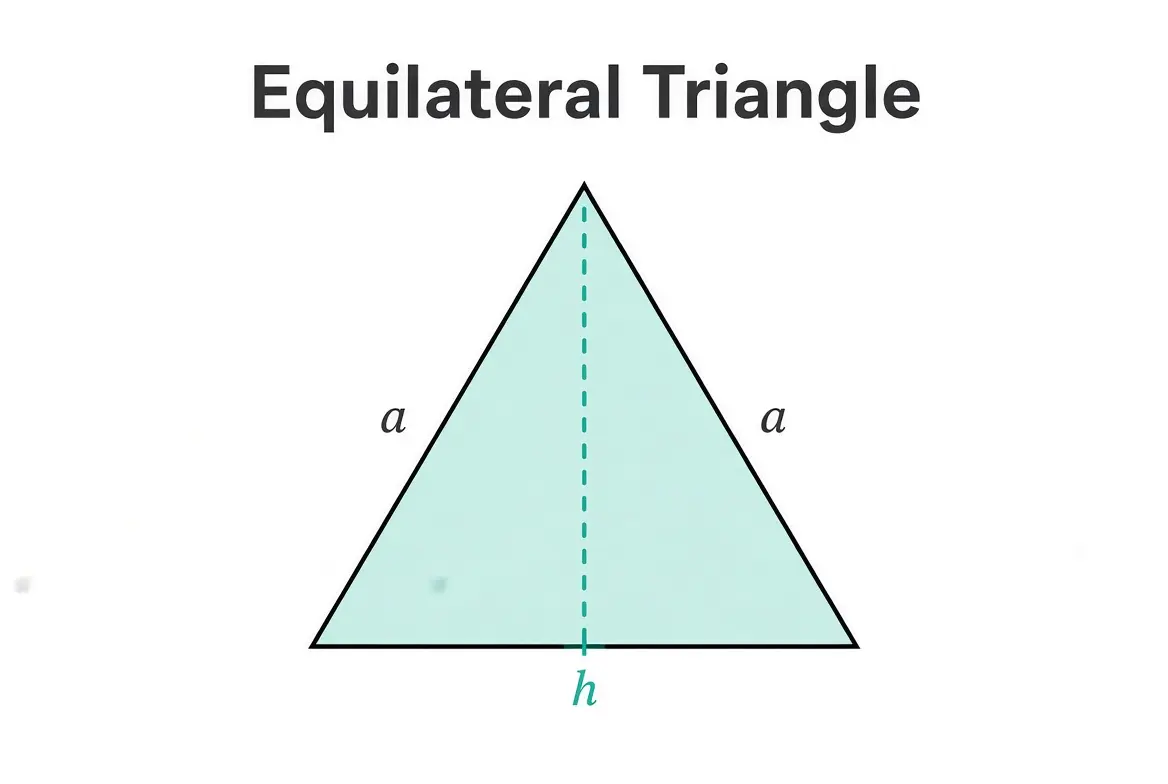
An equilateral triangle is a triangle with all three sides the same length and all three angles equal to 60 degrees. The word means equal-sided. Because everything is symmetric, a single side length determines every other measurement: the height, the area, the perimeter, and the radii of the circles that fit inside and around it. No other triangle is this predictable from one number. h a a a 60° 60° 60°
How do you find the area of an equilateral triangle?
Square the side, then multiply by the square root of three divided by four. The formula is A = (√3 / 4) × a². The √3 / 4 works out to about 0.4330, so a quick estimate is 0.433 times the side squared.
Take a side of 6. Square it: 36. Multiply by 0.4330: about 15.59 square units. You could also use the general triangle area rule, half the base times the height, and get the same answer, since the height of an equilateral triangle is a fixed fraction of its side.
What is the equilateral triangle area formula?
The formula is A = (√3 / 4) × a². It comes straight from the standard triangle area of half base times height. In an equilateral triangle the height is (√3 / 2) × a, so plugging that in gives half times a times (√3 / 2) × a, which simplifies to (√3 / 4) × a². The square root of three appears because the height splits the triangle into two 30-60-90 right triangles, and √3 is the ratio built into that shape.
How do you find the height of an equilateral triangle?
The height is (√3 / 2) × a, about 0.866 times the side. Drop a straight line from the top vertex to the middle of the base and it splits the triangle into two equal right triangles. That line is the height. For a side of 10, the height is about 8.66. This is the same right-triangle relationship described by the Pythagorean theorem, since the height, half the base, and the full side form a right triangle.
Worked example: finding the side from the area
Say you know an equilateral triangle covers 43.3 square centimeters and you want its side. Work the area formula backward. Multiply the area by four: 43.3 × 4 = 173.2. Divide by the square root of three: 173.2 ÷ 1.732 = 100. Take the square root: √100 = 10. So the side is 10 cm. From there every other value follows, a height of about 8.66, a perimeter of 30, and a circumradius near 5.77. The calculator runs the whole chain the instant you type the area.
Equilateral triangle values for common sides
Quick reference from the side length. Find your side to read the height, area, and perimeter, or use the calculator for any value.
| Side (a) | Height (h) | Area | Perimeter |
|---|---|---|---|
| 2 | 1.73 | 1.73 | 6 |
| 4 | 3.46 | 6.93 | 12 |
| 6 | 5.20 | 15.59 | 18 |
| 8 | 6.93 | 27.71 | 24 |
| 10 | 8.66 | 43.30 | 30 |
| 12 | 10.39 | 62.35 | 36 |
| 15 | 12.99 | 97.43 | 45 |
What are the circumradius and inradius?
Two circles pair naturally with an equilateral triangle. The circumcircle passes through all three corners, and its radius is R = a / √3, about 0.577 times the side. The incircle sits snugly inside, touching all three sides, with radius r = a / (2√3), about 0.289 times the side. A neat fact: the circumradius is always exactly twice the inradius, R = 2r, a relationship unique to the equilateral triangle among all triangles. The calculator gives both from any input.
How does the 30-60-90 triangle connect to it?
Cut an equilateral triangle straight down the middle and you get two identical 30-60-90 right triangles. This is the source of every formula on this page. The half-base, the height, and the full side form that right triangle, with sides in the ratio 1 to √3 to 2. The √3 that appears in the area and height formulas comes directly from this ratio. It is why an equilateral triangle and the 30-60-90 triangle are really two views of the same shape.
Why is the equilateral triangle the strongest shape?
Engineers reach for the triangle because, unlike a square, it cannot deform without one of its sides changing length. Push on a square frame and it collapses into a diamond, but a triangle holds its shape. Because all three sides and angles match, a load spreads evenly instead of concentrating on one member. That is why you see it in bridge trusses, roof supports, cranes, and bicycle frames. Equal sides mean no single member takes more stress than another.
What units does equilateral triangle area use?
Square units for the area, plain units for the side, height, perimeter, and radii. A side in centimeters gives an area in square centimeters and a height in centimeters. Keep your input in one unit, or switch units with the built-in menus, which convert every result to match.
Real example: sizing a yield sign
Traffic yield signs are equilateral triangles, which makes them easy to spec. A standard yield sign has sides of about 36 inches. Its area is (√3 / 4) × 36², which is 0.433 × 1,296, roughly 561 square inches of material per sign. Its height from base to point is about 31.2 inches. Sign makers use exactly this math to estimate sheeting and reflective film per sign, and the perimeter, 108 inches, tells them how much edge trim they need.
Equilateral triangle compared to a square of the same perimeter
A quick comparison shows how efficient shapes differ. Take an equilateral triangle and a square that both have a perimeter of 12. The triangle has sides of 4, giving an area of (√3 / 4) × 16, about 6.93 square units. The square has sides of 3, giving an area of 9. So for the same perimeter, the square holds more area than the triangle, and a circle would hold more still. Among regular shapes, more sides means more area for the same edge length. This is why the equilateral triangle, with the fewest sides, encloses the least area of any regular polygon for a given perimeter, even though its rigidity makes it the strongest to build with.
Where is the equilateral triangle used in real life?
Because the load splits evenly across three equal sides, it shows up wherever a frame has to hold its shape. Warning signs and the recycling symbol are equilateral too. Trusses and bracing in bridges and towers use it because the equal sides distribute force evenly. Musical triangles, snooker and pool rack frames, and many tile patterns are equilateral. The same symmetry is why it turns up in logos and in roof and gable shapes.
Frequently asked questions
What is the area of an equilateral triangle?
It is (√3 / 4) times the side squared. It is (√3 / 4) times the side squared. Enter your side above to get the number.
What is the formula for an equilateral triangle?
The area is A = (√3 / 4) × a², the height is (√3 / 2) × a, and the perimeter is 3a. All three come from the single side length.
Are all angles in an equilateral triangle 60 degrees?
Yes. All three angles are equal, and since the angles of any triangle add to 180, each one is exactly 60 degrees.
How do you find the side from the area?
Rearrange the area formula: side equals the square root of four times the area divided by the square root of three. The calculator does this when you enter the area.
Is an equilateral triangle also isosceles?
Yes. An isosceles triangle has at least two equal sides, and an equilateral triangle has three, so it counts as a special isosceles triangle.
What is the height of an equilateral triangle with side 10?
About 8.66. Multiply the side by √3 / 2, which is roughly 0.866, so 10 × 0.866 = 8.66.
What is the perimeter of an equilateral triangle?
Three times the side, since all three sides are equal. A triangle with a side of 8 has a perimeter of 24.
How do you find the area with just the height?
Find the side first: the side is twice the height divided by the square root of three. Then apply the area formula. The calculator does both steps when you enter the height.
Is an equilateral triangle a regular polygon?
Yes. It is the simplest regular polygon, a three-sided one with all sides and all angles equal. A square is the four-sided regular polygon, and so on up.
Can you fit a circle perfectly inside an equilateral triangle?
Yes, that is the incircle. It touches all three sides, and its radius is the side divided by two times the square root of three. The calculator gives this radius from any input.
Try these next
- Hexagon Calculator
- Area of a Rectangle Calculator
- Perimeter of a Circle Calculator
- Area of a Trapezoid Calculator