

Volume Of A Pyramid Calculator
Find the volume of a pyramid using V = (1/3) · base area · height. Pick a regular base, a rectangular (irregular) base, or enter a known base area directly.
The volume of a pyramid is one third of its base area times its height: V = (1/3) × base area × h. A square pyramid with a 5 cm base side and 10 cm height holds about 83.3 cm³. Enter your base and height above to get the answer.
This calculator handles any pyramid. A regular base from a triangle up to a twelve-sided polygon, a rectangular base with two different sides, or a base area you already know. It works out the base area for you, then the volume, in cubic centimeters through to US gallons.
How do you find the volume of a pyramid?
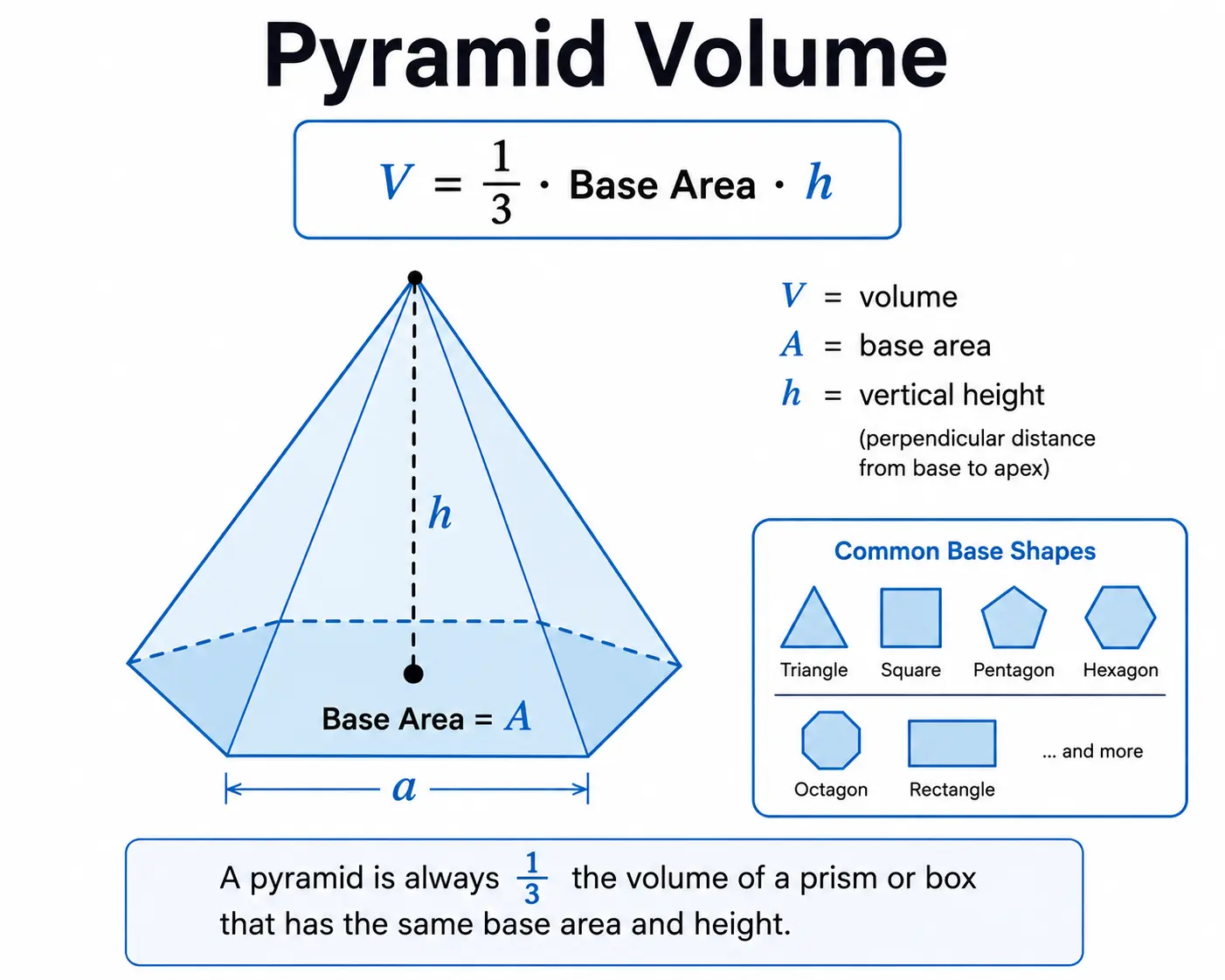
Find the area of the base, multiply by the height, then divide by three. In symbols, V = (1/3) × A × h, where A is the base area and h is the vertical height from the base up to the apex. The height is measured straight up through the center, not along a slanted face.
For a square pyramid with a base side of 6 cm and height 9 cm, the base area is 6 × 6 = 36 cm². Times the height, 36 × 9 = 324. Divided by 3 gives 108 cm³. The calculator runs every step once you enter the numbers. h a V = ⅓ × base area × h
What is the pyramid volume formula?
The core formula is V = (1/3) × base area × height. What changes is how you get the base area, and that depends on the base shape:
- Square or rectangle base: multiply the two sides, A = a × b
- Regular polygon base: A = (n / 4) × a² ÷ tan(180° / n), where n is the number of sides and a is the side length
- Any base you already measured: enter the area directly
Whichever base you have, the one third and the height stay the same. A pyramid is always a third of the prism that shares its base and height.
Why is a pyramid one third of a prism?
A pyramid with a given base and height holds exactly one third of the volume of a prism or box with the same base and height. Fill a pyramid-shaped container three times and you fill the matching box once. This is the same one third that shows up in cone volume, because a cone is just a pyramid with a round base. The taper from a full base up to a single point always costs you two thirds of the space.
How do you find the volume of a square pyramid?
The square base makes it simple. Square the base side to get the area, multiply by height, divide by three. So V = (1/3) × a² × h. A pyramid with a 4 m base side and 9 m height gives (1/3) × 16 × 9 = 48 m³. This is the most common pyramid people need, from architecture to the classic pyramids of Egypt.
How do you find volume with a rectangular base?
When the base is a rectangle instead of a square, the two sides differ. Multiply them for the base area, then apply the formula: V = (1/3) × a × b × h. A base of 6 by 4 with a height of 9 gives (1/3) × 24 × 9 = 72 cubic units. Switch the calculator to the rectangular base option and enter both sides. You can size the base itself with the rectangle area calculator.
Worked example: hexagonal pyramid volume
Polygon bases look intimidating but the calculator does the hard part. Say you have a hexagonal pyramid with a base side of 3 cm and a height of 8 cm. First the base area of a regular hexagon: the formula is (n / 4) × a² ÷ tan(180° / n). With six sides and a 3 cm side, that works out to about 23.38 cm². Now the volume: (1/3) × 23.38 × 8, which comes to roughly 62.35 cm³. You never touch the tangent function yourself. Pick the hexagon option, type the side and height, and the base area appears along with the final volume. For the flat shape on its own, use the hexagon calculator.
How do you convert slant height to vertical height?
Pyramids are often given with a slant height, the distance up the middle of a triangular face, because that is what you can measure on the outside. The volume formula needs the vertical height instead. For a square pyramid, the vertical height, half the base side, and the slant height form a right triangle. So vertical height equals the square root of the slant height squared minus half the base side squared. A square pyramid with a 6 cm base and a 5 cm slant height has a vertical height of √(5² − 3²) = √(25 − 9) = √16 = 4 cm. This is the same right-triangle logic as the Pythagorean theorem. Plug that 4 cm into the volume formula, not the 5 cm slant.
Pyramid volume for common square bases
Quick reference for square-based pyramids using V = (1/3) × a² × h. Find your base side and height, or use the calculator for other shapes.
| Base side (a) | Height (h) | Volume (⅓ a² h) |
|---|---|---|
| 3 | 6 | 18.00 |
| 4 | 9 | 48.00 |
| 5 | 10 | 83.33 |
| 6 | 9 | 108.00 |
| 8 | 12 | 256.00 |
| 10 | 15 | 500.00 |
| 12 | 20 | 960.00 |
Worked example: the Great Pyramid of Giza
Real numbers make the formula click. The Great Pyramid had a square base about 230.4 meters on each side and an original height of roughly 146.6 meters. Base area is 230.4 × 230.4, about 53,084 m². Volume is (1/3) × 53,084 × 146.6, which lands near 2.59 million cubic meters. That single formula, base area times height over three, describes one of the largest stone structures ever built. Enter those numbers in square base mode and the calculator returns the same figure.
What units does pyramid volume use?
Cubic units. Base sides and height in centimeters give a volume in cubic centimeters, which equals milliliters. Meters give cubic meters, feet give cubic feet. For containers, the calculator also converts to liters and gallons. Keep every measurement in the same unit before calculating, or convert with the built-in unit menus.
Does a taller or wider pyramid hold more?
Width usually wins because the base area depends on the side squared. Double the base side of a square pyramid and the base area quadruples, so the volume quadruples too. Double only the height and the volume merely doubles. If you are trying to maximize volume with limited material, spreading the base out adds more space than building tall.
Where is pyramid volume used in real life?
Architecture is the headline use, from ancient monuments to modern glass pyramids like the Louvre entrance. Beyond buildings, it sizes hoppers and funnels with square or rectangular openings, roof volumes for pyramid roofs, tent capacity, and heaps of material with a roughly pyramidal shape. Packaging designers use it for pyramid-shaped boxes and tea bags.
Frequently asked questions
What is the volume of a pyramid?
It is the space inside the shape. Use V = (1/3) × base area × height, which gives about 83.3 cubic units for a 5 by 10 square pyramid.
Why divide by three for a pyramid?
Because the shape narrows to a point instead of holding its full width, which costs two thirds of the space. The division by three accounts for the taper from base to apex.
Is a pyramid the same as a cone?
Almost. Both use one third of the base area times height. The only difference is the base. A pyramid has a flat polygon base, a cone has a circular one. A cone is really just a pyramid with infinitely many sides.
Do I use slant height or vertical height?
Vertical height, the straight distance from the base up to the apex. Slant height runs along a face and is longer. If you only have the slant height, see the conversion section above.
What is the volume of a triangular pyramid?
Find the triangular base area first, then apply the one third times height rule. For a regular triangle base, the calculator computes the area automatically when you pick the triangle option.
Does base shape change the one third rule?
No. Only the base area calculation changes with the base shape.
Can I find pyramid volume without the base area?
Only if you know the base shape and its dimensions, which let the calculator find the area for you. With a regular polygon you need the side length and number of sides. With a rectangle you need both sides. There is no shortcut that skips the base entirely.
What is the volume of a pyramid with a pentagon base?
Find the pentagon base area first, then take a third of it times the height. The calculator does this when you select the pentagon option, so you only enter the side length and the height.
Try these next
- Volume of a Sphere Calculator
- Volume of a Hemisphere Calculator
- Area of a Triangle Calculator
- Perimeter of a Circle Calculator