

Volume Of A Hemisphere Calculator
Find the volume of a hemisphere (half a sphere) using V = (2/3) · π · r³. Enter the radius, diameter, or volume, and get the surface areas too.
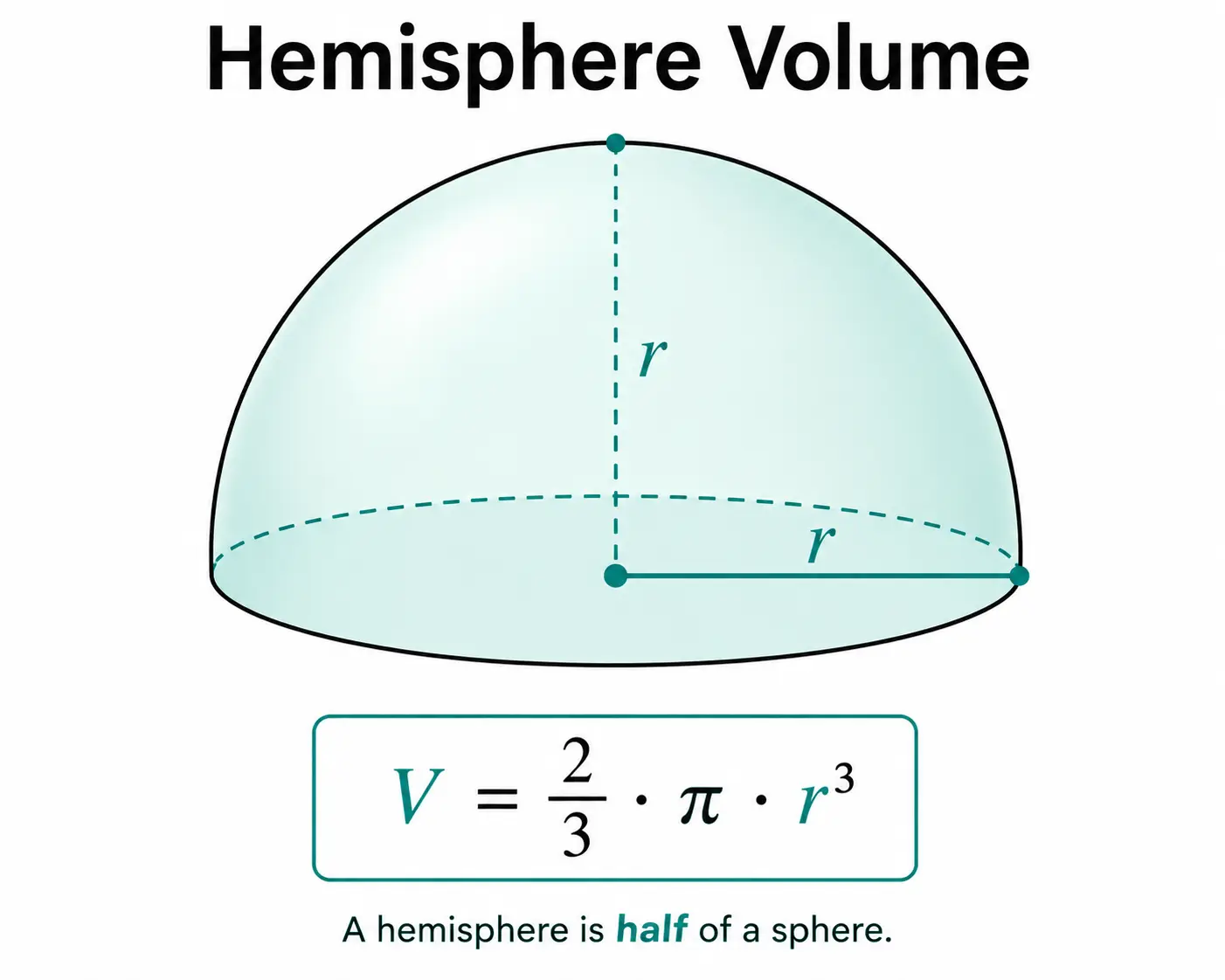
The volume of a hemisphere is two thirds of pi times the radius cubed: V = (2/3) × π × r³. That is exactly half a full sphere. A hemisphere with a 5 cm radius holds about 261.8 cm³. Enter the radius above to get the volume.
This calculator solves three ways. Give it the radius, the diameter, or the volume, and it fills in the rest. It also shows all three surface areas, the flat base, the curved dome, and the total. Work in any unit, read the result in cubic units, liters, or gallons, and copy the figure you need.
How do you find the volume of a hemisphere?
Cube the radius, multiply by pi, then multiply by two thirds. In symbols, V = (2/3) × π × r³. A hemisphere is a sphere sliced clean in half through the middle, so it holds exactly half the sphere's volume. That is where the two thirds comes from, since half of the sphere's four thirds is two thirds.
Take a hemisphere with radius 3 cm. Cube it: 27. Times pi is about 84.8. Times two thirds is roughly 56.5 cm³. The calculator does all three steps as soon as you type the radius. r V = 2⁄3 π r³
What is the hemisphere volume formula?
The formula is V = (2/3) × π × r³. It is the sphere formula with two thirds in place of four thirds, because a hemisphere is half a sphere. The radius is cubed, so volume grows fast as the hemisphere widens. Double the radius and the volume grows eight times. The two thirds and pi stay fixed, and only the radius changes from one hemisphere to the next.
How do you find hemisphere volume from the diameter?
Halve the diameter to get the radius, then run the formula. A diameter of 10 cm means a radius of 5 cm, giving a volume of about 261.8 cm³. The calculator links the radius and diameter, so enter either one and it fills the other automatically. No halving by hand.
What are the surface areas of a hemisphere?
A hemisphere has two surfaces, and people need different ones for different jobs. The flat circular base is π × r². The curved dome, called the cap, is 2 × π × r², which is half a sphere's surface. Add them for the total surface area: 3 × π × r².
For a hemisphere with radius 5, the base is about 78.5, the curved dome is about 157.1, and the total is about 235.6 square units. Open the surface area section in the calculator to see all three at once. Which one you want depends on whether you are painting just the dome, just the base, or the whole thing.
Hemisphere volume for common radii
Quick reference using V = (2/3) × π × r³. Find your radius, or use the calculator for exact values and reverse lookups.
| Radius (r) | Volume (²⁄₃πr³) | Total surface (3πr²) |
|---|---|---|
| 1 | 2.09 | 9.42 |
| 2 | 16.76 | 37.70 |
| 3 | 56.55 | 84.82 |
| 5 | 261.80 | 235.62 |
| 6 | 452.39 | 339.29 |
| 10 | 2,094.40 | 942.48 |
| 12 | 3,619.11 | 1,357.17 |
Worked example: finding radius from hemisphere volume
Say a hemispherical bowl holds 2,094.4 cubic units and you need its radius. Multiply the volume by three: 2,094.4 × 3 = 6,283.2. Divide by two pi: 6,283.2 ÷ 6.283 = 1,000. Take the cube root: the cube root of 1,000 is 10. The radius is 10 units. The cube root is the hard part on paper, since most volumes give messy roots, so the calculator does it for you. Type the volume in and read off the exact radius, diameter, and surface areas.
What units does hemisphere volume use?
Cubic units. A radius in centimeters gives cubic centimeters, which equal milliliters. Meters give cubic meters, inches give cubic inches. For bowls, domes, and tanks, the calculator also converts to liters and gallons, so you can size a half-round container by how much it holds. Keep the radius in one unit, or let the menus convert for you.
How much liquid does a hemisphere hold?
Bowls and half-round containers raise the same question: how much do they hold? Find the volume in cubic centimeters, then remember one cubic centimeter is one milliliter. A hemispherical bowl with a 10 cm radius holds about 2,094 cm³, which is 2,094 mL, or roughly 2.1 liters. Switch the output to liters or gallons and the calculator gives the capacity directly, no manual dividing.
How is a hemisphere related to a sphere?
A hemisphere is precisely half a sphere. Cut a sphere straight through its center and each piece is a hemisphere. So the volume is half, and the curved surface is half. Find the full ball with the sphere volume calculator. The one thing that is not shared is the flat base, which a full sphere does not have. That flat circle is the new face created by the cut, and it is why a hemisphere's total surface is three π r squared rather than half of the sphere's four.
Hemisphere compared to cone and cylinder
For the same radius, three familiar shapes line up neatly. A hemisphere of radius r holds (2/3) × π × r³. A cone with that radius and a height equal to r holds (1/3) × π × r³, exactly half the hemisphere. A cylinder with radius r and height r holds π × r³, so the hemisphere is two thirds of it. This is the same family of thirds that ties spheres, cones, and cylinders together, one of the tidiest patterns in solid geometry.
Real example: the ends of a storage tank
Many pressure tanks and propane cylinders are not pure cylinders. They are a cylinder with a hemisphere capping each end, which spreads pressure more evenly than a flat lid. To find the total volume, add the cylinder body to two hemispheres, and two hemispheres make one full sphere. So a capsule tank holds the cylinder volume plus a whole sphere of the same radius. That is why the hemisphere formula comes up in tank design.
Why do rounded tank ends use hemispheres?
It comes down to strength. A flat lid on a pressure tank has to fight the internal push at a sharp right angle, which concentrates stress at the rim where the flat meets the wall. A hemisphere spreads that same pressure smoothly around a curve, with no weak corner. That is why gas cylinders, propane tanks, and spacecraft fuel tanks nearly always have domed hemispherical ends rather than flat ones. The shape holds more pressure with less material, and the volume of those domed ends comes from the formula above.
Where is hemisphere volume used in real life?
Domes and bowls are the classic cases. It sizes a mixing bowl, a dome roof, an igloo, a half-round tank, a planetarium ceiling, and a scoop of ice cream sitting on a cone. Architects use it for domed buildings. Manufacturers use it for the rounded ends of pressure tanks, which are hemispheres capping a cylinder. Anything shaped like half a ball uses this formula.
Frequently asked questions
What is the volume of a hemisphere?
It is half a sphere's volume: V = (2/3) × π × r³. Cube the radius, multiply by pi, then take two thirds.
Why is the hemisphere formula two thirds pi r cubed?
Because halving the sphere's four thirds pi r cubed leaves two thirds pi r cubed.
Is a hemisphere exactly half a sphere?
Yes, apart from the flat base the cut creates. The section on how a hemisphere relates to a sphere covers this in full.
What is the total surface area of a hemisphere?
Three pi r squared, the curved dome plus the flat base.
How do I find the radius from a hemisphere's volume?
Multiply the volume by three, divide by two pi, then take the cube root.
What is the volume of a hemisphere with radius 10?
About 2,094.4 cubic units. The worked example above runs the same figure in reverse.
What is the curved surface area of a hemisphere?
Two pi r squared, the dome without the flat base. For a radius of 5, that is about 157.1 square units. It equals exactly half a full sphere's surface area.
Does a hemisphere include the flat circle in its surface area?
Only if you want the total. The curved surface is two pi r squared on its own. Add the flat base of pi r squared to reach the total of three pi r squared. Use whichever fits your task.
How do you find the diameter of a hemisphere?
The diameter is twice the radius, measured across the flat circular base. If you know the volume, find the radius first with a cube root, then double it.
Is half a sphere the same as a hemisphere?
Yes, they mean the same thing. A hemisphere is any half of a sphere cut through its center, whether it sits dome up or dome down.
Try these next
- Volume of a Pyramid Calculator
- Perimeter of a Circle Calculator
- Arc Length Calculator
- Area of a Rectangle Calculator