

Arc Length Calculator
Find the arc length of a circle sector with L = r · θ (θ in radians). Enter the central angle and the radius, and get the arc length, sector area, chord, and diameter too.
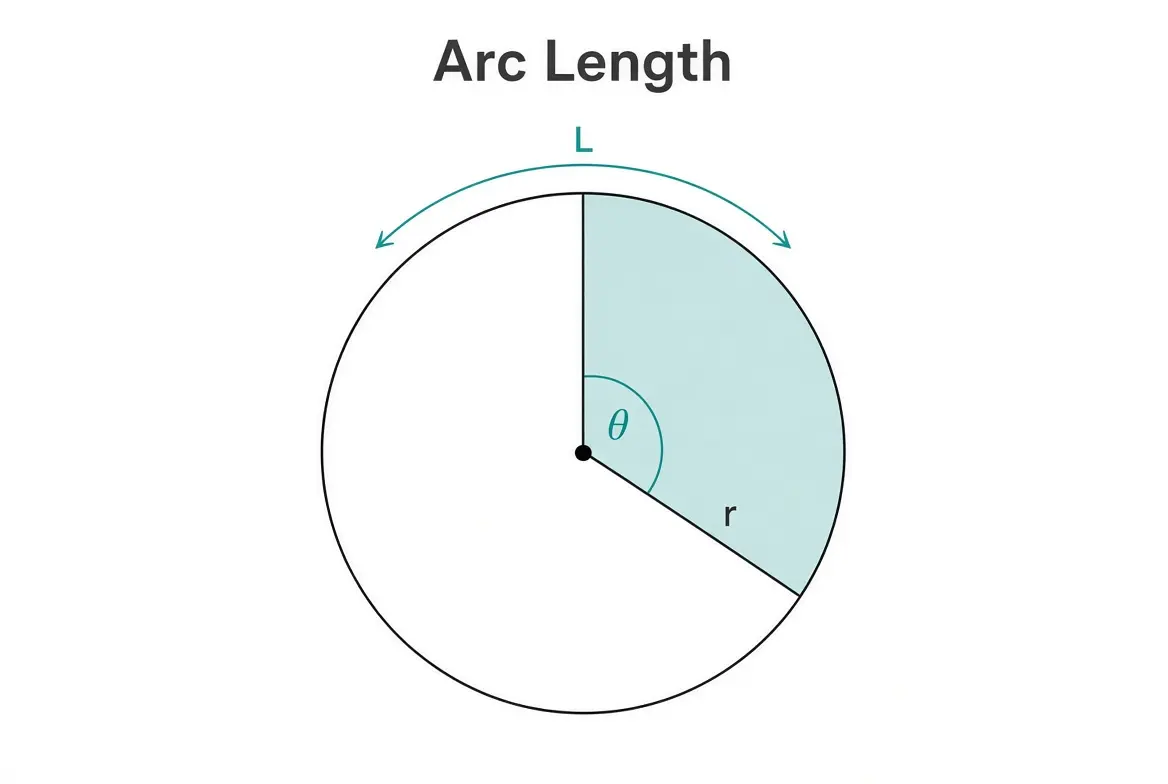
The arc length of a circle is the radius times the central angle in radians: L = r × θ. It is the distance along the curved edge of a slice of the circle. A 90 degree arc on a circle of radius 10 measures about 15.71 units. Enter the angle and the radius above, and the calculator finds the arc length, sector area, chord, and diameter at once.
It accepts the angle in degrees, radians, gradians, or turns, and lets you work backward from the arc, the chord, or the sector area too. Work in any unit from millimeters to yards, and copy the result out when you are done.
What is arc length?
Arc length is the distance measured along the curved part of a circle, not straight across it. Picture a slice of pizza: the arc is the curved crust, while the two straight edges are the radii. The longer the slice angle, the longer the crust. Arc length depends on two things, how big the circle is and how wide the angle at the center is.
For a full circle, the arc length is the entire circumference. For any smaller angle, it is a matching fraction of that circumference. θ L c r
How do you find arc length?
The clean formula uses radians: L = r × θ, where r is the radius and θ is the central angle in radians. If your angle is in degrees, either convert it to radians first, or use the degree version directly: L = 2 × π × r × (θ / 360).
For a radius of 10 and an angle of 90 degrees, the degree formula gives 2 × π × 10 × (90 / 360) = 62.83 × 0.25 = 15.71. The radian formula gives the same: 10 × (π / 2) = 15.71. The calculator handles the conversion, so you can enter degrees and it does the rest.
What is the arc length formula?
There are two forms, one for each angle unit:
- Radians: L = r × θ
- Degrees: L = 2 × π × r × (θ / 360)
They give identical answers. The radian version is shorter because radians are defined so that one radian of angle sweeps exactly one radius of arc. That is the whole reason radians exist, to make this formula as simple as r times θ. The degree version has the extra 360 because it converts the degree fraction into a slice of the full circumference.
How do you find arc length from degrees?
Take the angle as a fraction of a full circle, then multiply by the circumference. The fraction is the angle divided by 360. Multiply that by 2 × π × r. So a 45 degree arc on a radius of 8 is (45 / 360) × 2 × π × 8 = 0.125 × 50.27 = 6.28. In other words, a 45 degree arc is one eighth of the way around, so it is one eighth of the circumference. You can find that full circumference with the circle perimeter calculator.
Worked example: arc, chord, and sector together
Take a 120 degree slice of a circle with radius 5, like a wide wedge. First convert the angle to radians: 120 degrees is 120 divided by 180 times pi, which is 2pi over 3, about 2.094. The arc length is 5 times 2.094, about 10.47. The sector area is half times 25 times 2.094, about 26.18 square units. The chord is 2 times 5 times the sine of 60 degrees, which is 10 times 0.866, about 8.66. So the curved crust is 10.47, but the straight shortcut across is only 8.66. The calculator produces all three the instant you enter the angle and radius.
Arc length for common angles
Quick reference for a radius of 10. Scale proportionally for other radii, since arc length grows in direct proportion to the radius, or use the calculator for any values.
| Angle | Fraction of circle | Arc length (r = 10) | Sector area |
|---|---|---|---|
| 30° | 1/12 | 5.24 | 26.18 |
| 45° | 1/8 | 7.85 | 39.27 |
| 60° | 1/6 | 10.47 | 52.36 |
| 90° | 1/4 | 15.71 | 78.54 |
| 120° | 1/3 | 20.94 | 104.72 |
| 180° | 1/2 | 31.42 | 157.08 |
| 360° | full | 62.83 | 314.16 |
What is the sector area?
A sector is the full pie slice, the two radii plus the arc between them. Its area is A = ½ × r² × θ in radians, or the fraction θ / 360 of the whole circle's area in degrees. For a radius of 10 and a 90 degree angle, the sector area is a quarter of the circle, about 78.54 square units. The calculator shows the sector area alongside the arc length, since they share the same angle and radius.
What is the chord of an arc?
The chord is the straight line connecting the two ends of the arc, the shortcut across instead of around. It is always shorter than the arc. The chord length is c = 2 × r × sin(θ / 2). For a 90 degree arc on a radius of 10, the chord is about 14.14, noticeably less than the 15.71 arc. At exactly 180 degrees, the chord equals the diameter, since the arc is a half circle.
Why do radians make the formula simpler?
Radians are an angle unit built around the circle itself. One radian is the angle that sweeps an arc exactly equal to the radius. That definition is why arc length is just r times theta with no extra constants. A full circle is 2pi radians, because the circumference is 2pi times the radius, so it takes 2pi radius-lengths of arc to go all the way around. Degrees, by contrast, are an arbitrary split into 360 parts, which is why the degree formula needs that division by 360 to work. Radians remove the clutter.
Real example: distance around a running track curve
Running tracks show arc length in action. The curved ends of a standard track are semicircles, half-circle arcs of 180 degrees. If the inner lane has a radius of about 36.5 meters, each curved end has an arc length of pi times 36.5, roughly 114.7 meters. The two curves together add about 229 meters, and the two straights make up the rest of the 400 meter lap. Outer lanes have a larger radius, so their curves are longer, which is exactly why staggered starting lines exist. Runners in outer lanes start ahead to even out the extra arc length.
What units does arc length use?
Plain length units, the same as the radius. A radius in centimeters gives an arc length in centimeters. The angle is separate and can be degrees, radians, gradians, or turns. The sector area comes out in square units, since it is an area. Keep the radius and arc in matching length units, or let the calculator convert.
How does arc length connect to the full circle?
Arc length is simply a fraction of the perimeter of a circle. The whole way around is the circumference, 2 times pi times the radius. An arc is the portion of that edge cut off by the central angle. So a 90 degree arc is a quarter of the circumference, a 180 degree arc is half, and a 360 degree arc is the entire circumference. This makes the circle's perimeter the natural starting point: find the full circumference, then take the slice you need.
Where is arc length used in real life?
Anywhere something curves. Road and railway engineers use it to lay out curved sections and calculate how much track or asphalt a bend needs. It sizes curved architectural features, arches, and staircases. Clock makers use it for the sweep of a hand. It measures the distance a point travels on a rotating wheel or gear, and the length of a curved conveyor belt. Any curved path along a circle is an arc length problem.
Frequently Asked Questions (FAQs)
What is the difference between arc measure and arc length?
Arc measure is the angle in degrees, arc length is the distance along the curve. A 60 degree arc always has an arc measure of 60 degrees no matter how big the circle is, but its length changes with the radius: 5.24 units on a radius of 5, and 10.47 units on a radius of 10. Measure describes the angle, length describes the distance.
What is the difference between a major arc and a minor arc?
Two points on a circle create two arcs. The minor arc is the shorter one, with a central angle under 180 degrees. The major arc is the longer way round, and its angle is 360 minus the minor angle. If the minor arc measures 110 degrees, the major arc measures 250 degrees. On a radius of 10 that is 19.2 units the short way and 43.63 units the long way.
How do you find the central angle from the arc length?
Divide the arc length by the radius, which gives the angle in radians: θ = L / r. For an arc of 15.71 on a radius of 10, that is 1.571 radians, or 90 degrees. To get degrees directly, use θ = (L × 360) / (2 × π × r). The same inputs return 90 degrees.
How do you find the radius from the arc length?
Divide the arc length by the angle in radians: r = L / θ. An arc of 12.57 across a 90 degree angle gives 12.57 divided by 1.5708, which is a radius of 8. Enter the arc length and the angle above and the calculator works backward for you.
How does arc length change when the radius changes?
It changes in direct proportion. Double the radius and the arc length doubles for the same angle, because the bigger circle has a longer edge to sweep. A 40 degree arc measures 4.19 units on a radius of 6 and 6.98 units on a radius of 10. The angle sets the fraction of the circle, the radius sets the size.
Is sector length the same as arc length?
Yes, sector length is another name for the arc length of that sector. Some textbooks say sector length, some say arc length, and both mean the curved edge of the slice. Do not confuse it with sector area, which measures the space inside the slice and comes out in square units.
What is the difference between a sector and a segment?
A sector is the full pie slice bounded by two radii and the arc. A segment is the smaller region between the chord and the arc, with the triangle part cut away. Segment area is the sector area minus that triangle: A = ½ × r² × (θ − sin θ). For a radius of 10 and a 90 degree angle, the sector is 78.54, the triangle is 50, and the segment is 28.54.
How do you find the arc length of a curve that is not a circle?
That takes calculus, not the circle formula. For a function y = f(x) between x = a and x = b, the arc length is the integral of the square root of 1 plus (dy/dx) squared, taken with respect to x. For a parametric curve you integrate the square root of (dx/dt) squared plus (dy/dt) squared. This calculator handles circular arcs only, where the constant radius reduces all of that to L = r × θ.
Try these next
- Volume of a Sphere Calculator
- Volume of a Cone Calculator
- Hexagon Calculator
- Area of a Rectangle Calculator