Significant figures, often called sig figs, are easy to get wrong.
Students memorize rules.
Then forget them during exams.
The problem is not the rules.
The problem is understanding why they exist.
Significant figures tell you how precise a number really is.
They show which digits matter and which do not.
That matters any time a number comes from a measurement rather than a count.
If you report too many digits, your result looks more accurate than it really is.
If you report too few, you lose important information.
That is why lab reports and physics problems both ask you to round to a set number of sig figs.
Significant figures are the digits in a number that carry real measured information.
The rules below cover counting, rounding, and the arithmetic cases where most marks are lost.
Table of Contents
What Are Significant Figures?
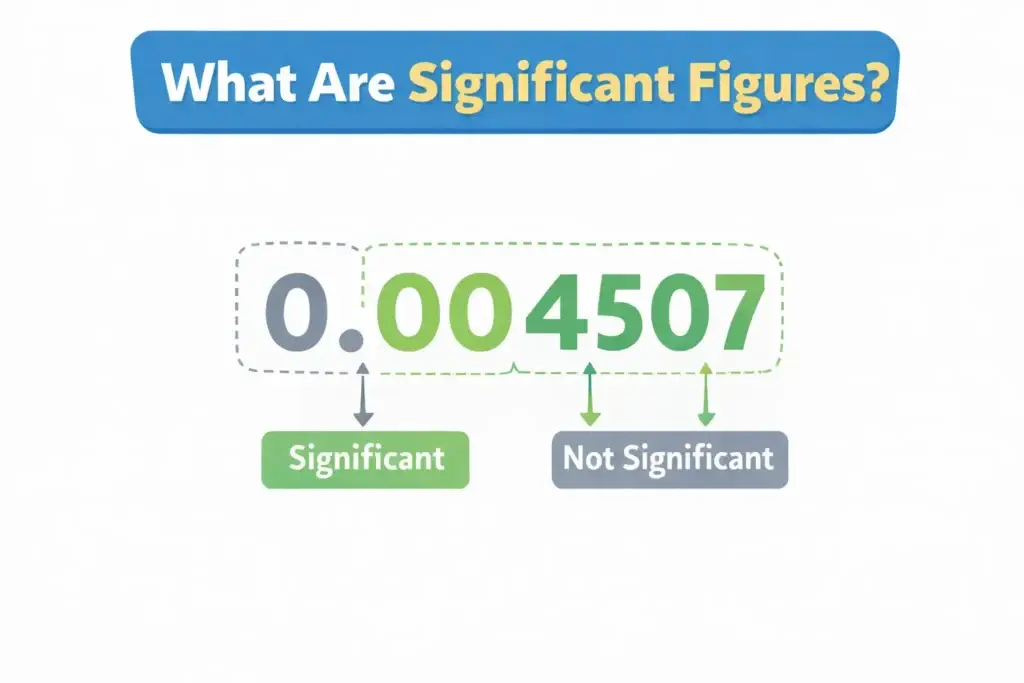
Significant figures are the digits in a number that carry meaning about its precision.
In simple terms, they tell you how accurate a measurement is.
Not every digit in a number is equally important.
Some digits are certain.
Some are estimated.
Significant figures include all the certain digits plus one estimated digit.
That is the core idea.
Simple definition
Significant figures are the digits that contribute to the value of a measurement.
They show how reliable the number is.
That is why you may also hear them called significant digits or significant numbers.
Significant Figures Example
Suppose you measure a length as:
This value has three significant figures.
Why?
The digits 1 and 2 are certain.
The digit 4 is estimated.
Now compare it with:
This value has four significant figures.
That extra zero matters.
It tells us the measurement was taken with more precision.
Why zeros can be confusing
Zeros are where most people get stuck.
Some zeros count as significant.
Some do not.
For example:
100 has one significant figure
100. has three significant figures
100.0 has four significant figures
The decimal point changes everything.
This is why understanding sig figs is more important than memorizing numbers.
What is an outlier in math vs sig figs
In math, numbers are exact.
In measurements, numbers are not.
Significant figures exist because measurements are never perfect.
They help prevent false accuracy.
Similarly, identifying an outlier is important when working with measured data, as extreme values can distort results even when significant figures are used correctly
Once you understand what significant figures represent, the rules start to make sense.
Why Significant Figures Matter
Significant figures are not just a formatting rule.
They protect your results from false precision.
In science, math, and engineering, accuracy matters more than appearance.
They show measurement precision
Every measurement has limits.
A ruler, scale, or calculator can only measure so accurately.
Significant figures tell the reader how precise your measurement really is.
Example:
2.5 kg
2.500 kg
Both look similar.
But the second value is far more precise.
Sig figs carry that difference in the number itself.
They prevent misleading results
Without significant figures, results can look more accurate than they actually are.
Example:
Measured value: 3.2
Calculated value shown as: 3.234567
That extra detail is fake precision.
It was never measured.
Using correct sig figs forces you to round results honestly.
They are required in real world fields
Significant figures are not optional in many areas.
They are used in:
Physics and chemistry labs
Engineering calculations
Medical measurements
Financial and scientific reports
Ignoring sig figs can lead to wrong conclusions or failed experiments.
They affect calculations
When you add, subtract, multiply, or divide numbers, sig figs control how you round the final answer.
That means:
Two people using the same numbers
Can get different answers
If sig fig rules are ignored
That is why a marking scheme will take points off for the wrong number of sig figs.
Why students lose marks
Most sig fig mistakes happen because people:
Round too early
Ignore trailing zeros
Do not apply sig fig rules in calculations
Understanding why significant figures matter helps you avoid all three.
Now that you know why sig figs exist, the next step is learning the core rules that decide which digits count.
How Do Significant Figures Work?
Significant figures work by counting only the digits that carry meaning about a measurement.
Not every digit in a number is equally important.
Some digits show real precision.
Others are just placeholders.
Once you know which digits count, rounding and calculations become much easier.
What makes a digit signifnt?
A digit is significant if it tells you something about the accuracy of a value.
In general:
Digits you measure directly are significant
Digits added only to position the decimal are usually not
The challenge is knowing which is which.
That is why sig fig rules exist.
Simple idea behind sig figs
Think of significant figures as a honesty system.
They answer one question:
How confident are we about this number?
Example:
150
150.
150.0
These look similar, but they do not mean the same thing.
150
Precision is unclear
150.
Precision goes to the ones place
150.0
Precision goes to the tenths place
Same number.
Different meanings.
Sig figs are about measurement, not math tricks
This is important.
Significant figures do not change the value.
They change how much confidence you claim in that value.
They protect readers from assuming precision that does not exist.
Why rules are necessary
Without rules, everyone would interpret numbers differently.
One person might treat zeros as meaningful.
Another might ignore them.
Sig fig rules remove that confusion.
They tell you exactly:
Which digits count
Which digits do not
How to round correctly
Once you understand how sig figs work, learning the rules becomes logical instead of confusing.
Significant Figures Rules
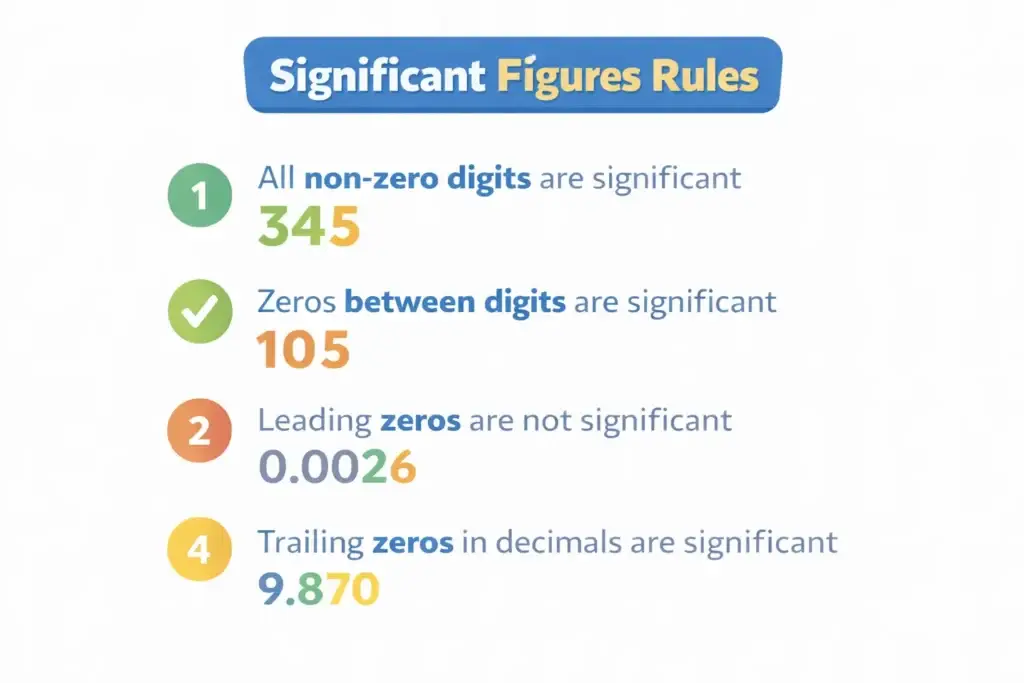
These are the core significant figures rules you must know.
Once these click, sig figs stop feeling confusing.
Read them slowly.
Each rule has a clear purpose.
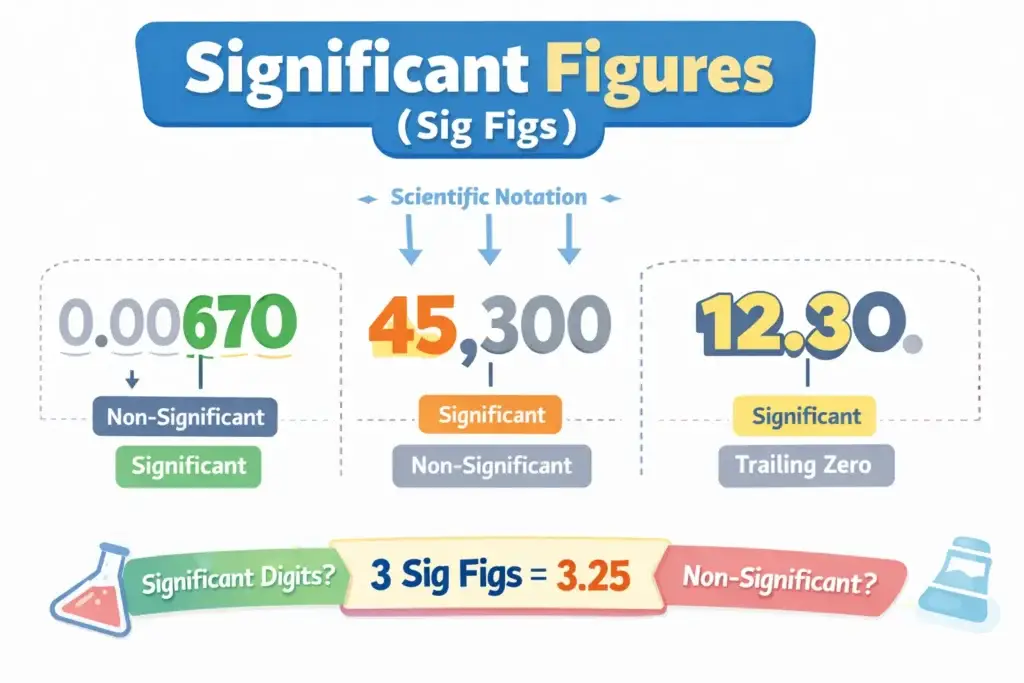
Rule 1: All non zero digits are significant
Any digit from 1 to 9 is always significant.
Examples:
123 → 3 significant figures
7.45 → 3 significant figures
908 → 3 significant figures
If it is not zero, it counts.
Rule 2: Zeros between non zero digits are significant
Zeros that sit between real numbers are meaningful.
Examples:
101 → 3 significant figures
2005 → 4 significant figures
5.007 → 4 significant figures
These zeros are part of the measurement, not placeholders.
Rule 3: Leading zeros are not significant
Zeros at the start of a number do not count.
They only show where the decimal point is.
Examples:
0.25 → 2 significant figures
0.0048 → 2 significant figures
0.00091 → 2 significant figures
Ignore all zeros before the first non zero digit.
Rule 4: Trailing zeros are significant only if a decimal point is shown
This rule causes the most confusion.
Examples:
150 → unclear
150. → 3 significant figures
150.0 → 4 significant figures
Without a decimal point, trailing zeros may not be significant.
With a decimal point, they are.
Rule 5: Trailing zeros in decimal numbers are significant
If the number has a decimal point, zeros at the end count.
Examples:
2.50 → 3 significant figures
0.0300 → 3 significant figures
6.000 → 4 significant figures
These zeros show precision.
Rule 6: Exact numbers have unlimited significant figures
Some numbers are exact, not measured.
Examples:
12 students
3 apples
60 minutes in an hour
Exact numbers do not limit sig figs in calculations.
Why these rules matter
These rules decide:
How many digits you keep
How you round answers
How precise your result looks
If you break these rules, your final answer may look more accurate than it really is.
How Many Significant Figures Does a Number Have?
To find how many significant figures a number has, follow a simple process.
Do not guess. Apply the rules step by step.
Once you practice this a few times, it becomes automatic.
Step 1: Remove leading zeros
Start by ignoring all zeros at the beginning of the number.
Examples:
0.045 → treat it as 45
0.000780 → treat it as 780
Leading zeros never count as significant figures.
Step 2: Count all non zero digits
Every digit from 1 to 9 counts.
Examples:
472 → 3 significant figures
9.81 → 3 significant figures
This part is always straightforward.
Step 3: Check zeros in the middle
Zeros between non zero digits always count.
Examples:
1002 → 4 significant figures
3.06 → 3 significant figures
These zeros add precision.
Step 4: Look for a decimal point
This decides whether trailing zeros count.
Examples:
250 → unclear, usually 2 significant figures
250. → 3 significant figures
250.0 → 4 significant figures
If a decimal point is present, trailing zeros are significant.
Step 5: Count trailing zeros only when allowed
For decimal numbers, trailing zeros always count.
Examples:
4.20 → 3 significant figures
0.0600 → 3 significant figures
These zeros show measurement accuracy.
Quick practice examples
Let’s apply everything together.
0.00340 → 3 significant figures
1200 → usually 2 significant figures
1200. → 4 significant figures
7.050 → 4 significant figures
Why this skill is important
Knowing how many significant figures a number has helps you:
Round answers correctly
Avoid over precision
Follow sig fig rules in calculations
In the next section, we will use these counts to learn how to calculate significant figures in real math operations, including multiplication and division.
Significant Figures Examples
Examples make sig figs much easier to understand.
Let’s walk through common cases you will actually see in math, physics, and chemistry.
Example 1: Whole numbers without decimals
450
This number has 2 significant figures.
Why?
Trailing zeros without a decimal point are not counted.
Now compare it with:
450.
This has 3 significant figures.
The decimal point changes everything.
Example 2: Numbers with decimals
3.140
This has 4 significant figures.
All non zero digits count.
Trailing zeros after a decimal also count.
Another one:
0.0560
This has 3 significant figures.
Leading zeros do not count.
The trailing zero does.
Example 3: Zeros between digits
1005
This has 4 significant figures.
The zero is between non zero digits, so it is significant.
Same rule here:
2.07
This has 3 significant figures.
Example 4: Scientific notation
Scientific notation removes all confusion.
4.50 × 10³
This has 3 significant figures.
6.022 × 10²³
This has 4 significant figures.
Only count digits in the coefficient.
Ignore the power of 10.
Example 5: Measurements
12.0 cm
This has 3 significant figures.
The trailing zero shows measurement precision.
12 cm
This has 2 significant figures.
Same value. Different accuracy.
Example 6: Rounding to specific sig figs
Round 0.004678 to 3 significant figures.
Step by step:
Ignore leading zeros → 4678
Keep first three digits → 4.67
Adjust decimal place → 0.00468
Why these examples matter
Sig figs are not just counting digits.
They communicate how precise a value really is.
If you get this section right, calculations become much easier.
Multiplication and division follow a different rule from addition and subtraction, and that is where most marks are lost.
How to Calculate Sig Figs in Calculations
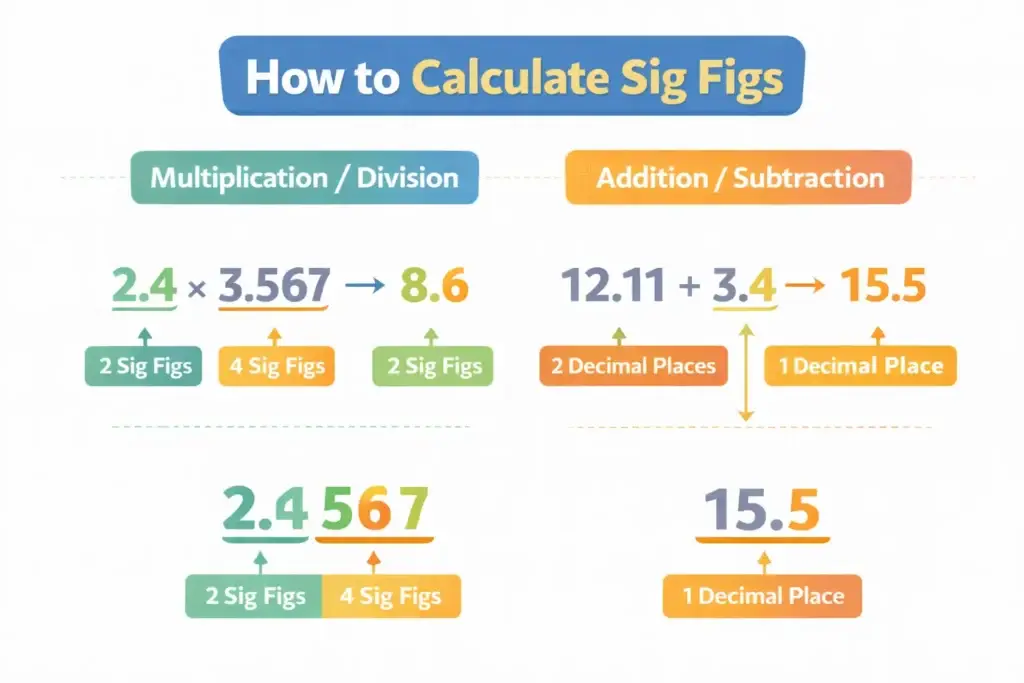
This is where most mistakes happen.
The rules for calculations are different from counting sig figs in a single number.
Sig Fig Rules for Multiplication and Division
For multiplication and division, the result must have the same number of significant figures as the value with the fewest sig figs.
Not the largest.
Not the average.
Always the fewest.
Example 1: Multiplication
2.4 × 3.567
Sig figs:
- 2.4 → 2 significant figures
- 3.567 → 4 significant figures
Calculation:
2.4 × 3.567 = 8.5608
Final answer:
8.6
Why?
Because 2.4 has only 2 significant figures.
Example 2: Division
15.0 ÷ 4.52
Sig figs:
- 15.0 → 3 significant figures
- 4.52 → 3 significant figures
Result:
15.0 ÷ 4.52 = 3.31858
Final answer:
3.32
Both values have 3 sig figs, so the answer keeps 3.
Sig Fig Rules for Addition and Subtraction
Addition and subtraction work differently.
Here, sig figs are based on decimal places, not total digits.
The result must match the number with the fewest decimal places.
Example 3: Addition
12.11
- 3.4
= 15.51
Decimal places:
- 12.11 → 2 decimals
- 3.4 → 1 decimal
Final answer:
15.5
Example 4: Subtraction
100.0 − 2.345
Decimal places:
- 100.0 → 1 decimal
- 2.345 → 3 decimals
Result:
97.655
Final answer:
97.7
Mixed Calculations Tip
When a problem includes multiple steps:
- Do not round in the middle
- Keep extra digits
- Round only the final answer
Early rounding can change the result.
Why calculation rules matter
Sig fig rules prevent false precision.
They stop you from reporting more accuracy than your data supports.
Once you master these rules, you can handle sig figs in any real calculation. Using the Sig Fig Calculator applies this instantly and avoids calculation mistakes.
Rounding to Significant Figures
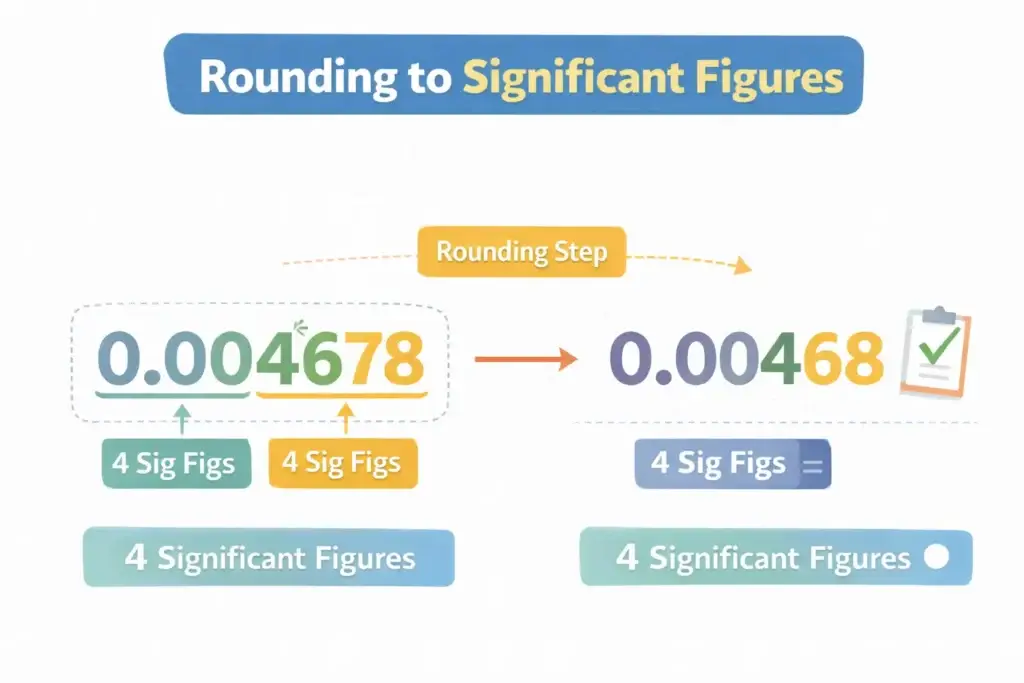
Rounding to the right number of significant figures keeps the answer honest about how precise the measurement was.
Here’s how to do it step by step.
Step 1: Identify how many sig figs you need
Decide how many significant figures your final answer must have.
This depends on the measurement, calculation rules, or your instructor’s instructions.
Example: Round 0.004678 to 3 sig figs.
Step 2: Ignore leading zeros
Leading zeros never count.
0.004678 → treat it as 4678 for rounding purposes.
Step 3: Count the digits
Count from the first non zero digit. Keep the number of digits equal to the sig figs you need.
For 3 sig figs: 4 → 6 → 7
Step 4: Look at the next digit
Check the digit immediately after your last sig fig:
- If it is 5 or greater → round up
- If it is less than 5 → keep it the same
Example:
4678 → last sig fig is 7, next digit is 8 → round up → 468
Step 5: Restore the decimal place
Bring back the decimal point to match the original number.
0.004678 → 0.00468 (3 sig figs)
Step 6: Apply trailing zeros if needed
If rounding creates trailing zeros in a decimal number, keep them to show precision.
Example: 2.5 rounded to 3 sig figs → 2.50
Quick Tips
- Always round at the final step of a calculation.
- Avoid rounding intermediate results to prevent errors.
- Use scientific notation for very large or very small numbers, which makes sig figs clearer.
Scientific Notation and Significant Figures
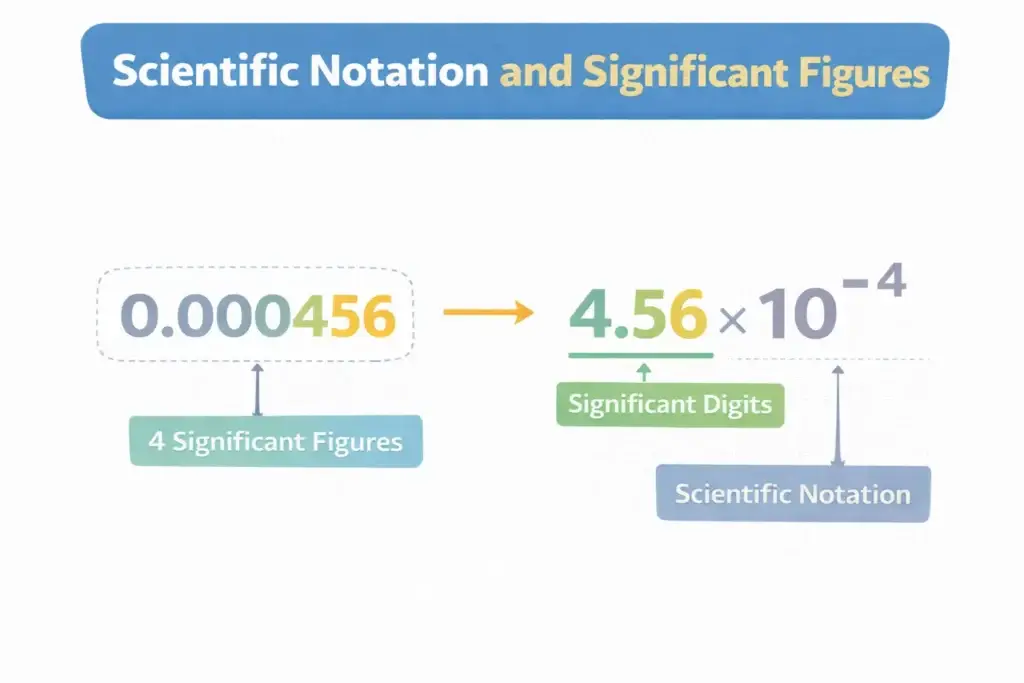
Scientific notation expresses very large or very small numbers clearly.
It also makes it easy to count and display significant figures without confusion.
Why Scientific Notation Helps
- Eliminates ambiguity with zeros
- Makes sig figs obvious
- Simplifies multiplication and division
Step 1: Express the number in scientific notation
Move the decimal point so there is only one non-zero digit to the left.
Example:
0.000456 → 4.56 × 10⁻⁴
123000 → 1.23 × 10⁵
Step 2: Count significant figures
All digits in the coefficient (the number before ×10) are significant.
- 4.56 → 3 significant figures
- 1.23 → 3 significant figures
The exponent does not affect sig figs.
Step 3: Apply sig figs in calculations
Scientific notation makes it easy to round results to the correct number of sig figs:
Example: Multiplication
(2.34 × 10³) × (5.6 × 10²)
Step 1: Multiply the coefficients
2.34 × 5.6 = 13.104 → round to 2 sig figs (fewest from inputs) → 13
Step 2: Combine powers of 10
10³ × 10² = 10⁵
Final answer: 1.3 × 10⁶
Notice how sig figs are clear and rounding is straightforward.
Step 4: When to use scientific notation
- Very large numbers: 6.022 × 10²³
- Very small numbers: 3.00 × 10⁻⁴
- Calculations with multiple steps where precision matters
Common Mistakes with Significant Figures
Even experienced students make mistakes with significant figures. Knowing the pitfalls helps you avoid errors in calculations, measurements, and reporting.
Mistake 1: Counting Leading Zeros
Leading zeros are never significant, but many beginners count them by mistake.
Wrong: 0.0045 → 4 sig figs
Correct: 0.0045 → 2 sig figs
Tip: Ignore all zeros before the first non-zero digit.
Mistake 2: Ignoring Trailing Zeros in Decimals
Trailing zeros after a decimal are significant. Missing them can underrepresent precision.
Example:
2.50 → 3 sig figs (trailing zero counts)
2.5 → 2 sig figs
Mistake 3: Misapplying Rules in Multiplication/Division
Always round the result to the fewest sig figs of any number in the calculation.
Wrong: 2.4 × 3.567 = 8.5608 → 8.5608 (kept all digits)
Correct: 2.4 × 3.567 = 8.6 (2 sig figs, as 2.4 has the fewest)
Mistake 4: Misapplying Rules in Addition/Subtraction
Here, decimal places matter, not total digits. The multiplication rule gets applied here by mistake.
Example:
12.11 + 3.4 = 15.51 → 15.5 (round to 1 decimal place)
Mistake 5: Rounding Too Early
Rounding intermediate steps can lead to cumulative errors.
Tip: Keep extra digits during calculation and round only at the final result.
Mistake 6: Confusing Measured Values with Exact Numbers
Exact numbers (like 12 eggs or 60 minutes) have unlimited significant figures. Treating them like measured numbers can incorrectly limit sig figs.
Mistake 7: Ignoring Scientific Notation
Very large or small numbers may seem tricky. Not using scientific notation can cause confusion with zeros.
Tip: Always write numbers in scientific notation when precision matters.
Why Avoiding These Mistakes Matters
- Prevents reporting false precision
- Keeps calculations accurate
- Ensures measurements are meaningful
- Helps in exams and professional applications
Frequently Asked Questions (FAQs)
-
What are significant figures?
Significant figures (sig figs) are the digits in a number that carry meaningful information about its precision. This includes all non-zero digits, zeros between non-zero digits, and trailing zeros in decimal numbers.
-
How to find significant figures?
To find sig figs:
Ignore leading zeros
Count all non-zero digits
Count zeros between non-zero digits
Count trailing zeros if there is a decimal point -
What are the significant figures rules?
All non-zero digits are significant
Zeros between digits are significant
Leading zeros are never significant
Trailing zeros are significant only if there is a decimal
For calculations: use fewest sig figs in multiplication/division and fewest decimal places in addition/subtraction -
How many significant figures are in 100?
100 → usually 1 sig fig (no decimal)
100.→ 3 sig figs (decimal present)
1.00 × 10² → 3 sig figs (scientific notation clarifies precision) -
How to calculate sig figs when adding or multiplying?
Multiplication/Division: Result has same sig figs as number with fewest sig figs
Addition/Subtraction: Result has same decimal places as number with fewest decimal places