

MG to ML & ML to MG Calculator
Density and concentration change with temperature, brand, and formulation. For medicine, always follow the exact dose on the label or your pharmacist’s instructions. This tool is for reference, not medical advice.
There is no fixed number of mg in a ml. Milligrams measure weight and milliliters measure volume, so you need the concentration to convert between them. The rule is simple: to go from mg to ml, divide by the concentration in mg/ml. To go from ml to mg, multiply. For example, at 10 mg/ml, 50 mg equals 5 ml, and 5 ml equals 50 mg. Enter your value and concentration for an exact result.
MG to ML Calculator helps you convert milligrams (mg) into milliliters (ml) based on a given concentration or density. This calculator helps you convert milligrams (mg) to milliliters (ml) and also ml to mg using concentration.
Unlike simple unit conversions, mg to ml is not a direct conversion. Milligrams measure weight, while milliliters measure volume. That means you need the substance’s density or concentration to get an accurate result.
Just enter the value in mg and the concentration (mg per ml), and the calculator will instantly show the equivalent volume in ml.
It’s especially useful for:
- Medicine dosage calculations
- Liquid supplements
- Lab and chemistry measurements
Fast, simple, and accurate.
MG to ML Conversion Formula
To convert milligrams (mg) into milliliters (ml), you need to use a simple formula based on concentration.
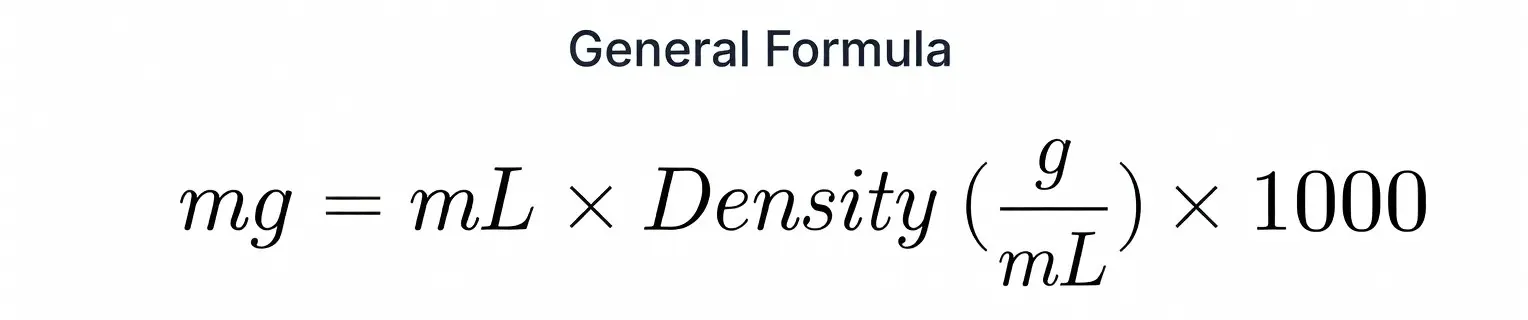
What this means:
- mg = the amount of substance
- concentration (mg/ml) = how many milligrams are in 1 milliliter
- ml = the final volume you want to find
Simple explanation:
You divide the total milligrams by the concentration to get the volume in milliliters.
For example, if a liquid has 10 mg per ml, and you have 50 mg:
- 50 ÷ 10 = 5 ml
So, 50 mg equals 5 ml in that case.
Important note:
This formula only works when you know the concentration or density.
Without it, you cannot accurately convert mg to ml.
ML to MG Conversion Formula
To convert ml to mg, multiply the volume in ml by the concentration in mg/ml. If a liquid is 10 mg/ml, then 5 ml contains 5 × 10 = 50 mg. The formula is mg = ml × concentration. This is the calculation you need when you know the liquid volume and want the total weight of active ingredient, common with syringes, liquid medicine, and lab solutions.

What this means:
- ml = the volume of the liquid
- concentration (mg/ml) = how many milligrams are in 1 ml
- mg = the total weight you want to find
Simple example:
If concentration = 10 mg/ml and you have 5 ml:
5 × 10 = 50 mg
5 ml = 50 mg
Important:
Just like mg to ml, this conversion also depends on concentration.
Without it, you cannot calculate the correct value.
Why MG to ML Conversion Is Not Direct
This is where most people get confused.
Milligrams (mg) and milliliters (ml) measure completely different things.
- mg measures weight (mass)
- ml measures volume (space)
So, you can’t directly convert mg to ml like you would convert cm to meters.
The missing piece: concentration
To convert mg to ml, you need to know:
How much mg is present in 1 ml of the substance
This is called concentration (mg per ml).
Simple way to understand it:
Think of two liquids:
- Liquid A: 10 mg per ml
- Liquid B: 50 mg per ml
Now take 50 mg of each:
- In Liquid A → 50 mg = 5 ml
- In Liquid B → 50 mg = 1 ml
Same mg. Different ml.
Why?
Because the concentration is different.
ML to MG Conversion
You can also convert milliliters (ml) back into milligrams (mg) using the same concentration value.
This is useful when you know the volume and want to find the exact amount in mg.
How it works:
To convert ml to mg, multiply the volume by the concentration.
If a liquid contains 10 mg per ml, then every 1 ml has 10 mg.
Example 1: 1 ml to mg
If concentration = 10 mg/ml
1 × 10 = 10 mg
1 ml = 10 mg
Example 2: 5 ml to mg
If concentration = 20 mg/ml
5 × 20 = 100 mg
5 ml = 100 mg
Example 3: 10 ml to mg
If concentration = 5 mg/ml
10 × 5 = 50 mg
10 ml = 50 mg
Quick tip:
Always check the concentration on the label.
Even small differences in mg per ml will change the final result.
How to Convert MG to ML (Step-by-Step)
Converting mg to ml is simple once you know the concentration.
Follow these steps:
Step 1: Identify the amount in mg
Start with the value you want to convert.
Example: 50 mg
Step 2: Find the concentration
Check how many milligrams are in 1 ml of the substance.
Example: 10 mg per ml
You’ll usually find this on:
- medicine labels
- supplement bottles
- lab data
Step 3: Apply the formula
Use this:
ml = mg ÷ concentration
So:
50 ÷ 10 = 5 ml
Step 4: Get your result
The final answer is:
50 mg = 5 ml (based on 10 mg/ml)
Quick tip:
Always double-check the concentration.
How to Convert ML to MG (Step-by-Step)
Converting ml to mg is easy when you know the concentration.
Follow these simple steps:
Step 1: Identify the volume in ml
Start with the value you want to convert.
Example: 5 ml
Step 2: Find the concentration
Check how many milligrams are in 1 ml of the substance.
Example: 10 mg per ml
You can find this on:
- medicine labels
- supplement bottles
- lab information
Step 3: Apply the formula
Use this:
mg = ml × concentration
So:
5 × 10 = 50 mg
Step 4: Get your result
The final answer is:
5 ml = 50 mg (based on 10 mg/ml)
Quick tip:
Always double-check the concentration before calculating.
Even small changes in mg per ml can affect the final result.
Practical Examples of MG to ML Conversion
Here are some real examples to help you understand how mg to ml conversion works in different situations.
Example 1: 5 mg to ml
If concentration = 5 mg/ml
5 ÷ 5 = 1 ml
5 mg = 1 ml
Example 2: 10 mg to ml
If concentration = 2 mg/ml
10 ÷ 2 = 5 ml
10 mg = 5 ml
Example 3: 2.5 mg to ml
If concentration = 1 mg/ml
2.5 ÷ 1 = 2.5 ml
2.5 mg = 2.5 ml
Example 4: 50 mg to ml
If concentration = 10 mg/ml
50 ÷ 10 = 5 ml
50 mg = 5 ml
Example 5: 100 mg to ml
If concentration = 20 mg/ml
100 ÷ 20 = 5 ml
100 mg = 5 ml
Example 6: 500 mg to ml
If concentration = 100 mg/ml
500 ÷ 100 = 5 ml
500 mg = 5 ml
Example 7: 1 ml to mg
If concentration = 10 mg/ml
1 × 10 = 10 mg
1 ml = 10 mg
Example 8: 5 ml to mg
If concentration = 20 mg/ml
5 × 20 = 100 mg
5 ml = 100 mg
Example 9: 10 ml to mg
If concentration = 5 mg/ml
10 × 5 = 50 mg
10 ml = 50 mg
Example 10: 2.5 ml to mg
If concentration = 2 mg/ml
2.5 × 2 = 5 mg
2.5 ml = 5 mg
Example 11: 0.5 ml to mg
If concentration = 10 mg/ml
0.5 × 10 = 5 mg
0.5 ml = 5 mg
Syringe-Based Examples (Common in Medicine)
For a syringe, the ml reading is the dose volume you draw up. Divide the prescribed mg by the concentration printed on the vial. If a vial reads 2 mg/ml and the dose is 2 mg, you draw 1 ml. If the concentration is 4 mg/ml for the same 2 mg dose, you draw 0.5 ml. Always read the concentration from the label, because the same mg dose is a different ml volume at a different strength. These are very common in real use, especially for liquid medications.
Example: 2.5 mg to ml (Syringe)
If concentration = 2.5 mg/ml
2.5 ÷ 2.5 = 1 ml
2.5 mg = 1 ml syringe
Example: 1 mg to ml (Syringe)
If concentration = 1 mg/ml
1 ÷ 1 = 1 ml
1 mg = 1 ml
Important:
These examples change based on concentration.
Always check the label before calculating, especially for medicines.
MG to ML Quick Conversion Table
This table gives you a quick idea of mg to ml conversions using a sample concentration.
For this example, we assume:
1 ml = 10 mg (concentration = 10 mg/ml)
| Milligrams (mg) | Milliliters (ml) |
|---|---|
| 1 mg | 0.1 ml |
| 2 mg | 0.2 ml |
| 5 mg | 0.5 ml |
| 10 mg | 1 ml |
| 20 mg | 2 ml |
| 50 mg | 5 ml |
| 100 mg | 10 ml |
Important:
This table is only valid for 10 mg per ml concentration.
If the concentration changes, the results will also change.
Quick takeaway:
- Higher concentration → less ml needed
- Lower concentration → more ml needed
MG to ML Conversion Table (Water)
These values are for water and any liquid with a density close to 1 g/mL. For other substances, use the calculator above.
| Milligrams (mg) | Milliliters (mL) |
|---|---|
| 1 mg | 0.001 mL |
| 2 mg | 0.002 mL |
| 2.5 mg | 0.0025 mL |
| 5 mg | 0.005 mL |
| 10 mg | 0.01 mL |
| 20 mg | 0.02 mL |
| 50 mg | 0.05 mL |
| 100 mg | 0.1 mL |
| 200 mg | 0.2 mL |
| 500 mg | 0.5 mL |
| 1000 mg | 1 mL |
ML to MG Conversion Table (Water)
| Milliliters (mL) | Milligrams (mg) |
|---|---|
| 0.1 mL | 100 mg |
| 0.25 mL | 250 mg |
| 0.5 mL | 500 mg |
| 1 mL | 1000 mg |
| 2 mL | 2000 mg |
| 2.5 mL | 2500 mg |
| 5 mL | 5000 mg |
| 10 mL | 10000 mg |
| 20 mL | 20000 mg |
MG to ML for Syringes and Medicine
When drawing medicine into a syringe, the mg to ml conversion depends on the concentration, not on density. The concentration is printed on the vial or bottle, usually as something like "10 mg/mL".
To find the mL to draw: mL = dose in mg ÷ concentration in mg/mL.
For example, if you need a 2 mg dose and the vial is labeled 10 mg/mL, then 2 ÷ 10 = 0.2 mL. Always double check against the label and your prescriber's instructions before drawing any dose.
Use Cases of MG to ML Conversion
This conversion is used in many real-life situations where accuracy matters.
Medicine Dosage
Doctors and patients use mg to ml conversion to measure liquid medicines correctly.
Especially important for:
- syrups
- injections
- pediatric doses
Supplements and Nutrition
Liquid supplements often list values in mg, but you consume them in ml.
This helps you:
- take the correct dose
- avoid under or overdosing
Laboratory and Chemistry Work
In labs, substances are measured by weight but used in liquid form.
MG to ML conversion helps in:
- preparing solutions
- mixing chemicals accurately
Fitness and Health Tracking
Some liquid nutrients or compounds are tracked in mg but consumed in ml.
This is common in:
- fitness supplements
- health routines
Pharmacy and Medical Calculations
Pharmacists use this conversion daily to:
- prepare medications
- ensure correct concentrations
Quick takeaway:
If you’re dealing with any liquid where dosage or measurement matters, this conversion becomes essential.
Try These Calculators Next
Frequently Asked Questions (FAQs)
How many mg are in 1 ml?
It depends on the concentration.
For example, if the concentration is 10 mg/ml, then:
1 ml = 10 mg
But this value changes for every substance.
How many ml is 1 mg?
Use the formula:
ml = mg ÷ concentration
If concentration is 1 mg/ml:
1 mg = 1 ml
If concentration is 10 mg/ml:
1 mg = 0.1 ml
How many ml is 2.5 mg?
Again, it depends on concentration.
If concentration = 2.5 mg/ml:
2.5 mg = 1 ml
If concentration = 5 mg/ml:
2.5 mg = 0.5 ml
How many milliliters are in a milligram?
There is no fixed value.
Milliliters depend on:
- the substance
- its concentration
You must know mg per ml to convert correctly.
Can you convert mg to ml without concentration?
No, you cannot.
Without concentration or density, the conversion is not possible.
What is the difference between mg and ml?
- mg (milligram) measures weight
- ml (milliliter) measures volume
They are different units, so you need concentration to convert between them.
How to convert mg to ml?
To convert mg to ml, divide the milligrams by the concentration (mg per ml).
For example, if concentration is 10 mg/ml:
50 mg ÷ 10 = 5 ml
How to convert ml to mg?
To convert ml to mg, multiply the milliliters by the concentration.
For example, if concentration is 10 mg/ml:
5 ml × 10 = 50 mg
What is the mg to ml conversion formula?
The formula is:
- ml = mg ÷ concentration
- mg = ml × concentration
Both depend on mg per ml value.