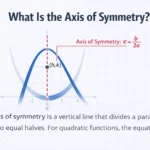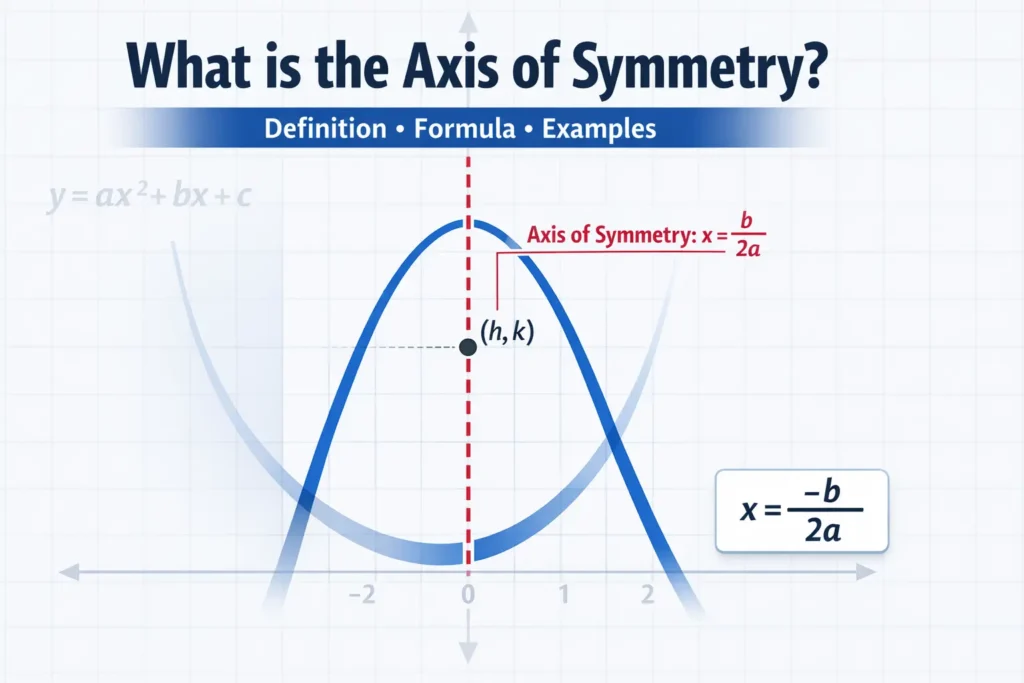
The axis of symmetry is a vertical line that divides a graph or shape into two identical mirror halves. In quadratic functions, the axis of symmetry passes directly through the vertex of a parabola and shows where the graph is perfectly balanced.
The axis of symmetry is the vertical line x = -b/(2a) that splits a parabola into two mirror halves. The same rule applies whether you are solving a quadratic equation or graphing a parabola.
Table of Contents
What Is the Axis of Symmetry?
The axis of symmetry is a line that divides a shape or graph into two equal, mirror-image halves. If you were to fold the shape along this line, both sides would match exactly.
In mathematics, the axis of symmetry is most commonly discussed in relation to parabolas and quadratic functions. For a parabola, the axis of symmetry is a vertical line that passes through the vertex (the highest or lowest point of the graph). This line splits the parabola into two perfectly identical sides.
Axis of Symmetry Definition (Clear Version)
The axis of symmetry definition in algebra is:
A vertical line that divides a parabola into two symmetrical halves and passes through its vertex.
Simple Example
Imagine the parabola represented by:
This graph is perfectly balanced on both sides of the y-axis.
Here, the axis of symmetry is:
Because the y-axis divides the parabola into two identical mirror images.
Once you can find the axis of symmetry you can:
- Find the vertex of a parabola
- Graph quadratic equations correctly
- Solve quadratic equations more efficiently
- Understand symmetry in algebra and geometry
Axis of Symmetry in a Parabola (Why It Matters)
When working with quadratic functions, the axis of symmetry plays a central role in understanding the shape and behavior of a parabola.
A parabola is the graph of a quadratic equation, typically written in standard form:
Every parabola has a turning point called the vertex. The axis of symmetry is the vertical line that passes directly through this vertex and divides the parabola into two identical halves.
What Is the Vertex of a Parabola?
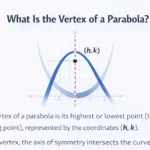
The vertex of a parabola is the highest or lowest point on the graph:
- If a>0, the parabola opens upward, and the vertex is the minimum point.
- If a<0, the parabola opens downward, and the vertex is the maximum point.
The axis of symmetry always passes through the vertex.
So if the vertex is at:
Then the axis of symmetry is:
This is why understanding the vertex helps you immediately find the axis of symmetry.
Why the Axis of Symmetry Is Important
The axis of symmetry helps you:
- Identify the exact center of a parabola
- Find the vertex quickly
- Graph quadratic equations accurately
- Understand how the parabola reflects evenly on both sides
- Solve optimization problems in algebra
For example, if you’re analyzing projectile motion or maximum profit problems, the axis of symmetry tells you where the turning point occurs.
Axis of Symmetry Formula (Quadratic Functions)
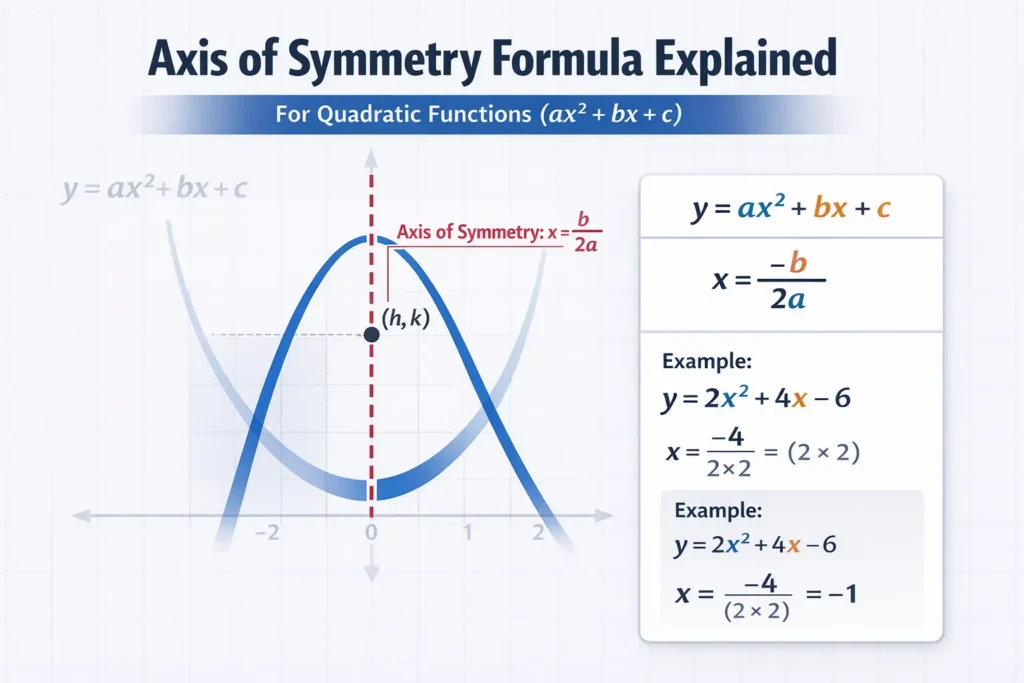
To find the axis of symmetry for a quadratic equation written in standard form, we use a simple and powerful formula.
A quadratic equation in standard form looks like this:
Where:
- a is the coefficient of x2
- b is the coefficient of x
- c is the constant
Axis of Symmetry Formula
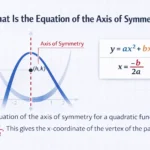
For any quadratic equation in standard form, the axis of symmetry formula is:
This formula gives the equation of the axis of symmetry.
Notice that the answer is always written as:
That’s because the axis of symmetry is a vertical line.
Why the Formula Works (Simple Explanation)
The axis of symmetry represents the exact middle of the parabola.
The formula:
calculates the x-value where the parabola changes direction, which is also the x-coordinate of the vertex.
So:
- The formula gives the x-value of the vertex
- That same x-value forms the axis of symmetry
Axis of Symmetry Example Using the Formula
Find the axis of symmetry for:
Step 1: Identify a and b
- a=2
- b=4
Step 2: Plug into the formula
Final Answer:
The equation of the axis of symmetry is:
Key Things to Remember
- Always include the negative sign in front of b
- Always divide by 2a, not just 2
- The answer is written as x = value, never y =
How to Find the Axis of Symmetry (Step-by-Step Methods)
There are different ways to find the axis of symmetry, depending on how the quadratic equation is given. Below are the three most common methods students need to know.
Find the Axis of Symmetry From Standard Form
If the quadratic equation is written in standard form:
Use the axis of symmetry formula:
Step-by-Step Example
Find the axis of symmetry for:
Step 1: Identify a and b
- a=3
- b=−6
Step 2: Substitute into the formula
Final Answer:
That is the equation of the axis of symmetry.
Find the Axis of Symmetry From Vertex Form
If the quadratic is written in vertex form:
The axis of symmetry is much easier to find.
Rule:
If the equation is in vertex form, the axis of symmetry is:
Axis of Symmetry From Vertex Example:
Find the axis of symmetry for:
Since
Final Answer:
This method is the fastest way to find the axis of symmetry in vertex form.
Find the Axis of Symmetry From a Graph
If you are given a graph of a parabola:
Step 1: Locate the vertex
Find the highest or lowest point on the graph.
Step 2: Identify its x-coordinate
The x-value of the vertex gives you the axis of symmetry.
Step 3: Write the equation
Always write it as:
Quick Summary of All Methods
- Standard Form → Use
- Vertex Form → Axis is
- From Graph → Axis passes through the vertex
Axis of Symmetry Calculator
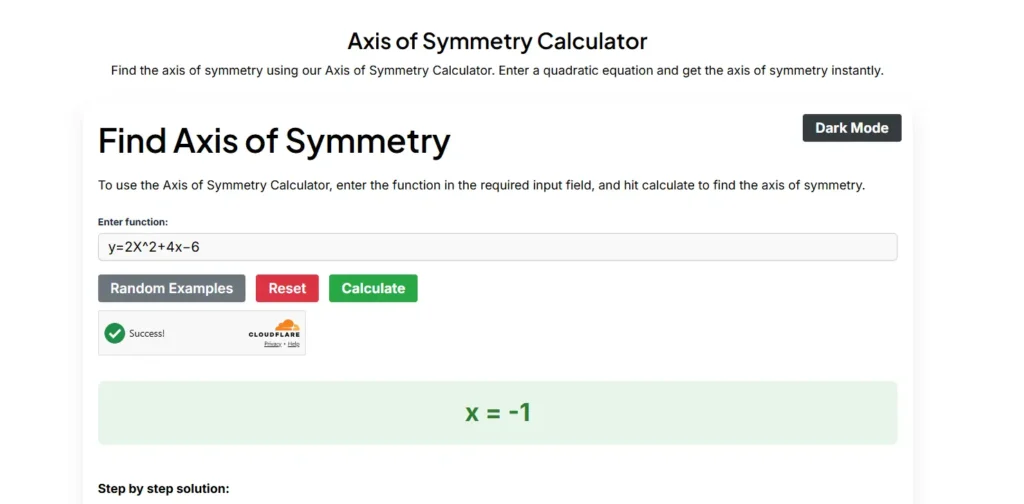
If you don’t want to calculate manually, you can use an axis of symmetry calculator to find the answer instantly.
An axis of symmetry calculator works using the formula:
Enter the values of:
- a (coefficient of )
- b (coefficient of )
The calculator automatically computes:
- The x-coordinate of the vertex
- The equation of the axis of symmetry
Try the Axis of Symmetry Calculator
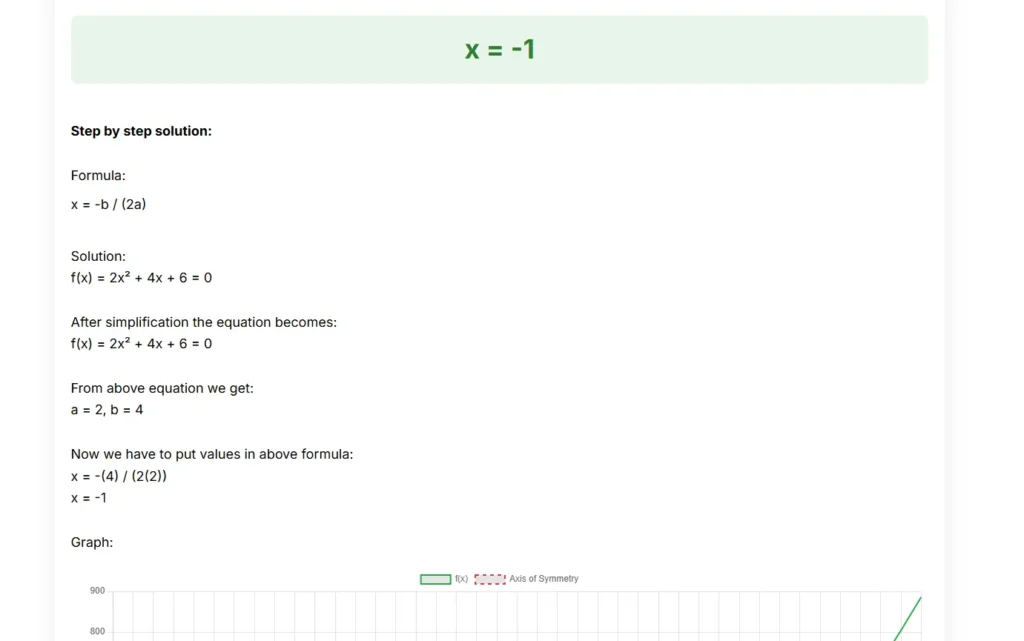
For example, suppose your quadratic equation is:
Here:
So the expression becomes:
The result is:
That means the axis of symmetry is:
When Should You Use a Axis of Symmetry Calculator?
An axis of symmetry calculator is helpful when:
- The numbers are large or involve fractions
- You are checking homework answers
- You want quick verification
- You are preparing for exams
However, it’s important to understand the formula first, especially for test situations where calculators may not be allowed.
Axis of Symmetry Examples (Solved Problems)
Now let’s go through several axis of symmetry examples using different forms of quadratic equations.
Example 1: Standard Form (Basic)
Find the axis of symmetry for:
Step 1: Identify a and b
- a=1
- b=8
Step 2: Use the axis of symmetry formula
Final Answer:
Example 2: Negative Leading Coefficient
Find the axis of symmetry for:
Step 1: Identify a and b
- a=−2
- b=12
Step 2: Apply the formula
Final Answer:
Even though the parabola opens downward (because a is negative), the formula works exactly the same way.
Example 3: Vertex Form
Find the axis of symmetry for:
In vertex form:
Here:
So
Final Answer:
This is the fastest way to find the axis of symmetry when the equation is already in vertex form.
Example 4: From a Graph
Suppose the vertex of a parabola shown on a graph is:
The axis of symmetry is simply the vertical line passing through the vertex.
Final Answer:
Example 5: Word Problem
A ball is thrown upward, and its height is modeled by:
Find the axis of symmetry.
Step 1: Identify a and b
- a=−4
- b=16
Step 2: Apply the formula
Final Answer:
This means the ball reaches its maximum height at seconds.
These examples show that no matter how the quadratic equation is presented (standard form, vertex form, graph, or word problem), the axis of symmetry always passes through the vertex and is written as:
What Is the Equation of the Axis of Symmetry?
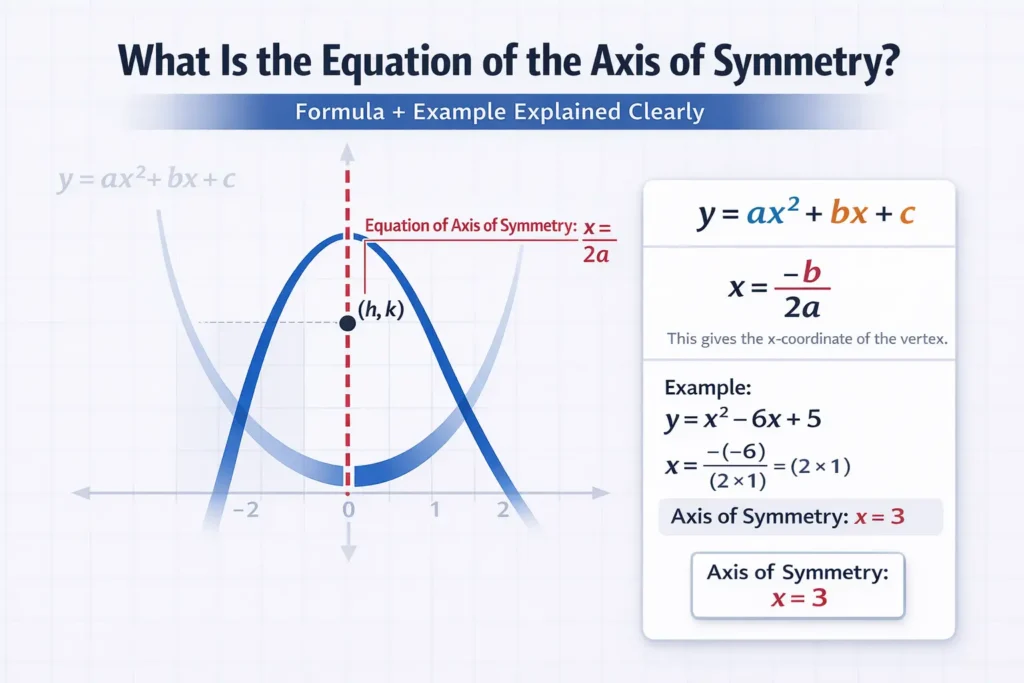
A question that comes up often is:
What is the equation of the axis of symmetry?
The equation of the axis of symmetry is always written in the form:
This is because the axis of symmetry is a vertical line.
Why Is It Written as x = ?
The axis of symmetry divides a parabola into two equal mirror halves. Since most quadratic functions are written as:
their graphs open upward or downward. That means their symmetry is vertical, not horizontal.
So the axis of symmetry:
- Is a vertical line
- Passes through the vertex
- Has a constant x-value
That’s why its equation is written as:
where h is the x-coordinate of the vertex.
Connecting Formula to the Equation
If a quadratic is in standard form:
First use the formula:
The result you get is the equation of the axis of symmetry.
For example:
If
Then:
So the equation of the axis of symmetry is:
Common Confusion to Avoid
❌ The axis of symmetry is NOT written as:
- A point like (3, 4)
✅ It is always written as:
Because it represents a vertical line, not a point.
Important Rule to Remember
If the vertex is:
Then the equation of the axis of symmetry is:
The line is always vertical.
Relationship Between the Vertex and Axis of Symmetry
The vertex and the axis of symmetry are directly connected.
What Is the Vertex of a Parabola?
The vertex of a parabola is the turning point of the graph:
- If the parabola opens upward → the vertex is the minimum point
- If the parabola opens downward → the vertex is the maximum point
The vertex is written as a coordinate:
Where:
- h is the x-coordinate
- k is the y-coordinate
How the Axis of Symmetry Relates to the Vertex
The axis of symmetry always passes directly through the vertex.
That means:
If the vertex is:
Then the axis of symmetry is:
Notice something important:
The axis of symmetry uses only the x-coordinate of the vertex.
It does NOT use the y-coordinate.
Why This Relationship Is Important
This relationship helps you:
- Quickly find the axis once you know the vertex
- Graph parabolas accurately
- Understand symmetry visually
- Solve quadratic equations more efficiently
For example:
If the vertex is:
The axis of symmetry is:
The line runs vertically through the point (5, -2) and splits the parabola into two mirror halves.
Quick Summary
- The vertex is the turning point of a parabola
- The axis of symmetry passes through the vertex
- The equation of the axis is always
- The axis uses only the x-coordinate of the vertex
Common Mistakes Students Make (And How to Avoid Them)
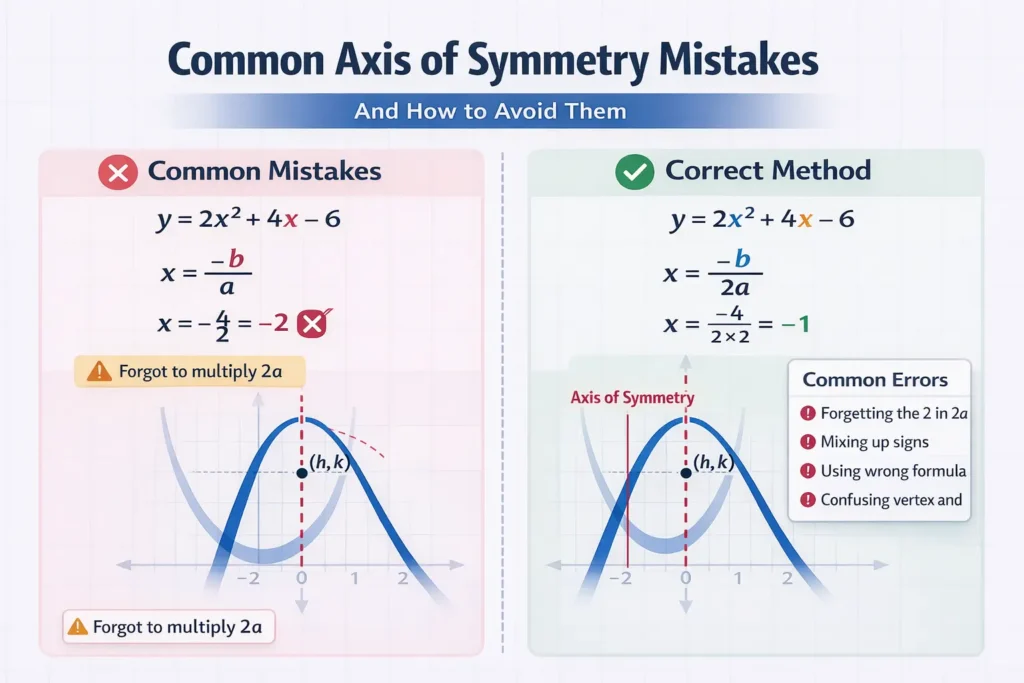
When learning about the axis of symmetry, students often make small mistakes that lead to wrong answers. Let’s go over the most common ones so you can avoid them.
Mistake 1: Forgetting the Negative Sign in the Formula
The axis of symmetry formula is:
Many students accidentally write:
But the negative sign in front of b is extremely important.
Example:
For:
Correct calculation:
If you forget the negative sign, you would incorrectly get:
That completely changes the graph.
Mistake 2: Dividing by 2 Instead of 2a
Another common error is dividing by just 2 instead of 2a.
Correct formula:
Not:
If this mistake gives the wrong axis.
Mistake 3: Writing y = Instead of x =
The equation of the axis of symmetry is always written as:
Students sometimes write:
That would represent a horizontal line, which is incorrect for vertical parabolas.
Remember:
- Quadratics in the form open up or down
- Their axis of symmetry is vertical
- So it must be written as x=number
Mistake 4: Confusing the Vertex With the Axis
The vertex is a point:
The axis of symmetry is a line:
They are related, but they are not the same thing.
Mistake 5: Mixing Up Standard and Vertex Form
If the equation is already in vertex form:
You do NOT need the formula .
The axis of symmetry is simply:
Using the formula in this case wastes time and can cause errors.
Quick Checklist Before Finalizing Your Answer
- Did you use correctly?
- Did you divide by 2a?
- Did you write your answer as ?
- Did you simplify fully?
Avoiding these common mistakes will help you solve axis of symmetry problems faster and more accurately.
Frequently Asked Questions (FAQs)
-
What Is the Axis of Symmetry?

The axis of symmetry is a line that divides a shape or graph into two equal mirror-image halves.
In quadratic functions, it is the vertical line that passes through the vertex of a parabola and splits it into two identical sides.
It is always written in the form: -
What Is the Equation of the Axis of Symmetry?
The equation of the axis of symmetry is a vertical line written as:
Where h is the x-coordinate of the vertex.
If the quadratic is in standard form:
Then the equation is found using: -
How to Find the Axis of Symmetry?
There are three main methods:
From standard form:
From vertex form:
If
Then:
From a graph:
Find the vertex and use its x-coordinate. -
How to Find the Axis of Symmetry of a Parabola?
To find the axis of symmetry of a parabola:
Identify the form of the quadratic equation.
If it is in standard form , use:
If it is in vertex form, use:
If given a graph, locate the vertex and use its x-value.
The axis of symmetry always passes through the vertex. -
How to Find Axis of Symmetry in Vertex Form?
If the equation is written as:
The axis of symmetry is simply:
You do not need to use the formula .
Example:
Axis of symmetry: -
What Is the Vertex of a Parabola?
The vertex of a parabola is the turning point of the graph.
It is written as:
If a>0, the vertex is the minimum point.
If a<0, the vertex is the maximum point.
The axis of symmetry always passes through the vertex -
What Is the Axis of Symmetry Formula?
For a quadratic equation in standard form:
The axis of symmetry formula is:
This formula gives the x-coordinate of the vertex and the equation of the axis of symmetry.