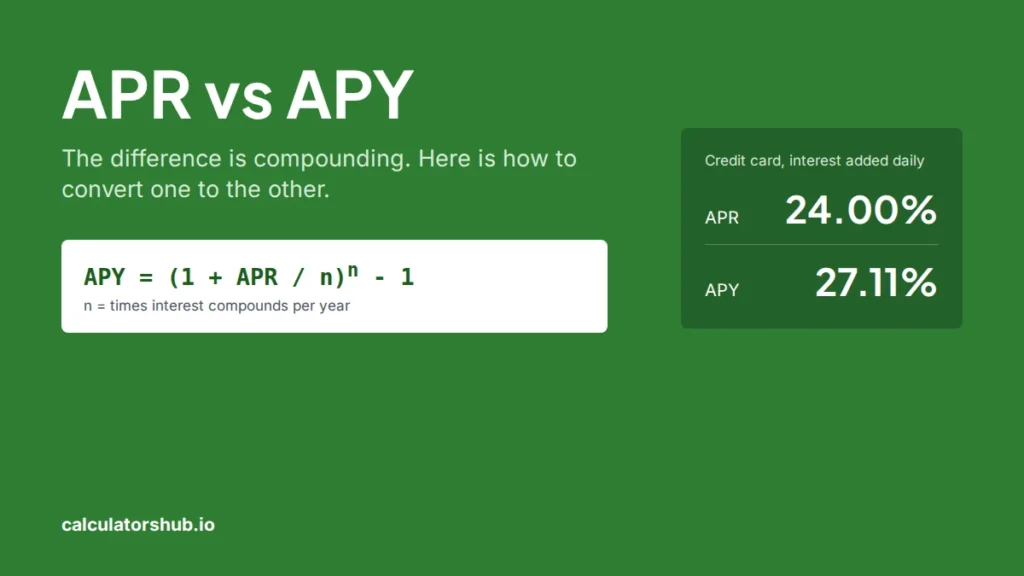
A savings account advertises 4.50% APY. Your credit card statement says 24% APR. Both are yearly rates, but they’re measured in different ways, and the difference changes how much money you earn or pay. APR is the yearly rate before compounding. APY is the yearly rate after compounding. A 5% APR charged monthly works out to 5.12% APY, and a credit card at 24% APR that adds interest daily costs 27.11% over a year if the balance just sits there.
Below you’ll find the formula for each, a table that converts common APRs into APY, and worked examples for savings, a credit card and a mortgage. Every number can be checked with the formula next to it.
What is the difference between APR and APY?
The whole difference comes down to compounding. When interest is added to your balance, that new interest starts earning (or costing) interest too. APR leaves that effect out. APY counts it.
| APR | APY | |
|---|---|---|
| What it measures | The yearly cost of borrowing | The yearly earnings on a deposit |
| Where you see it | Credit cards, mortgages, car loans, personal loans | Savings accounts, CDs, money market accounts |
| Includes compounding? | No | Yes |
| US law that requires it | Truth in Lending Act (Regulation Z) | Truth in Savings Act (Regulation DD) |
| What you want | Lower | Higher |
Notice what that means when you read rate sheets. The number on a loan leaves out the extra cost of compounding, while the number on a savings account already includes the extra earnings. So when you compare two offers, compare APR with APR or APY with APY, never one against the other.
What is APR?
APR stands for annual percentage rate. The Consumer Financial Protection Bureau describes it as a broader measure of the cost of borrowing than the interest rate. On a mortgage, APR reflects the interest rate plus any points, mortgage broker fees and other charges you pay to get the loan (CFPB: mortgage interest rate vs APR).
On a credit card, the APR you see is the yearly interest rate the issuer charges. Annual fees and late fees are listed separately, and they don’t change the APR.
Is APR the same as the interest rate?
Sometimes. On a credit card they are usually the same number. On a mortgage or car loan they differ, because APR adds the upfront fees to the interest rate and spreads them across the life of the loan. If a lender quotes a low rate with high fees, the APR is where that shows up.
What is APY?
APY stands for annual percentage yield. Under Regulation DD, it measures the total interest an account pays in a year, based on the interest rate and how often interest compounds, stated as a yearly rate on a 365-day year.
That makes APY the number you can take at face value. Put $10,000 in an account paying 4.50% APY, leave it alone for a year, and you’ll have earned $450. How often the bank adds interest doesn’t matter at that point, because APY already includes it.
The APY formula, and how to convert APR to APY
To turn an APR into an APY, use this formula:
APY = (1 + APR / n)^n - 1
Here n is the number of times interest compounds in a year: 12 for monthly, 365 for daily. Write the APR as a decimal, so 5% becomes 0.05.
Here’s 5% APR with monthly compounding, step by step:
- Divide the APR by 12:
0.05 / 12 = 0.0041667. That’s the rate charged each month. - Add 1 and raise it to the 12th power:
1.0041667^12 = 1.05116. - Subtract 1:
1.05116 - 1 = 0.05116, or 5.12% APY.
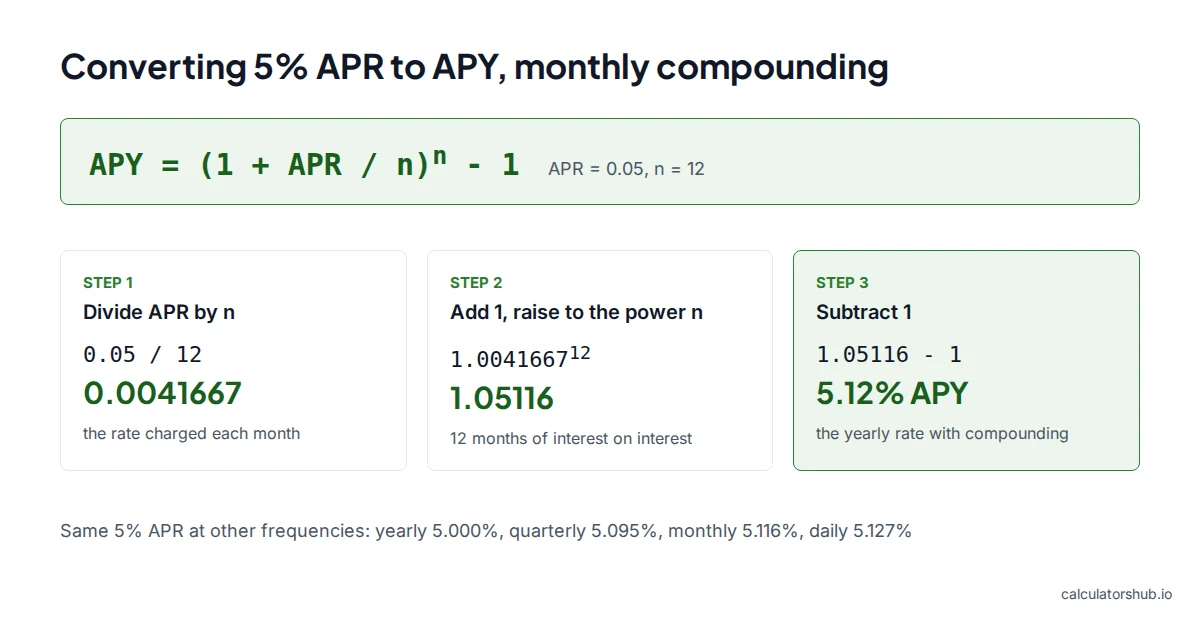
The more often interest compounds, the higher the APY climbs, because each payment of interest starts earning sooner. The same 5% APR gives 5.000% APY if interest is added once a year, 5.095% quarterly, 5.116% monthly and 5.127% daily.
How to convert APY back to APR
Banks advertise savings accounts in APY, but interest is credited at the APR rate divided by the number of periods. To go backwards, use:
APR = n × ((1 + APY)^(1/n) - 1)
A 4.50% APY with monthly compounding works out to a 4.410% APR, which is 0.3675% credited each month. You can check it by putting 4.410% back into the first formula. You get 4.50% again.
The official APY formula banks use
Regulation DD gives banks their own version of the formula, built from the dollars an account actually earns:
APY = 100 × ((1 + Interest / Principal)^(365 / Days in term) - 1)
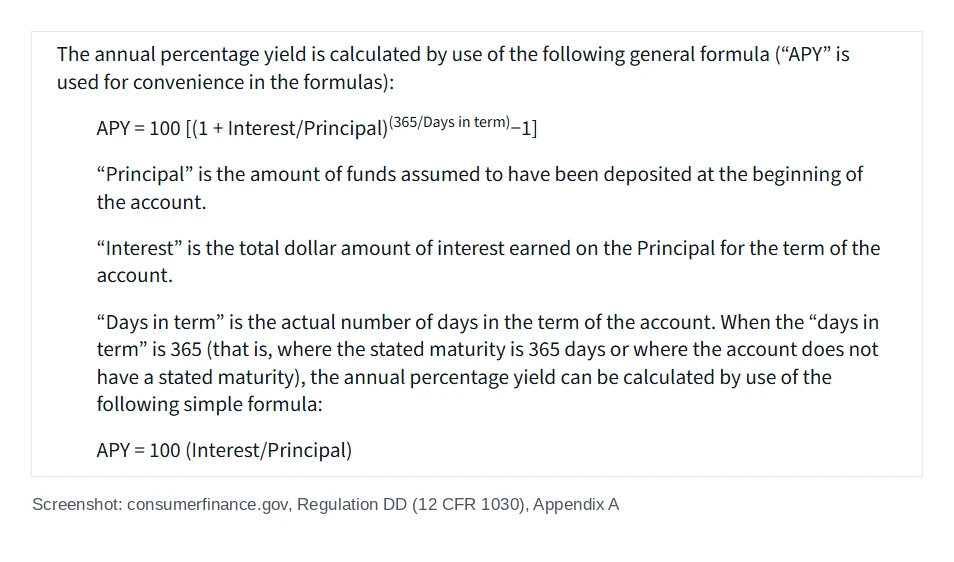
The regulation’s own examples show how it works. A $1,000 deposit that earns $61.68 over 365 days has an APY of 6.17%. A six-month CD that earns $30.37 on $1,000 over 182 days has an APY of 6.18%, slightly higher, because the formula assumes you could reinvest at the same rate for the rest of the year (CFPB: Regulation DD, Appendix A).
If this looks familiar, it’s the same idea behind the CAGR formula: both turn growth into one yearly rate that already includes compounding.
APR to APY conversion table
The first column is the APR. The other two columns show the APY each APR becomes, depending on how often interest is added.
| APR | APY, monthly compounding | APY, daily compounding |
|---|---|---|
| 3.00% | 3.04% | 3.05% |
| 4.50% | 4.59% | 4.60% |
| 5.00% | 5.12% | 5.13% |
| 10.00% | 10.47% | 10.52% |
| 20.00% | 21.94% | 22.13% |
| 24.00% | 26.82% | 27.11% |
| 29.99% | 34.48% | 34.96% |
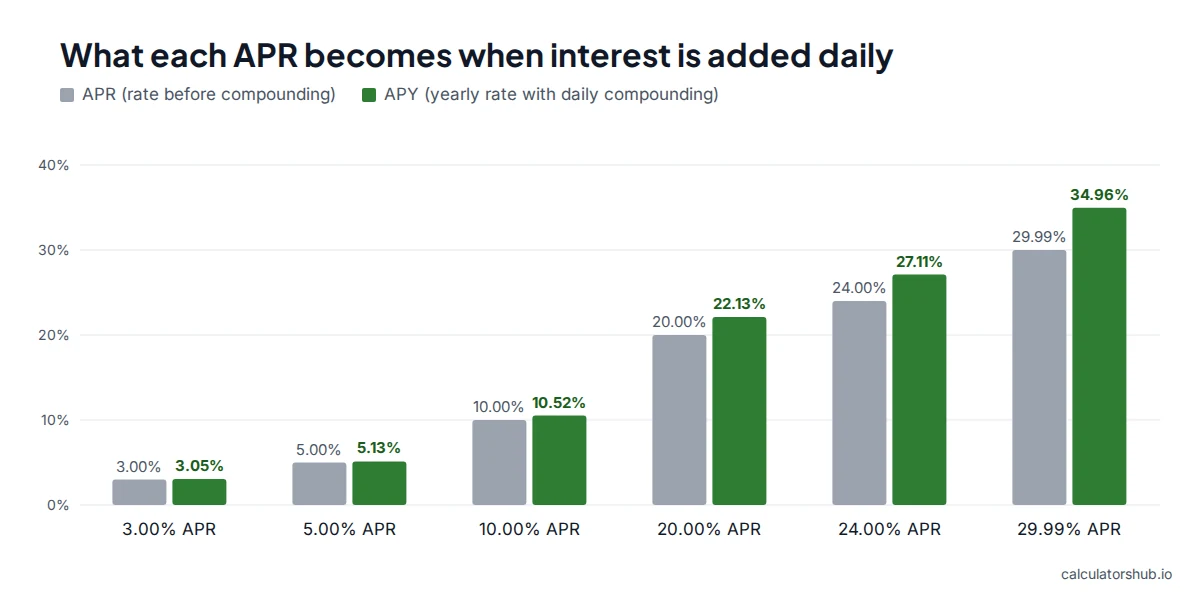
At low rates the gap is small. 3% APR becomes 3.05%, a difference you’d barely notice. At credit card rates it gets much bigger: 24% becomes 27.11%, and 29.99% becomes 34.96%. Compounding grows with the rate, so the higher the APR, the more the stated number understates what you pay.
How much does compounding change what you earn?
Say you put $10,000 into savings. Bank A pays 4.5% APR with interest added monthly. Bank B pays 4.5% APY. They look identical, but they aren’t.
Bank A pays $459.40 in the first year, because 4.5% APR with monthly compounding is 4.59% APY. Bank B pays $450.00. After five years, Bank A’s balance is $12,517.96 and Bank B’s is $12,461.82, a gap of $56.14.
The fix is to convert every offer to APY before you compare. In practice this is rarely a problem in the US, because Regulation DD requires banks to state APY on deposit accounts, but rate tables on comparison sites sometimes mix the two.
How credit card APR works day to day
Most credit cards don’t charge your APR once a month. They charge a daily periodic rate, which the CFPB says is generally your APR divided by 365 or 360, depending on the issuer. That daily interest is added to your balance, and the next day’s interest is charged on the new, higher balance (CFPB: daily periodic rate).
Here’s what that looks like on a card at 24% APR:
- The daily rate is 24% divided by 365, or 0.06575% a day.
- On a $2,000 balance over a 30-day billing cycle, interest without compounding would be $39.45. With daily compounding it’s $39.83.
- If you made no payments and no new purchases for a full year, the $2,000 would grow to $2,542.30. That’s 27.11%, not 24%.
- If the issuer divides by 360 instead of 365, the daily rate is 0.0667%, and over a full year the effective cost rises to 27.54%.
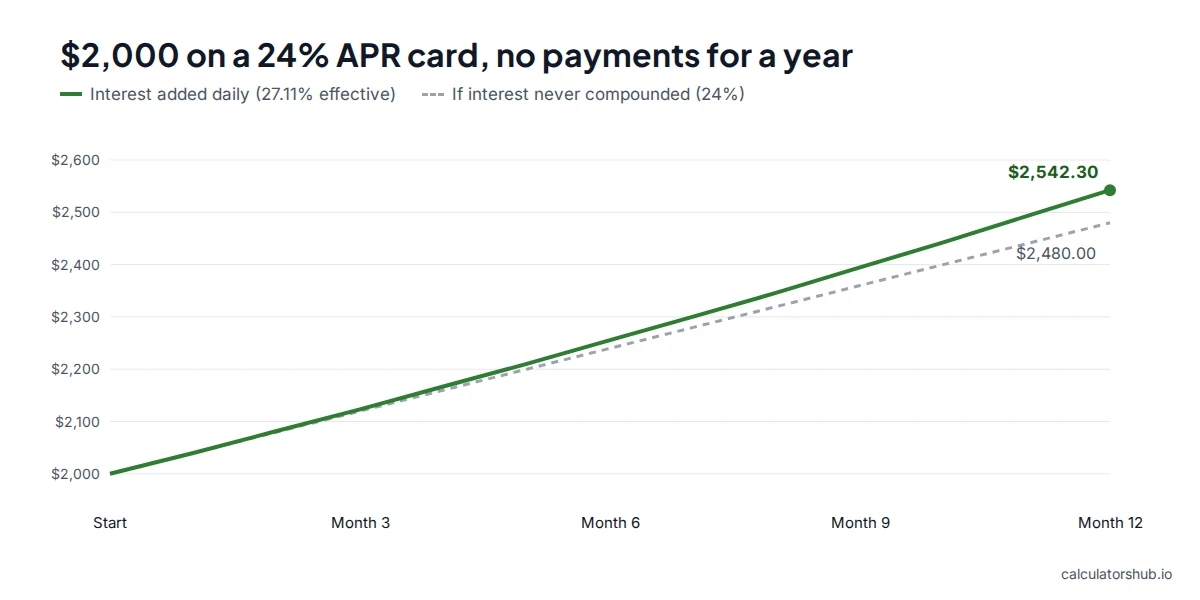
Your statement shows the APR. The real yearly cost of carrying a balance is the APY figure from the table above, and the only way to stop the compounding is to stop carrying the balance.
Why a mortgage APR is higher than its interest rate
Take a $300,000 mortgage for 30 years at a 6.50% fixed rate. The monthly payment is $1,896.20.
Now say you pay $6,000 in points and lender fees at closing. Your payment doesn’t change, but you effectively received $294,000 for the same 30 years of $1,896.20 payments. Work out the rate that turns $294,000 into those payments and you get an APR of about 6.70%.
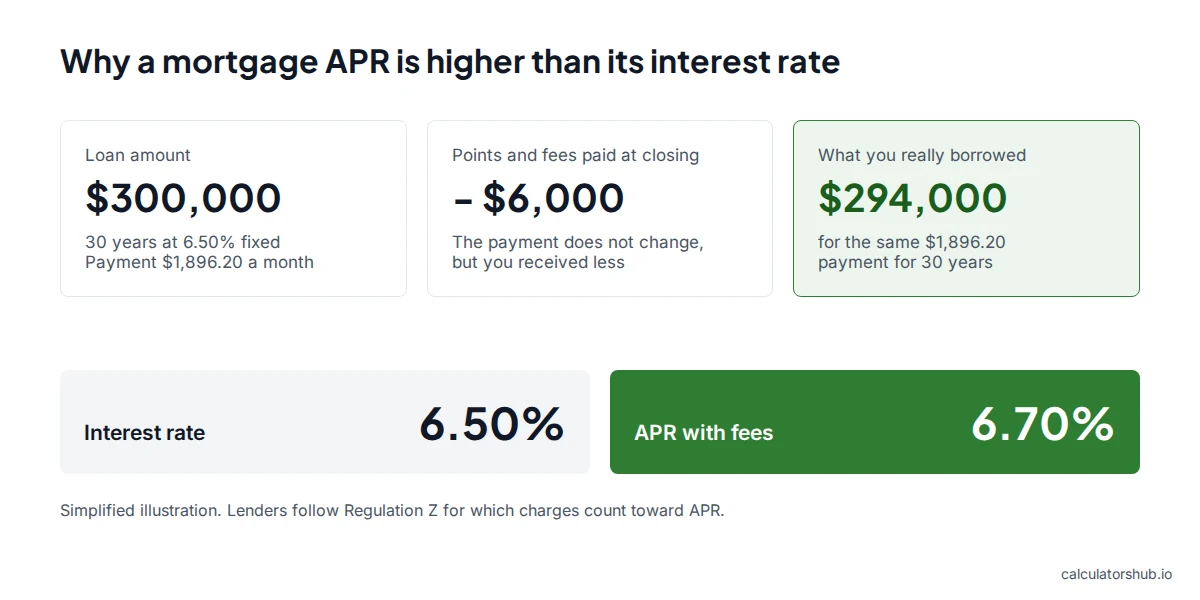
This is a simplified example. The exact APR on a loan follows Regulation Z rules about which charges count, and you’ll find it on page 3 of your Loan Estimate under Comparisons.
One thing APR doesn’t tell you: it spreads the fees over the full 30 years. If you expect to sell or refinance in five years, you’ll pay those fees over a much shorter time, so a loan with high fees costs you more than its APR suggests.
Which number should you compare?
When you’re borrowing, compare APR, and compare it between loans of the same type and length. A 15-year mortgage APR and a 30-year mortgage APR aren’t measuring the same thing. On a credit card, remember that the real cost of a carried balance is higher than the APR because of daily compounding.
When you’re saving, compare APY. It’s the one number that already accounts for how often interest is paid.
For investments that don’t pay a fixed rate, such as stocks or funds, neither APR nor APY applies. There you want the annualized return, which the ROI calculator works out alongside your total return.
Frequently asked questions
What is the difference between 5% APR and 5% APY?
On $1,000 for one year, 5% APR compounded monthly leaves you with $1,051.16, while 5% APY leaves you with $1,050.00. The APR version pays more, because 5% APR with monthly compounding equals 5.12% APY.
How much is 5% APY on $1,000?
$50 after one year, for a balance of $1,050, as long as you don’t add or withdraw money and the rate stays the same.
How long does it take to double money at 5% APY?
About 14.21 years. The formula is years = ln(2) / ln(1 + APY), which for 5% is 0.6931 divided by 0.0488.
Is 29.99% APR high for a credit card?
Yes. The Federal Reserve’s G.19 release dated October 7, 2026 puts the average credit card rate at 22.36% for accounts that were charged interest in August 2026, and 21.19% across all accounts (Federal Reserve G.19). With daily compounding, 29.99% APR costs 34.96% a year on a balance you carry.
Can APR or APY change?
Yes, if they’re variable. Most credit card APRs are tied to the prime rate and move when it moves. A regular savings account’s APY can change at any time, while a CD’s APY is usually fixed for its term.
Is APY the same as the interest rate?
Only if interest is added once a year. With any more frequent compounding, the APY is higher than the stated interest rate.
This article explains how APR and APY are calculated. It isn’t financial advice. Check the APR and APY disclosed by your lender or bank before you decide.