

Point Slope Form Calculator
The point slope form calculator writes the equation of a line from a slope and one point.
Enter the values and the calculator applies the point slope formula and returns the full equation.
Use it in algebra and coordinate geometry when:
- The slope (m) is given
- A single point (x₁, y₁) is known
- You need the point slope form equation fast
A point slope calculator also converts the result into slope intercept form.
What Is Point Slope Form?
Point slope form is a way to write the equation of a straight line when you know two things:
- The slope of the line
- One point that lies on the line
It is commonly written as:
This is called the point slope form equation.
Where:
- m is the slope
- (x₁, y₁) is a known point on the line
- (x, y) represents any point on the line
The point slope equation is especially useful when the slope and a specific point are given directly in a problem.
Instead of first converting to slope-intercept form, you can immediately plug the values into the formula and write the equation in one step.
Point Slope Formula Explained
The point slope formula is used to write the equation of a line when you know the slope and one point on the line.
The standard formula is:
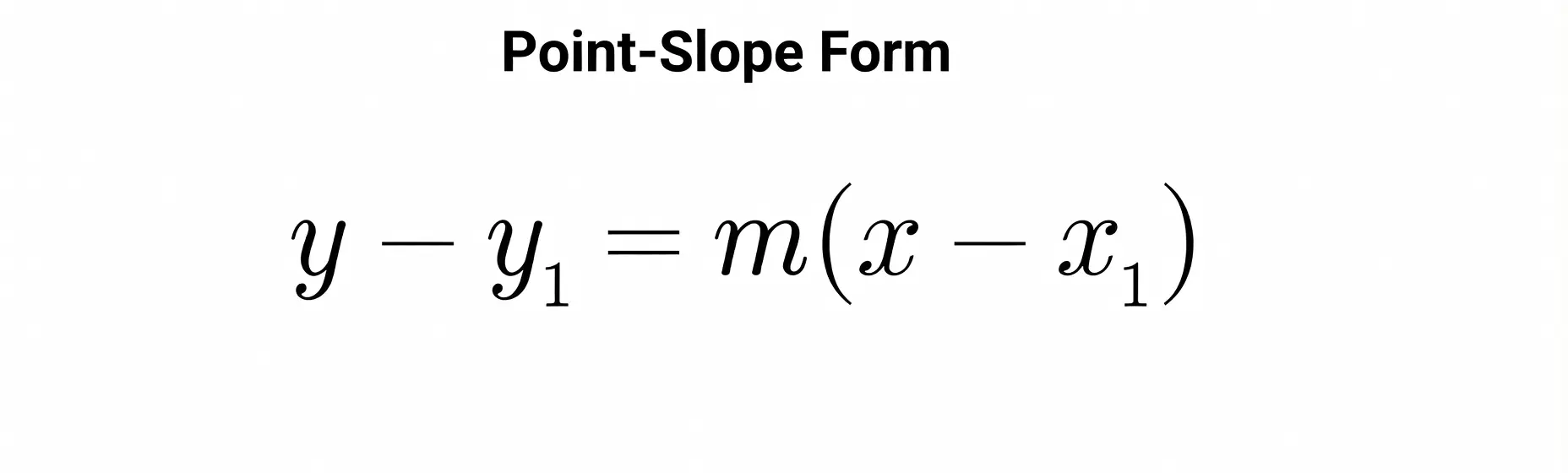
This is the core point slope equation.
What Each Variable Means
- m = slope of the line
- (x₁, y₁) = known point on the line
- (x, y) = any point on the line
Why This Formula Works
Slope is defined as rise over run:
If we multiply both sides by (x − x₁), we get:
That’s the point slope form equation.
This formula directly connects slope and a known point to create the equation of a line, making it one of the fastest ways to write linear equations in algebra. If a problem gives you two points instead of a slope, you can also use our quadratic regression calculator for curved data, but for a straight line the method above is all you need.
How to Convert Point Slope to Slope Intercept Form
Sometimes you need to rewrite a point slope equation into slope-intercept form.
Slope-intercept form looks like this:
Here’s how to convert step by step.
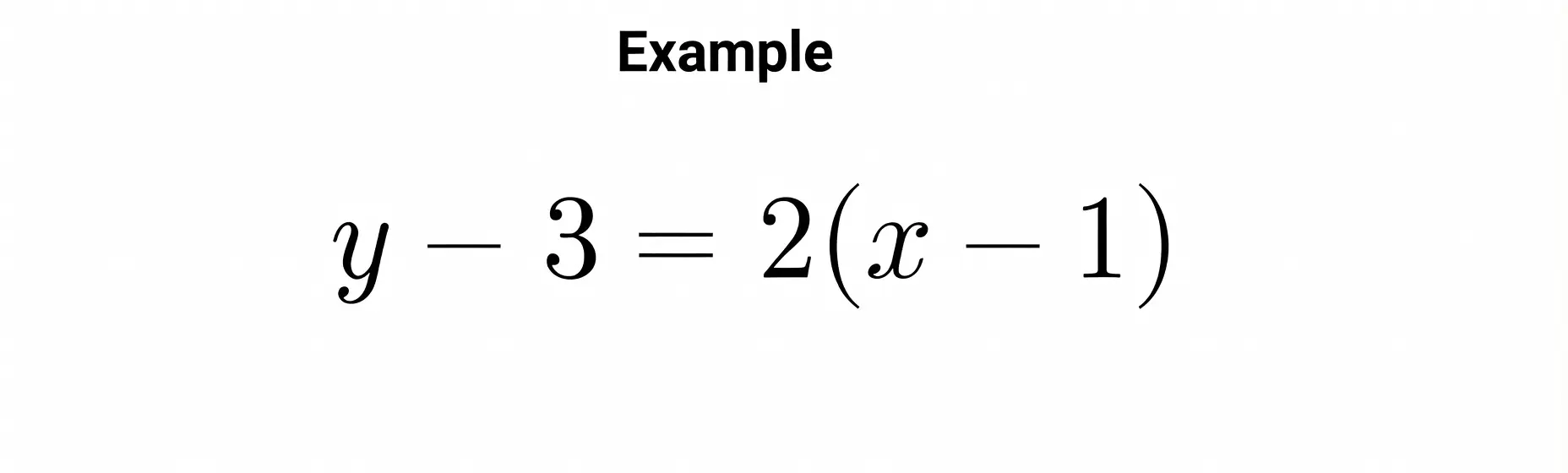
Step 1: Start with the Point Slope Form
Example:
Step 2: Distribute the Slope
Multiply 2 by each term inside the parentheses:
Step 3: Solve for y
Add 3 to both sides:
y = 2x − 2 + 3
y = 2x + 1
Final Answer in Slope-Intercept Form
The end result is always y = mx + b, where m is the slope and b is where the line crosses the y-axis. Slope intercept form explained covers what each part of that equation is doing if the conversion feels mechanical.
Why Convert?
Converting point slope to slope intercept form makes it easier to:
- Identify the y-intercept
- Graph the equation quickly
- Compare multiple lines
The calculator above performs this conversion and shows both forms.
How to Convert Point Slope to Standard Form
Standard form is written as Ax + By = C, where A, B, and C are integers and A is positive. Many textbooks ask for the final answer in this form, so knowing the conversion is worth the extra step.
Step 1: Start with the point slope equation
Take an equation you already have in point slope form. Say y − 3 = 2(x − 1), from the point (1, 3) with slope 2.
Step 2: Distribute and move x and y to one side
Distribute the slope, then move the x term to the left so the variables sit together:
y − 3 = 2x − 2
y = 2x − 1
−2x + y = −1
Step 3: Make A positive
Standard form needs a positive number in front of x. Multiply the whole equation by −1:
2x − y = 1
That is the standard form of the same line. All three versions, point slope, slope intercept, and standard, describe one line. Our slope intercept form calculator handles the middle step if you want to check your algebra.
What about fraction slopes?
When the slope is a fraction, clear the denominator first. Take the point (4, −2) with slope 3/4:
y + 2 = 3/4(x − 4)
Multiply every term by 4 to remove the fraction:
4y + 8 = 3(x − 4)
4y + 8 = 3x − 12
3x − 4y = 20
Check it by plugging the point back in: 3(4) − 4(−2) = 12 + 8 = 20. It works, so the standard form is correct.
Writing the Equation from Two Points
You do not always get the slope handed to you. When a problem gives two points instead, find the slope first, then use point slope form with either point.
Step 1: Find the slope
Slope is the change in y over the change in x. For the points (2, 3) and (6, 11):
m = (11 − 3) / (6 − 2) = 8 / 4 = 2
Step 2: Plug into point slope form
Use either point. Using (2, 3):
y − 3 = 2(x − 2)
It does not matter which of the two points you pick. Both give the same line once you simplify. Using (6, 11) instead gives y − 11 = 2(x − 6), which simplifies to the exact same slope intercept form, y = 2x − 1.
A quick fraction example
For the points (−1, 2) and (3, 4):
m = (4 − 2) / (3 − (−1)) = 2 / 4 = 1/2
Then y − 2 = 1/2(x + 1). The calculator above does this when you switch to the two points option, so you can check a homework answer.
Point Slope Form Examples Table
Here are common point and slope pairs written in all three forms, so you can match your problem quickly.
| Point & Slope | Point Slope Form | Slope Intercept Form | Standard Form |
|---|---|---|---|
| (2, 3), m = 4 | y − 3 = 4(x − 2) | y = 4x − 5 | 4x − y = 5 |
| (1, −2), m = 3 | y + 2 = 3(x − 1) | y = 3x − 5 | 3x − y = 5 |
| (0, 5), m = −2 | y − 5 = −2(x) | y = −2x + 5 | 2x + y = 5 |
| (−3, 1), m = 2 | y − 1 = 2(x + 3) | y = 2x + 7 | 2x − y = −7 |
| (4, 0), m = −1 | y = −(x − 4) | y = −x + 4 | x + y = 4 |
| (−2, −6), m = 5 | y + 6 = 5(x + 2) | y = 5x + 4 | 5x − y = −4 |
Example Problem (Step-by-Step)
Let’s solve a full example using the point slope form.
Problem:
Write the equation of a line with slope m = 3 that passes through the point (2, −1).
Step 1: Use the Point Slope Formula
The formula is:
Substitute the given values:
- m = 3
- x₁ = 2
- y₁ = −1
So we get:
y − (−1) = 3(x − 2)
Step 2: Simplify
Distribute the 3:
Step 3: Convert to Slope-Intercept Form (Optional)
Subtract 1 from both sides:
Final Answer
Point slope form:
y + 1 = 3(x − 2)
Slope-intercept form:
y = 3x − 7
Common Mistakes in Point Slope Form
Even though the point slope form equation is simple, small mistakes can lead to wrong answers.
Here are the most common errors to avoid.
1. Sign Errors
Many students forget that subtracting a negative becomes addition.
For example:
y − (−4) should become
y + 4
Missing this step changes the entire equation.
2. Forgetting Parentheses
The formula is:
You must keep parentheses around (x − x₁).
Incorrect:
y − 3 = 2x − 1
Correct:
y − 3 = 2(x − 1)
Parentheses ensure the slope multiplies both terms.
3. Mixing Up the Coordinates
Remember:
- x₁ goes inside (x − x₁)
- y₁ goes inside (y − y₁)
Switching them produces the wrong point slope equation.
4. Incorrect Conversion to Slope-Intercept Form
When converting point slope to slope intercept, students sometimes forget to fully distribute or isolate y correctly.
Take your time during algebra steps.
The calculator above catches these mistakes, so use it to check your working.
Try these next
- Quadratic Formula Calculator
- Linear Regression Calculator
- Axis of Symmetry Calculator
- Correlation Coefficient Calculator